Perplexity Computer Explained: The 2026 AI Launch That Got Drowned Out
Perplexity Computer may have launched in the shadow of OpenAI and Anthropic, but its shift from “AI that answers” to “AI that acts” could be far more important than another model update.

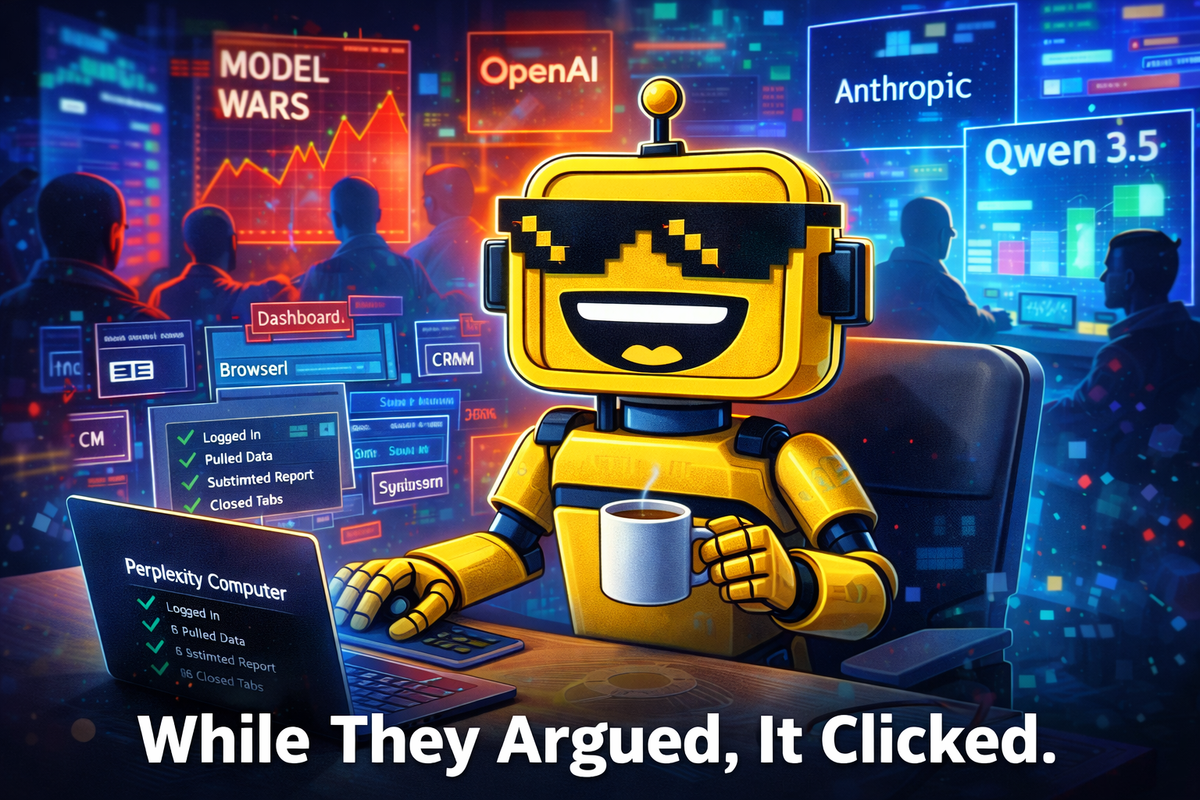
The past week in AI has felt less like a product cycle and more like a volume contest. OpenAI continues to bend the attention economy in its usual direction. Anthropic continues its delicate dance between safety philosophy and capability flexing. Qwen 3.5 from Alibaba reignited the now-predictable “global AI race” discourse. And layered on top of that was the ever-growing theater of OpenClaw setups, passive income screenshots, and AI-agent-as-side-hustle evangelism.
In the middle of all of it, Perplexity shipped Perplexity Computer.
It wasn’t ignored. It just didn’t arrive with fireworks, manifesto threads, or geopolitical undertones. Compared to the gravitational pull of frontier model announcements, it felt smaller. But smaller in spectacle does not mean smaller in significance.
If anything, Perplexity Computer represents a more grounded, commercially relevant shift than yet another benchmark leap.
From Talking AI to Acting AI
For the past two years, most AI progress has been framed around intelligence: reasoning improvements, multimodal inputs, context windows, benchmark charts. The dominant question has been, “Which model is smarter?”
Perplexity Computer subtly reframes the question. Instead of asking whether an AI can think better, it asks whether an AI can do more.
At its core, Perplexity Computer is designed to interact with software interfaces the way a human user would. That means navigating browsers, clicking through workflows, completing multi-step tasks, and operating across applications rather than simply generating text in a chat box. It’s a shift from conversational AI to execution-layer AI.
That distinction matters. Thinking is impressive. Acting is valuable.
Perplexity’s Strategic Pivot
Perplexity built its brand as an AI-native answer engine. Clean citations, structured research, fast summaries — it positioned itself as the rational alternative to both traditional search and chaotic chatbot responses. In a world drowning in generated text, Perplexity leaned into clarity and sourcing.
But search is becoming commoditized. Every major AI platform now offers retrieval-augmented answers, citations, and conversational UX. The moat around “answer engines” is narrowing as foundation models improve across the board.
So Perplexity appears to be moving down the stack.
Perplexity Computer signals a pivot from being a layer that interprets information to becoming a layer that executes tasks. Instead of stopping at “Here’s how to complete this workflow,” the ambition becomes “I’ve completed it for you.” That repositioning shifts Perplexity closer to infrastructure and further away from being perceived as just another AI interface.
Why This Matters More Than Another Model Release
The AI news cycle rewards spectacle, but the market rewards friction reduction. Most knowledge workers do not suffer from a shortage of answers. They suffer from a surplus of interfaces.
They log into multiple dashboards. They reconcile spreadsheets. They copy information between tools. They navigate portals that were clearly designed in 2011 and never updated. Their problem isn’t cognitive; it’s operational.
If an AI can reliably navigate those systems, the economic value becomes tangible. A slightly better paragraph generator is incremental. An AI that can execute repetitive workflows across software environments is transformative.
Perplexity Computer, at least directionally, is a bet on that transformation.
The Emerging Category: AI That Uses Your Computer
There is a vocabulary gap forming in real time. People are searching for terms like “AI agent,” “AI assistant,” “autonomous system,” and “computer-use AI,” but the definitions remain blurry. Most users don’t care about taxonomy. They care whether the system can complete the task.
Perplexity Computer squarely targets this emerging category of AI that interacts directly with software environments. That is different from answering questions about the software. It is different from suggesting next steps. It is about taking action inside real interfaces.
This category is still being defined. The companies that clearly articulate what “AI computer agents” actually mean in practice will accumulate long-term authority around those search terms. Right now, most coverage is model-centric. Execution-layer AI remains underexplained.
That’s why Perplexity’s move deserves more attention than it received during a crowded news week.
Why It Felt Smaller Than It Was
Part of the muted reaction comes down to tone. Perplexity didn’t wrap the launch in philosophical positioning. It didn’t ignite a safety debate or a geopolitical narrative. It didn’t trigger a benchmark arms race.
It shipped a product feature aimed at practical utility.
In an attention economy optimized for drama, practicality rarely dominates timelines. But historically, the companies that quietly solve workflow problems often outlast those that dominate discourse cycles.
When the noise fades, what remains are the tools that people actually use.
The Risk Layer
Execution-layer AI is inherently harder than conversational AI. Interfaces change. Credentials matter. Security becomes central. Reliability cannot be optional. An AI hallucinating a paragraph is annoying; an AI misclicking in a financial dashboard is consequential.
These challenges are real. They will determine whether Perplexity Computer becomes a durable platform feature or a demo-era curiosity.
But difficulty is also where defensibility lives. If Perplexity can make AI reliably operate across real-world software environments, it moves beyond being “an AI search competitor.” It becomes workflow infrastructure.
Infrastructure does not need fanfare. It needs reliability.
Final Take
Perplexity Computer did not dominate last week’s AI headlines. OpenAI, Anthropic, and the broader AI arms race absorbed most of the oxygen. In that context, Perplexity’s move felt comparatively quiet.
But once the benchmark comparisons lose their novelty, the more important question will remain: which AI systems actually reduce daily friction?
Perplexity is betting that the next meaningful leap is not simply smarter language generation, but practical execution. In a market saturated with increasingly capable chatbots, the AI that finishes the task may ultimately matter more than the AI that writes the best answer.
And that’s why Perplexity Computer deserves a closer look.