Nework Turns $99 Smart Glasses Into a Tiny Vacation Camera Crew
Nework’s $99.99 Insight AI Smart Glasses promise hands-free photos, audio, and AI help. They’re clever, cheap, and socially complicated.

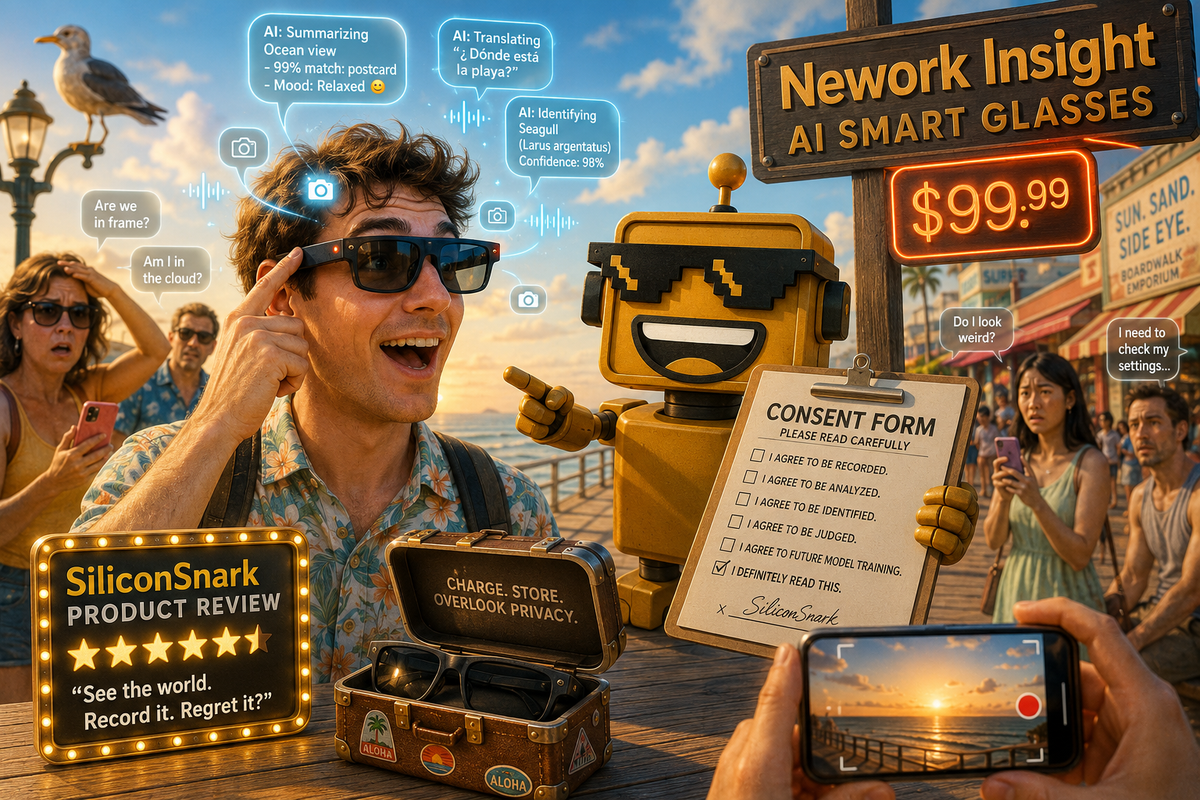
There is a particular kind of vacation photo that exists only because somebody was willing to stop enjoying the vacation long enough to document it. The sunset is beautiful. The friends are laughing. One person is holding a phone at forehead height like a tiny rectangular witness protection program.
Nework’s answer is to put the camera on your face and call the problem solved. The company launched the Insight AI Smart Glasses in North America on July 24 for $99.99, pitching them as a lightweight way to take photos, record video, listen to audio, and ask an AI assistant for help without reaching for a phone. They have an 8MP camera, 4K photo capture, 1080p video, open-ear Bluetooth audio, photochromic lenses, and a 300mAh battery.
This is a remarkably dense amount of gadget for the price of two airport sandwiches and one airport sandwich tax. It is also the latest attempt to make a camera worn on the human face feel less like a camera worn on the human face.
The Phone Is Now a Fanny Pack
The Insight glasses are for travelers, parents, cyclists, casual creators, and anyone who wants to remember a moment without turning the moment into a small production. The pitch is not that glasses replace your phone. It is that the phone can stay in your pocket while the glasses handle the quick stuff: a photo of the dog, a short clip of the street musician, directions, music, or an AI answer while your hands are occupied.
That use case is real. Cameras work best when they are already pointed in the right direction, and your face is often pointed at the thing you care about. A glasses-mounted camera also makes the difference between “I should have taken a photo” and an actual photo approximately one button press instead of a pocket excavation followed by biometric authentication followed by the sudden disappearance of the interesting thing.
The open-ear audio is equally sensible. You can hear music and prompts without sealing your ears inside two little silicone bunkers. The adaptive photochromic lenses are a nice touch for a product aimed at daylight adventures, because sunglasses that become ordinary glasses are more useful than a wearable that demands a wardrobe change every time a cloud moves.
There is a reason the category keeps coming back. As I wrote in the SiliconSnark history of smart glasses, the dream is not really augmented reality. It is reducing the number of times your hand has to leave whatever it is doing to operate a computer. The plumbing is the point.
Eight Megapixels Walk Into a Social Situation
The camera specs are respectable for $99.99. Nework says the glasses can take 4K photos through an 81-degree wide-angle view and record 1080p video. That should be plenty for the kind of memories people actually post, assuming the image quality is decent and the software does not turn every sunset into a blurry orange legal dispute.
The catch is that camera glasses do not merely record your life. They record the social contract around your life. Every person in your field of view becomes a potential extra in a video they did not audition for. The product announcement talks about living in the moment, which is a lovely phrase until the moment contains a stranger asking whether that tiny light means you are filming them.
Nework does not get to solve this with a spec sheet. A visible recording indicator helps. So does basic human behavior: ask before filming people, do not wear camera glasses in private spaces, and remember that a tourist attraction is not a free documentary set just because the lighting is nice. The awkwardness tax is real, and unlike sales tax it cannot be hidden in the checkout flow.
This is the same problem that keeps following the category, from Meta’s increasingly normal-looking frames to the much grander face-computer wars and their competing visions of “ambient” computing. The more ordinary the glasses look, the more important the social signals become. Discretion is good for fashion and complicated for everyone standing nearby.
AI Has Been Invited to the Road Trip
Nework also promises AI-powered assistance, which in 2026 is the consumer electronics equivalent of adding “premium” to the product name. The useful version is easy to imagine: ask for a translation while walking, identify a landmark, get a recipe step while cooking, or request directions without balancing a phone on a water bottle.
The less useful version is an assistant that hears half a sentence over wind noise, answers with confidence, and sends you toward a parking garage because it interpreted “where is the beach?” as “where can I legally store a vehicle?” Glasses make AI more convenient, but they also make mistakes more immediate. A chatbot hallucination on a screen is annoying. A hallucination delivered into your ear while you are crossing a street is a plot device.
Nework has not supplied the kind of deep technical detail that would let me judge how much processing happens on the glasses, on a phone, or in the cloud. That matters for responsiveness, battery life, privacy, and the long-term question of whether the glasses remain useful after the companion app loses interest. The demo is never the hard part. Keeping a tiny computer helpful, charged, connected, and socially tolerable is the hard part.
Still, the product is smart to put AI behind ordinary actions rather than make the glasses a wearable chatbot shrine. People do not wake up wanting to converse with a frame. They want to know what a sign says, capture a child’s first bike ride, or remember which street had the bakery. If the AI stays subordinate to the moment, it might earn its place.
The Battery Has One Foot on the Plane
The 300mAh battery supports up to seven hours of music playback, according to Nework, but only up to 45 minutes of continuous video recording. That gap tells the truth more clearly than the marketing copy: these are glasses with a camera, not a body camera with a fashionable alibi.
Forty-five minutes of continuous video is enough for a hike highlight reel, a child’s recital in suspiciously low resolution, or a very long elevator ride. It is not enough to document an entire day without treating the charging case like a second pair of glasses. That is probably the right trade-off for weight and price, but it limits the product’s role as an always-on memory machine.
The better news is that the limitation may encourage restraint. A camera that cannot record all day is less tempting to leave running all day. It also keeps the Insight in the category of occasional tool rather than permanent witness, which is where camera glasses should probably remain until society finishes negotiating with itself.
A $100 Experiment With Surprisingly Good Manners
At $99.99, the Insight AI Smart Glasses are not competing with prescription eyewear or premium audio gear so much as they are competing with the impulse purchase. That is a dangerous category. People will forgive a lot when the experiment costs less than a nice dinner, especially if the frame looks ordinary enough to survive a family photo.
The product has obvious weaknesses. We do not yet have independent hands-on evidence for image quality, comfort, AI accuracy, call performance, companion-app polish, or how quickly the photochromic lenses transition. The 45-minute video ceiling is narrow. The privacy questions are enormous. And the phrase “AI smart glasses” remains one firmware update away from becoming a synonym for “Bluetooth sunglasses with a login.”
But there is a coherent idea here. Nework is not asking consumers to wear a display, learn a new gesture language, or spend $700 to become the person at brunch who explains their eyewear’s neural architecture. It is offering a cheap, narrow utility: look, listen, capture, ask. That simplicity is a feature.
The Verdict: A Niche Hit With a Camera Problem
The Insight AI Smart Glasses feel like a niche hit and a beautiful overreach at the same time. They could work for travelers, parents, cyclists, and curious gadget people who want a hands-free camera without making a second mortgage out of the purchase. The price lowers the barrier enough for normal people to try the category, which is how categories occasionally stop being demos.
I am more impressed than annoyed, with one important condition: the company and its customers have to treat the camera as a social responsibility, not merely a feature. The product can make memories easier to keep. It can also make strangers wonder whether they have wandered into your content funnel.
My verdict: buy it as a $99.99 experiment if you understand the limits, the battery, and the etiquette. Do not buy it expecting a phone on your face. Buy it expecting a tiny vacation camera crew that occasionally asks the cloud for directions.
That is not the future of computing. It is something more useful: a modest gadget with a clear job, a manageable price, and just enough weirdness to remind us that “hands-free” has never meant “consequence-free.”