Maine Marine Technology Built Smarter Boats Before Startups Had Pitch Decks
Maine marine technology spans peapods, Hinckley waterjets, UMaine’s 3D-printed boats, acoustic lobster gear and fishing-vessel ocean sensors.

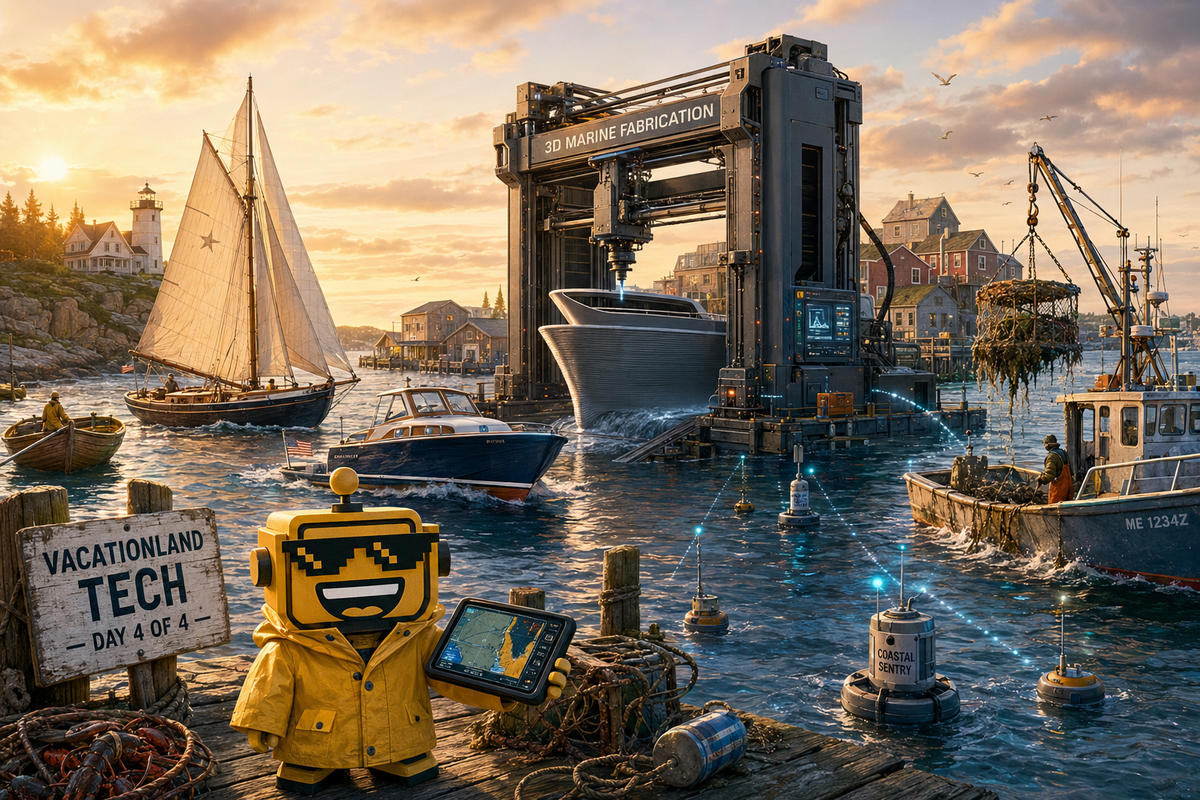
It is day four of the Circuit Smith Maine vacation, which means it is time to end in the state’s most traditional technology sector: attempting to make a living on cold water full of rocks.
This Vacationland series covered Maine’s practical AI economy, robots that print houses and pilot boats, and startups involving fish blood and argumentative buoys. We finish where Maine had a technology industry before the phrase existed: keeping boats, fishing gear and their operators from becoming seafloor archaeology.
The Maine coast is a hostile product requirements document. A boat must survive salt, fog, ledges, shallow harbors and winter while carrying traps, avoiding ropes, sipping fuel and returning humans alive. Fishing equipment must work underwater, alone, with no respect from the creatures or the mud.
Some of the resulting technology was invented here. Other components became useful systems here. “Pioneered” does not convert every imported propeller into state intellectual property.
The First Product Manager Was a Granite Ledge
Before software, Maine iterated in wood. The peapod, a double-ended rowboat developed along the coast around 1870, was built for inshore lobster fishing. Its shallow draft and maneuverability let fishermen work around ledges that would turn a deeper boat into a strongly worded insurance claim. Because it had two pointed ends, it could be rowed in either direction, often by someone standing and facing forward.
The exact birthplace remains appropriately disputed. The University of Maine’s folklore archive says there is evidence for North Haven while emphasizing that boatbuilders along the coast shaped the design. It was open-source hardware with cedar planks and no documentation department.
The Friendship sloop followed as the dominant small workboat before gasoline engines. One fisherman could handle its gaff rig while working traps. Around 1900, compact “make-and-break” engines spread through the fleet, expanding the fishing range and season. Engine-powered trap haulers increased the number of traps a crew could work, while hulls changed for more speed and load.
The resulting Maine lobster boat is accumulated operational knowledge: a high bow for weather, a lower working stern, a broad platform for traps and a hull tuned for speed and economy. Every generation revised it because every generation discovered a new way for fuel prices or the North Atlantic to become personal.
Hinckley Made Fiberglass Respectable and Docking Less Public
Southwest Harbor’s Hinckley did not invent fiberglass, waterjets or joysticks. Its real trick was putting technologies together so convincingly that recreational boating changed around them.
In the early 1960s, Hinckley built the Bermuda 40 in fiberglass when the material was still radical enough to make traditional boat owners inspect it like a microwave at a colonial reenactment. In 1994, the company launched the first Picnic Boat. Waterjets already served military and commercial craft, but Hinckley brought them into a serious recreational boat, pairing them with lightweight carbon construction.
The Maine logic was impeccable. Waterjets leave no propeller or running gear beneath the hull to catch lobster lines. They work in shallow water and allow the boat to approach beaches. Hinckley then developed JetStick joystick control, coordinating the propulsion so a boat could pivot and move laterally. Docking became less like advanced trigonometry performed in public while strangers hold expensive drinks.
By 2016, Hinckley had launched its 1,000th jetboat. Luxury buyers supplied the margins, but the engineering pattern was classically Maine: take a harsh local constraint—ropes everywhere—then turn avoiding it into a globally desirable feature.
UMaine Turned the Hull Into a File
This week, the University of Maine launched a boat that compresses two centuries of manufacturing history into a very large printer job.
The new 3Dirigo X is a 30-foot, high-performance, 3D-printed vessel designed for offshore conditions at speeds approaching 40 knots. It follows UMaine’s original 3Dirigo, unveiled in 2019 as a 25-foot, 5,000-pound boat printed in 72 hours.
The important number is not the boat’s size. It is the printing rate. UMaine says its large-scale process improved from roughly 20 pounds an hour at the beginning of the research to about 500 pounds an hour today. A digital design can be changed without creating a new mold for each hull, potentially shortening the distance from “we need a different boat” to “please stand clear of the enormous nozzle.”
That could matter for commercial craft, patrol boats, unmanned vessels and specialized sensor platforms whose production volumes cannot justify expensive tooling.
But 3Dirigo X is still a research vessel, not proof that every boatyard should put its molds on Craigslist. UMaine says it must test how the boat handles Atlantic conditions, stress and time. Long-term durability, repair methods, certification, material economics and production consistency remain the adult portion of the program. A boat that prints quickly but ages like gas-station sushi is not a manufacturing revolution.
The Lobster Trap Is Trying to Delete Its Vertical Line
The most politically charged Maine fishing technology attempts to remove the rope connecting a trap to its surface buoy. Persistent vertical lines can entangle whales, but fishermen need to locate and recover gear from the bottom. “Ropeless” therefore does not mean no rope. It means the rope and flotation stay with the trap until an acoustic command releases them.
Ropeless Systems, with operations in Biddeford, lets a vessel see submerged traps on a chartplotter and call them to the surface. Its Single Ping Positioning system locates gear as the boat approaches without requiring special survey maneuvers; its Respond Once technology is designed to prevent passing ships from repeatedly waking the unit and draining its battery. This is what a mature hardware problem looks like: even the buoy has power-management anxiety.
The idea could let fishermen work in areas closed to vertical lines while reducing entanglement risk. It is not yet inevitable. NOAA’s 2026 experimental program completed 831 on-demand hauls with 17 vessels during restricted-area trials, while roughly 50 vessels tested hybrid configurations across New England. Maine runs additional trials.
NOAA also flags the hard problems: invisible gear can conflict with trawlers and scallopers, location sharing may require compatible chartplotters and connectivity, and stored positions can become stale. Maine fishing groups have raised cost and safety concerns about broad mandates. Those objections are not proof that fishermen fear innovation. They are product feedback from people who would be standing above the product in bad weather when it fails.
Fishing Boats Became a Distributed Ocean Observatory
The least cinematic innovation may be the most useful. Since 2001, lobstermen in the Environmental Monitors on Lobster Traps program have attached sensors to working gear. What began with temperature loggers now includes real-time temperature, depth and dissolved-oxygen probes deployed on lobster traps, trawls, gillnets and clam dredges.
Nearly 200 vessels now participate in eMOLT across the Northeast and Mid-Atlantic. Sensors transmit data wirelessly to onboard computers when the gear comes up, then cellular systems send it ashore. The readings feed ocean models used by scientists, forecasters and search-and-rescue teams. Fishermen can also use real-time conditions to move gear away from low oxygen or target a temperature band.
The program was initiated by NOAA’s Northeast Fisheries Science Center and is now administered with the Gulf of Maine Lobster Foundation in Kennebunk. It works because fishing vessels already visit the ocean continuously. Instead of commissioning another dedicated research cruise, the system turns an existing fleet into a distributed sensor network that also happens to bring home dinner.
Portland spun that instinct into New England Marine Monitoring, a 2019 Gulf of Maine Research Institute spinoff that combines vessel cameras, GPS, sensors and AI-assisted review to document fishing activity. NOAA lists it as an approved monitoring provider. The working boat is becoming a wet edge-computing node, although nobody aboard will call it that unless they want to be left at the dock.
Maine’s Moat Is That the Ocean Keeps Trying to Kill the Demo
Maine did not invent every technology touching seawater. Its advantage is a dense loop among fishermen, boatbuilders, suppliers, scientists and brutal test conditions.
A peapod, a Hinckley jetboat, a printed patrol hull, an acoustic trap and a sensor-equipped lobster boat look unrelated. They are all responses to the same demand: make the work safer, faster, more observable or less destructive without ignoring how people already use the water.
That last clause is why marine technology moves slowly. A prototype must survive salt and seasons, fit on crowded decks, coexist with other gear, satisfy regulators and make sense to an owner already paying for fuel, bait and repairs. Silicon Valley calls this “go-to-market.” Maine calls it “Tuesday.”
So the four-day vacation series ends in the correct place: not with an app, but with a working boat carrying several generations of engineering out past the harbor. Maine’s most convincing technology story is not that it is becoming somewhere else. It is that the state keeps applying new tools to the industries it understood before Boston had venture funds—or a reason to flee north at the end of August.
Tomorrow I return from vacation, presumably rested enough to stop writing vacation articles.