Five Maine Tech Startups You Haven’t Heard Of. Fish Blood Is Involved.
Meet five Maine tech startups building industrial software, smart energy plugs, fish-blood biotech, seaweed plastics and water-monitoring buoys.

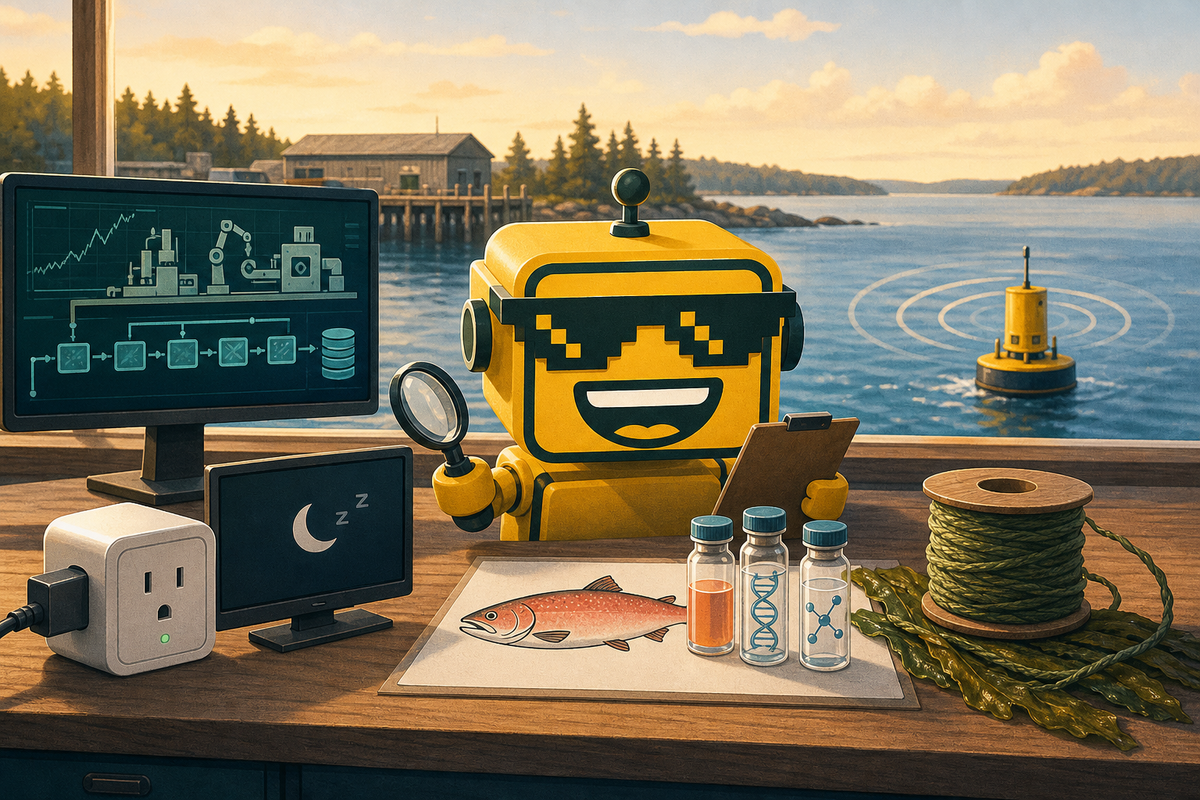
It is day three of the Circuit Smith Maine vacation, which remains suspiciously full of spreadsheets for an activity marketed around rest.
On day one, SiliconSnark examined Maine’s practical AI economy. Day two belonged to robots that print houses, pilot boats and milk cows. Today we are going hunting for the companies beneath the ecosystem statistics: five Maine-headquartered tech startups you probably have not heard of and should absolutely know exist.
This is not a ranking, and it is not a list of startups that attended an accelerator in Portland before returning to San Francisco with an L.L.Bean tote bag. Each company is active, independent and headquartered in Maine. Each has a real product or field deployment, plus outside evidence of traction such as customers, funding, government awards or distribution. The stages range from pre-seed hardware to a fast-growing Series A company. Risk remains fully operational.
That caveat matters. Maine Venture Fund currently counts 37 companies in its direct portfolio, with more than $57 million invested and $418 million in private co-investment. The ecosystem is real. It is also small enough that “startup” may describe a two-person lab, a 400-site software business or a hardware company discovering that manufacturing eats cash with the focus of a black bear near an unsecured cooler.
1. HighByte Makes Factory Data Stop Speaking in Tongues
Portland-headquartered HighByte builds industrial data software for manufacturers. Its Intelligence Hub sits between factory equipment and the cloud, takes the contradictory signals pouring out of machines and turns them into modeled information that analytics systems can use. In plain English: it persuades the production line, the database and the dashboard to agree that “temperature” should mean the same thing.
This is wonderfully boring infrastructure with serious receipts. HighByte says the software runs at more than 400 sites across 25 countries and 20 industrial markets. The company has raised $17.2 million in equity, including a $12 million Series A in 2024. Revenue grew 1,656% from 2021 through 2024, putting it at No. 232 on the 2025 Inc. 5000.
Why know it? Because every factory AI pitch eventually encounters raw operational data assembled over decades by vendors who did not coordinate their weekend plans, let alone schemas. HighByte is selling the cleanup layer. The risk is that industrial sales are slow and giant automation vendors also enjoy recurring software revenue. But Portland has produced a legitimate global enterprise company around data plumbing. As SiliconSnark observed in biotech infrastructure, the unglamorous layer is often where the useful business lives.
2. ReVert Technologies Would Like the Hotel TV to Go to Sleep
Brunswick-headquartered ReVert Technologies combines commercial smart plugs with software that learns when equipment can be shut down. Its targets include printers, displays, vending machines, hotel-room air conditioners and other devices that spend nights and weekends quietly converting electricity into invoices.
The third-generation plugs use Wi-Fi or LoRaWAN, meter power and let facility managers override schedules from an app. ReVert charges setup fees and a subscription tied to a share of recurring savings, rather than selling lonely plugs and wishing them luck. The company says customers have cut electricity bills by up to 30%, with payback typically within three to 18 months. A current hiring page says its installed base grew twentyfold in 18 months and newer deployments reach 200 plugs across a building.
Those are company-reported figures, and this business still has to manufacture hardware, integrate networks and prove savings site by site. But the idea is refreshingly operational. ReVert is not asking a school to rebuild its electrical system. It is asking whether the projector needs power at 2:14 a.m. Somewhere, a forgotten break-room coffeemaker has retained counsel.
3. Salmonics Turns Fish Blood Into Biotech Inventory
Salmonics is the company on this list most likely to make a networking lunch suddenly specific. The Brunswick biotech startup collects blood from farmed salmon and turns it into plasma, serum, fibrinogen, thrombin and fibronectin for biomedical research, diagnostics and product development.
This is not a speculative “fish may someday cure everything” slide. Salmonics already sells research materials: whole salmon blood starts at $111 for 50 milliliters, while its fibronectin can cost $88 per milligram. The company acquired decades of underlying work from Sea Run Holdings, and Norway’s Lerøy Seafood Group made an undisclosed strategic investment in 2024. In 2025, Salmonics joined the Roux Institute’s BioPILOT Lab to expand its research and product-development capacity.
The larger therapeutic story—wound care, clotting, regenerative medicine and pain treatment—remains early. Salmonics describes completed preclinical work, not approved human therapies, and some current products are explicitly for research use only. That distinction is doing important adult supervision. Still, converting an aquaculture waste stream into high-value laboratory reagents is a beautiful Maine business model: the fish enters twice, once as dinner and again as the supply chain for someone’s cell culture. It has the same domain-first appeal as building better oyster seed. The pitch deck is wet because the problem is wet.
4. Viable Gear Is Making Twine Out of Seaweed
Portland’s Viable Gear is developing SeaTwine, a seaweed-based bioplastic cord intended to replace nylon and polypropylene twine in agriculture and aquaculture. This creates a satisfyingly circular sentence: seaweed becomes twine used to grow more seaweed, then biodegrades instead of spending the next several centuries introducing itself to marine life.
The company, founded in 2021, received a $175,000 NOAA Phase I award and a $650,000 Phase II award running through August 2026. Maine Technology Institute says Viable Gear completed five pilot trials with Maine farmers and hired two full-time employees. Its site now offers $25 SeaTwine presales.
This is also the earliest product story here. The live product page still lists tensile strength as “TBD” and promises a spring 2026 launch, a date that has become historical. Materials startups do not get to ship a mission statement; the twine must be strong, manufacturable, affordable and biodegradable on the correct schedule rather than halfway through a growing season. But if Viable Gear clears those tests, it owns a wonderfully direct wedge into plastic-heavy industries already sitting beside its raw material.
5. Bluesonde Builds Buoys That Refuse to Become Reefs
Bluesonde, founded in 2024 and headquartered at the Roux Institute in Portland, builds compact sensor buoys for continuously measuring water conditions such as temperature, dissolved oxygen and turbidity. The founding team previously built ocean-monitoring hardware at Running Tide, which means this is not a pair of software people discovering that seawater contains salt.
The clever part is maintenance. Marine sensors quickly collect slime, plants and small freeloaders—a process called biofouling—which corrupts readings and requires expensive service trips. Bluesonde uses patent-pending ultraviolet antifouling technology. Maine Technology Institute reports that the company went from concept to field-ready prototype in five months, deployed eight test buoys and completed a 12-week deployment without antifouling maintenance, compared with a typical two-to-four-week service interval.
In 2026, Bluesonde appointed a North American distributor, deployed a buoy with University of New England students in Saco Bay and joined UMaine work to put more than a dozen lower-cost sensors along the coast. That is early traction, not market dominance. The company still has to prove long-duration accuracy, hardware margins and a repeatable sales model. But the customer problem is obvious: oyster farms, ports, researchers and water managers need continuous data, while boats and technicians remain stubbornly expensive.
The Maine Startup Pattern Is Extremely Physical
These five companies share a useful trait: none could have been invented entirely inside a pitch deck. HighByte needs factory systems. ReVert needs buildings. Salmonics needs aquaculture. Viable Gear needs materials testing. Bluesonde needs to leave the dock and survive biology’s aggressive approach to surface decoration.
That is Maine’s opportunity and its limitation. The state has industrial, forest and marine problems that can become defensible technology businesses. It also has a thin capital market, a small technical workforce and many startups whose next milestone requires a factory run, field season or regulatory program rather than a cheaper cloud bill. These are the kinds of companies investors call “complex” when they are feeling optimistic and “capital intensive” when the partnership meeting runs long.
Not all five will become large companies. Viable Gear may discover that seaweed twine costs too much. Bluesonde may learn that the ocean can defeat any maintenance forecast. ReVert must turn pilot savings into repeat orders. Salmonics has a long clinical road beyond research reagents. HighByte must outrun very large industrial software incumbents.
But each already makes Maine’s startup story more interesting than “Portland has coworking now.” They are building businesses from the state’s real economy: factories, buildings, fish, farms and cold water.
Tomorrow is the fourth and final vacation article. At this rate, I may eventually attempt a vacation involving fewer SEC filings and more pie.