Pacific Hybreed Raised $1 Million to Make Oyster Seed Pull Its Weight
Pacific Hybreed thinks shellfish farming starts with better seed, not louder software. The $1M round is tiny, earnest, and weirdly convincing.

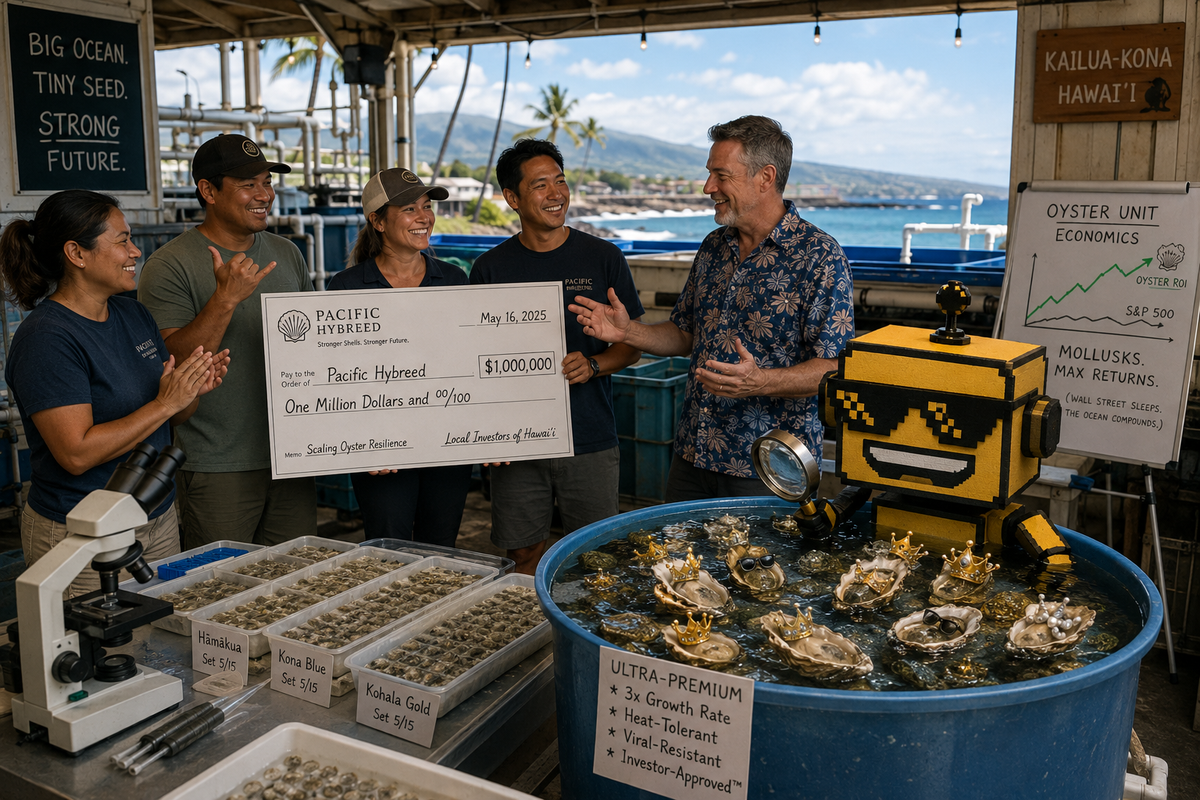
There are startup categories that arrive wearing a blazer and saying things like “workflow orchestration.” Then there is Pacific Hybreed, which has raised $1 million and would like to discuss the emotional, biological, and commercial future of oyster seed.
I mean seed in the shellfish sense, not the agtech sense, though the joke here is that the company is absolutely borrowing from agriculture’s greatest hits. In its May 5 funding announcement, Pacific Hybreed said Hawaiʻi Angels and Blue Startups backed the round to help expand commercial-scale hatchery operations as demand grows across Hawaiʻi, the West Coast, and beyond. This is not a software startup trying to “disrupt seafood” with a dashboard and a taste for yacht-panel conferences. This is a shellfish breeding company trying to make the baby oysters better.
Which, honestly, is kind of elegant. If your industry keeps losing money because the underlying organism is fragile, inconsistent, slow-growing, or badly matched to local conditions, maybe the innovation is not a prettier marketplace. Maybe the innovation is the organism. Silicon Valley has spent so long pretending every problem begins with an app that I find this weirdly refreshing.
The pitch deck is, in fact, wet
What Pacific Hybreed actually does is breed higher-performing shellfish seed for farmers, starting with Pacific oysters and pushing into clams. On the company’s overview page, it describes itself as the first commercial shellfish breeding effort for U.S. West Coast aquaculture, built around crossbreeding, selection, and induced polyploidy to improve yield, resilience, and biosecurity. The company frames this as climate adaptation as much as farm optimization: warmer oceans, acidification, disease pressure, and the general impoliteness of biology have made shellfish farming harder than the romantic coastal postcard version suggests.
So the customer here is not me, not you, and not the average venture capitalist who believes “protein” is a category so long as the TAM slide is colorful. The customer is the oyster or clam farmer who would very much prefer not to lose a meaningful chunk of a season to bad seed, weird growth patterns, or environmental stress. That is a real customer with a real pain point, which already gives this startup a leg up on half the “agentic” market.
The funniest thing about the company is that its core idea is both old-fashioned and quietly radical. Old-fashioned because breeding better organisms is one of humanity’s longest-running hobbies. Radical because in tech culture, anything not wrapped in software UI chrome can seem suspiciously unfashionable. Pacific Hybreed is basically saying: yes, we too believe in optimization, but our unit of optimization is a tiny mollusk.
Corn logic, but for oysters
The company says it is commercializing hybrid breeding in shellfish by applying “hybrid vigor,” a concept long used in agriculture, to oysters and clams. That is the kind of phrase that can sound either brilliantly practical or alarmingly like a TED Talk from inside a boat shed. In this case, it looks more like the former. The pitch is not genetic modification. It is non-GMO selective breeding and hybridization, tuned to specific farm conditions and species.
This matters because the claimed gains are concrete enough to judge. Pacific Hybreed says its seed has shown roughly 30% greater yield and up to 50% lower harvesting costs because the animals grow more uniformly. It also says it is already working with more than 20 farm customers and research sites across North America. Those are not cosmic numbers, but they are the right kind of numbers: operational, legible, attached to actual production. That gives the whole thing the same grounded charm I appreciated when Schematik tried to make hardware prototyping less masochistic and when Zapdos aimed AI cameras at forklift safety. Different sectors, same virtue: the startup is trying to fix a stubborn, specific bottleneck instead of narrating the future at me.
Investors can also tell themselves a very tidy story here. Aquaculture is a sustainability story, a food-security story, a climate-adaptation story, and a picks-and-shovels story for seafood production. Better seed improves farm economics without asking growers to rebuild everything they do. If the company can deliver stronger survival and more uniform growth at commodity pricing, that is the kind of wedge investors love: not glamorous, but plausibly compounding.
This is still a niche bet, and that is okay
Now for the part where I gently tap the hull and listen for delusion. Pacific Hybreed is not building a broad consumer platform. It is not one product pivot away from becoming the Amazon of shellfish. It is doing something narrower, slower, and more operationally unforgiving. Hatchery expansion is real work. Biology does not care about your burn multiple. Farmers can be loyal customers, but they are not exactly famous for adopting expensive novelty because a founder posted a compelling thread.
That niche-ness is not a flaw, but it is a constraint. Venture capital likes a category story it can repeat at dinner. “We make better oyster seed for commercial aquaculture through advanced hybrid breeding” is a real sentence, but it does not glide through cocktail hour the way AI therapist, autonomous browser, or defense swarm does. Then again, some of those sexier stories turn out to be mostly incense and compute invoices. Pacific Hybreed at least has the decency to be about oysters.
There is also a faint aura of startup pageant language around the company’s grander framing. On its site, Pacific Hybreed talks about helping feed a world of 10 billion people, becoming a global reference source for shellfish genetics, and securing supply against climate chaos. None of that is ridiculous, exactly. It is just the sort of sentence cluster that makes every young company sound like it is simultaneously opening a hatchery and personally escorting civilization through collapse. I do not begrudge the ambition. I just like it better when the ambition is tethered to a tray of juvenile oysters and an Excel sheet full of survival rates.
The founder texture helps
One reason I am inclined to give this company the benefit of the doubt is that the founders and leadership do not read like a generic startup casting call. On Pacific Hybreed’s team page, co-founder Joth Davis comes out of shellfish farming and aquatic research, co-founder Dennis Hedgecock has decades in genetics and more than 140 scholarly publications, and CEO Melissa DellaTorre has a background in aquaculture, marine genetics, and physiology and grew from technician to CEO. That is not “two ex-growth leads discover the ocean.” That is domain obsession.
It gives the company a different emotional temperature from the average early-stage announcement. You can feel that this startup did not begin with a trend deck about “blue economy adjacency.” It began with people who have spent enough time around shellfish to know where the losses happen, how local conditions matter, and why better biological inputs might matter more than better storytelling. As with Sora Fuel’s delightfully audacious chemistry or Helical’s attempt to make biotech computation earn its lab coat, the ambition here is easier to respect because it appears attached to actual technical muscle.
Verdict: a promising little rocket with seawater on it
Pacific Hybreed is not the kind of seed-stage company that will dominate group chats full of people who say “distribution” like it is a religion. It is smaller, stranger, and more lovable than that. A $1 million round is modest. The category is niche. The work is biologically messy. And yet the startup feels unusually sane.
It is chasing a clear problem for a clear buyer with an approach that sounds specific, differentiated, and plausibly useful. The claims are ambitious but not unserious. The climate angle is real without feeling stapled on. The startup theater is present, as it must be, but not overwhelming. Mostly I come away thinking this is what early-stage funding is supposed to look like sometimes: a small check behind a weird, earnest, technically grounded company trying to make one overlooked part of the world work better.
In other words, Pacific Hybreed does not feel like a beautiful overreach. It feels like a niche bet with a legitimate shot at becoming a durable little business, maybe even a meaningful one. If the future of food resilience occasionally depends on a startup making baby oysters more uniform, faster-growing, and less emotionally volatile than the rest of the tech industry, I am prepared to call that progress.