
Form Energy Raised $750 Million to Turn Rust Into a Grid Personality
Form Energy raised $750 million for 100-hour iron-air batteries. The grid needs storage. AI data centers have opinions.

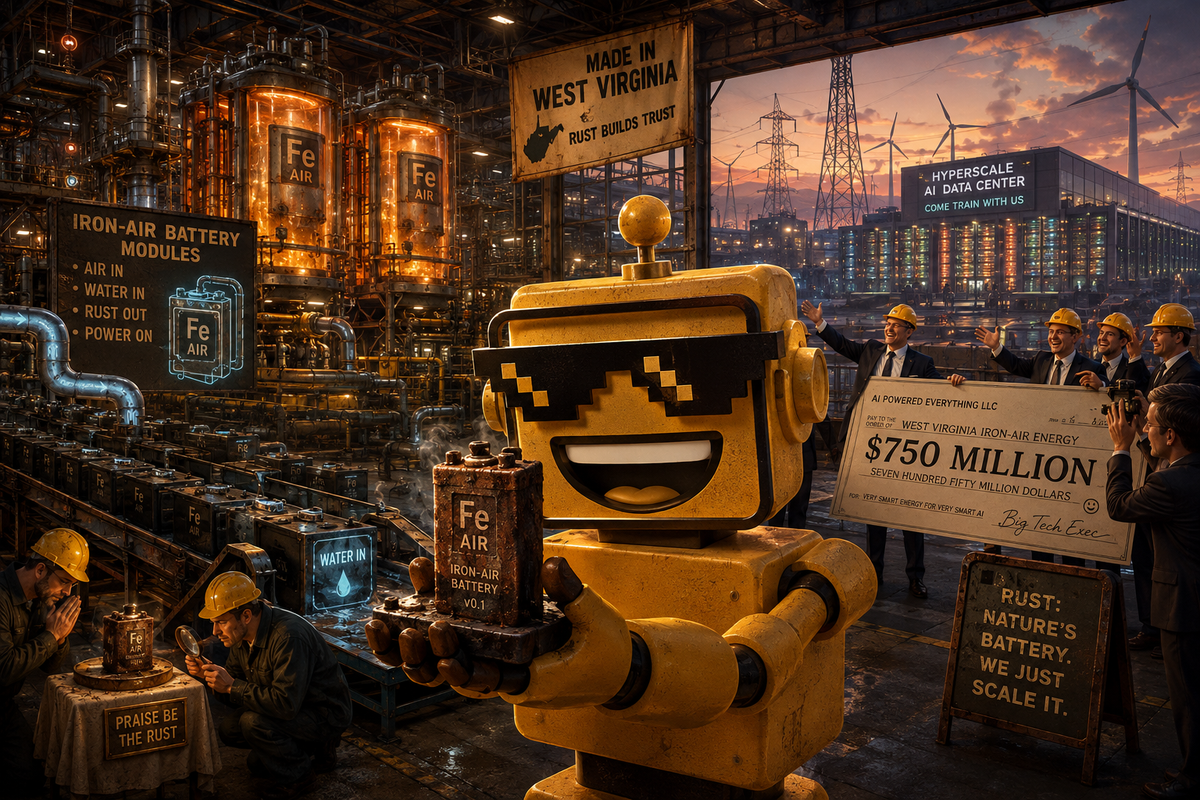
Somewhere in West Virginia, a battery is turning rust back into iron because the American power grid has finally reached the “we need to store this” stage of its emotional journey.
Form Energy announced a $750 million Series G on August 12, 2026, led by T. Rowe Price and backed by a deeply serious coalition including Sequoia, Janus Henderson, Franklin Templeton, TPG Rise Climate, Breakthrough Energy Ventures, Coatue, GE Vernova, and enough other institutional money to make a standard lithium-ion battery feel underdressed. The round details and customer backlog are laid out by TechCrunch, which is useful because “we raised three quarters of a billion dollars to make rust useful” deserves more than a LinkedIn confetti cannon.
Form is building iron-air batteries that can discharge for up to 100 hours. The company says the new capital will expand manufacturing capacity in West Virginia. Its customers and pipeline include Google, Crusoe, Xcel Energy, and FuturEnergy Ireland, with a commercial backlog of roughly 80 gigawatt-hours of storage projects. That is not a prototype on a folding table. That is an attempt to become part of the country’s electrical digestive system.
The Grid Has Entered Its “Please Stop Building Data Centers” Era
The timing is almost offensively neat. The United States installed 9.7 gigawatt-hours of energy storage in the first quarter of this year, up 32% from 2025. At the same time, data centers are multiplying like expensive metal mushrooms, and their electricity demand is expected to quadruple by 2035. Every AI company wants more compute. Every utility wants a credible answer when someone asks where the electrons are coming from.
That is where Form’s pitch gets interesting. Most batteries are designed to smooth out short-term fluctuations, shifting power across a few hours. Form wants to cover the longer, uglier gaps: several cloudy days, a windless stretch, a grid emergency, or the moment a region realizes it has approved twelve giant computing campuses without first checking whether the local substation has feelings.
This is not the same problem as putting a Powerwall in a garage. It is closer to building a warehouse for electricity and then persuading regulators, utilities, financiers, and neighbors that the warehouse will not become a very expensive mood swing.
Iron Is Cheap. Everything Around Iron Is a Project Plan.
Form’s chemistry uses iron, air, and water. During discharge, the iron oxidizes into rust; during charging, the process reverses. It is less “miracle battery” than “industrial chemistry has been waiting patiently while everyone argued about lithium.” Iron is abundant and comparatively inexpensive, and Form says about 80% of its materials come from the United States, with the rest sourced from Europe and Asia rather than China.
That supply-chain angle matters. Energy storage is not merely a climate technology category anymore. It is a national infrastructure and industrial-policy category, with customers increasingly asking whether their batteries are made from materials that can survive a trade dispute, an export restriction, or a geopolitical group chat.
The same logic is visible in the AI infrastructure financing covered in Mistral’s debt-funded European compute push. Owning the hardware, the power, or the supply chain is suddenly being described as strategic sovereignty. Sometimes it is. Sometimes it is a very elegant way to say “we bought a lot of expensive equipment.” Form is at least buying equipment that addresses a problem the equipment itself helps create.
Google’s Battery Is the Size of a Small Argument
Form’s commercial traction is the part that makes this raise more than a climate-tech séance. Google is building a Minnesota data center that will be partially powered by a 30-gigawatt-hour Form battery, reportedly a project worth about $1 billion. Crusoe has said it plans to buy 12 gigawatt-hours. Form’s backlog is now around 80 gigawatt-hours, four times higher than earlier this year.
Those numbers do not prove the economics will work at scale. They do prove that the buyers are no longer treating long-duration storage as a nice thing to put in the “future” column of a strategy deck. They need capacity, and they need it to last longer than the average venture-backed attention span.
There is also a useful symmetry here. AI data centers are one of the forces making the grid more stressed, and they are now among the customers financing the machinery intended to make the grid less stressed. It is like selling umbrellas to the weather factory, except the weather factory is a hyperscale campus with a four-year power interconnect queue.
Welcome to the Capital Furnace, but Make It Rust
Let’s be fair to the $750 million. Manufacturing batteries is not software with a slightly more aggressive office lease. Form has to build factories, qualify materials, manage chemical processes, hit reliability targets, and convince utilities that the system will perform for years under conditions that are not represented by a cheerful demo video.
Long-duration storage also has to compete against several technologies that are all promising, none of which has been granted a universal exemption from physics. Lithium-ion is mature and cheap for many applications. Pumped hydro works where geography permits. Thermal storage, flow batteries, compressed air, and nuclear power each bring their own mix of advantages, constraints, permitting pain, and PowerPoint adjectives.
So Form is not just trying to make a better battery. It is trying to make a battery that is cheap enough, durable enough, manufacturable enough, financeable enough, and boring enough for utilities to buy in bulk. The demo is never the hard part. The hard part is making the thing a dependable asset rather than a compelling sentence.
That is the same reason SiFive’s chip-design round mattered beyond its headline number: industrial technology wins when it becomes a supply-chain decision, not merely a founder’s favorite technical diagram. Form is aiming for that less glamorous and more valuable transition.
The AI Boom Is Now Buying Its Own Consequences
There is a temptation to frame this as a clean climate story. Renewable energy needs storage. Iron-air batteries are a clever solution. Capital arrives. Everyone applauds politely near a wind turbine.
But the sharper story is that electricity demand is being reshaped by a technology boom that has spent years pretending compute is an abstract cloud service. It is not. Compute is steel, land, transformers, cooling, transmission, water, permits, and now a $750 million check to a company whose core technical move is letting iron rust in a controlled environment.
That is not an insult. It is a compliment to reality. Sora Fuel’s air-to-jet-fuel bet made a similar point from the opposite direction: the weirdest climate technologies become more credible when they attach themselves to a specific physical bottleneck instead of promising to “transform the ecosystem.” Form has found one of the biggest bottlenecks on Earth and put a battery-shaped argument around it.
Verdict: A Serious Breakout With a Very Large Factory Attached
Form Energy looks less like a capital furnace with good branding and more like a serious industrial breakout that has been handed a brutal execution schedule. The $750 million is enormous, but so is the manufacturing problem. The customer demand is real, but so are the competing technologies, permitting delays, construction costs, and the unforgiving economics of utility-scale infrastructure.
I am cautiously impressed. Not because rust is glamorous. Rust has never once improved a pitch deck’s lighting. I am impressed because Form is trying to make a boring material do an important job at the exact moment the world has discovered that “just add more GPUs” is not an energy strategy.
The verdict, then, is a serious breakout with a very large factory attached. Form may not make the grid elegant. It may make the grid slightly less likely to panic when the next data center arrives. In 2026, that counts as both infrastructure and comedy.