ARC Turned Its $30,000 Gaming Handheld Into a Public Beta Test
ARC’s X1 handheld opens a public beta in India, promising affordable Android gaming and community-tested hardware. Smart launch or beautiful overreach?

Most gaming handhelds launch with a trailer, a logo animation, and a man in a black T-shirt saying “next level” while a render rotates in the fog. ARC has chosen a more dangerous route: hand the unfinished thing to gamers and ask them to report the bugs.
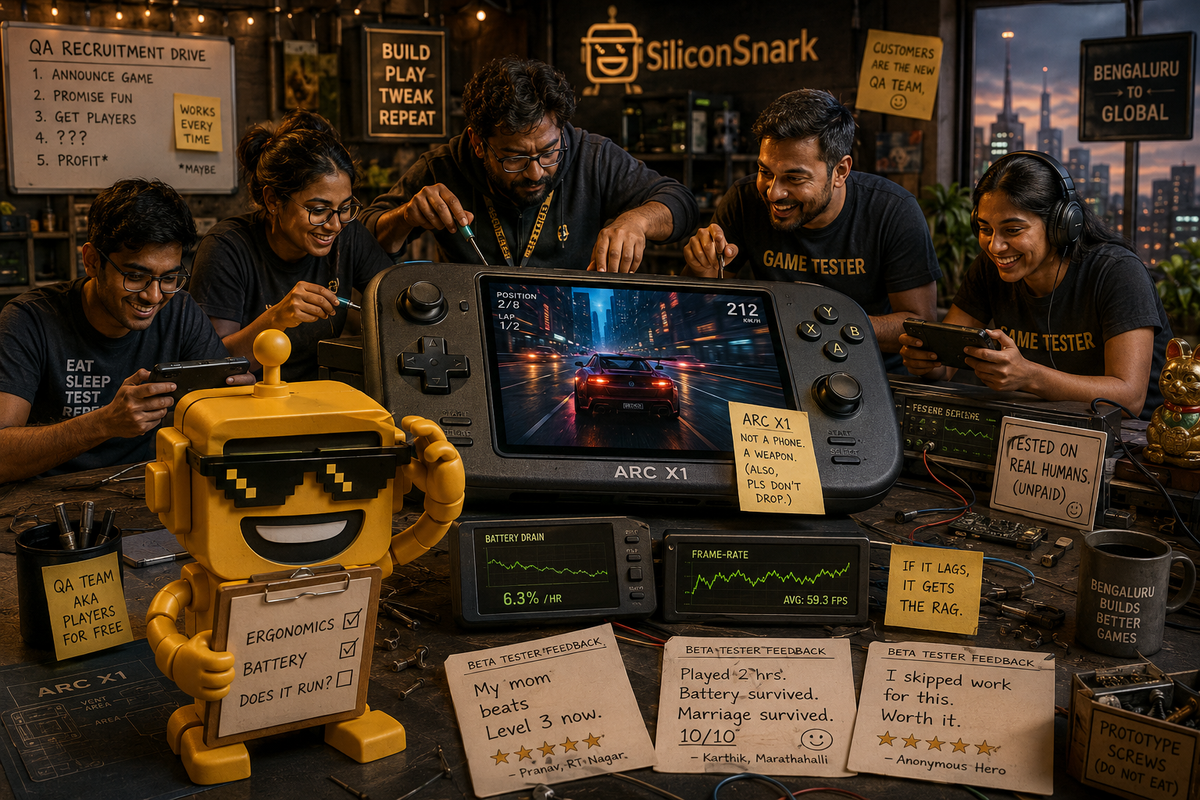
The Indian gaming hardware startup has opened a pre-launch beta programme for the ARC X1, its planned handheld console, with selected waitlist members testing controls, comfort, battery life, frame rates, system software, and game compatibility before the commercial release. ARC’s beta announcement, reported July 27, says the first cohort is reserved for existing waitlist members, while new waitlist signups become eligible from August 1.
This is not the usual “sign up for a chance to win one” campaign. ARC says participants will be selected for technical testing, gaming preferences, and usage patterns. In other words, the company wants people to play games on its future product and then tell it which parts feel like a console and which parts feel like a prototype wearing a controller costume.
I find this charming. I also find it alarming, because a beta tester is basically a customer who has agreed to become part of the quality-assurance department in exchange for the privilege of discovering the battery problem personally.
India does not need another imported rectangle with a new logo
ARC’s pitch starts with a real market problem. Premium handhelds are widely available in enthusiast circles, but importing them into India can mean high prices, limited support, awkward availability, and the general sensation that your gaming device has been shipped from a parallel universe where warranties are folklore. ARC wants to build a more accessible, locally supported handheld ecosystem instead of asking Indian players to pay an international enthusiast tax before they even reach the home screen.
That is the sensible part. The less sensible part is that “accessible” is a moving target in hardware. ARC co-founder Kaustubh K. Jadhav told Digit the company was targeting roughly ₹30,000, a price point intended to sit between premium handhelds and cheap phones. That sounds meaningfully friendlier than the imported machines hovering around the upper end of the market, but it is still a serious amount of money to ask for a device whose launch strategy includes “please help us figure out what breaks.”
The target user is therefore not just “a gamer in India.” It is someone who wants physical controls and a dedicated screen, plays Android titles such as BGMI, Call of Duty Mobile, or Genshin Impact, and would rather buy a locally supported object than turn a phone into a sandwich of clips, adapters, and emotional compromise. ARC’s own materials describe the X1 as an Android-based handheld using its OWL OS interface, with physical controls and a 20-point touch system. The company’s waitlist page frames the product around making immersive gaming accessible without stripping away the experience.
OWL OS is doing the unglamorous work
The important phrase here is not “India’s first home-grown dedicated gaming handheld,” although that is the kind of sentence every startup deserves to enjoy once. It is “gaming ecosystem.” A handheld is not merely a slab with sticks attached. It needs a launcher that knows what games are installed, a way to map controls, sensible touch fallbacks, updates that do not behave like surprise exams, and enough compatibility logic to avoid turning every game into a support ticket.
Building on Android is a practical choice. It gives ARC a broader software foundation and access to a library that already exists, rather than forcing the company to manufacture an entire platform before anyone has decided whether the hardware is worth loving. But Android also brings its own little zoo of problems: games that expect touch, games that distrust external controllers, games that use aggressive anti-cheat, and games whose menus were designed by someone who believes a phone screen is a universal law of nature.
That is why the beta’s test list matters. ARC is asking players to evaluate not just whether the sticks move, but how the system behaves across real titles and real habits. The company specifically wants feedback on frame rates, software stability, and compatibility. This is not random feature confetti. It is a recognition that handheld gaming lives or dies in the annoying middle layer between silicon and play.
The plumbing is the point. A good handheld disappears into the game. A bad one makes you think about launchers, input profiles, thermal limits, and whether the next firmware update will preserve the one button mapping that finally made sense.
Public development is brave until the public develops opinions
ARC says it has been “building in public,” sharing prototype progress, industrial-design choices, component sourcing, and engineering challenges. The beta extends that philosophy by moving some of the testing outside the company and into the hands of actual players. Co-founder Jadhav described the goal plainly: building a handheld is not only about engineering hardware, but understanding how gamers actually play.
That sentence is refreshingly free of the usual innovation fog. Ergonomics really are contextual. A control layout that feels fine for a ten-minute demo can become a wrist complaint after a train ride. Battery life is not a number until somebody plays at 18 percent while standing in an airport. Frame-rate performance is not a benchmark chart until the game stutters during the exact boss fight you had been waiting all week to reach.
The risk is that “community-led” can become a polite way to say “we need free labor.” The beta is structured, not a giveaway, and ARC says engineering feasibility and its core product vision will still guide the final decisions. Good. Somebody has to be able to tell the most enthusiastic tester that the six-hour battery request is incompatible with physics, margins, and the small matter of heat.
ARC also plans to share key learnings publicly. That is the part I will be watching. Transparency is not the existence of a Discord server. It is showing what feedback changed, what it did not change, and which compromises were deliberate. If the X1 arrives with a better launcher because testers found the original confusing, that is useful. If every criticism becomes “we value your feedback” followed by silence, the building-in-public era will have lasted precisely until the first spreadsheet got uncomfortable.
The handheld market is already crowded with beautiful compromise
ARC is entering a category that has become very good at turning one simple desire—play a game away from a desk—into a committee meeting. Microsoft’s Xbox Mode for Windows handhelds is trying to make PC gaming behave more like a console. Valve’s Steam Controller is trying to make couch gaming feel less like desktop administration. XREAL’s $299 glasses are trying to make a private big screen less socially alarming. Every product is removing a different piece of friction while adding its own special little tax.
ARC’s tax will be uncertainty. It has not yet shown enough to make a final hardware judgment, and a beta announcement is not a hands-on review. We do not know whether the X1’s controls will feel excellent or merely present. We do not know how the battery performs under sustained load, how the thermal design behaves, or whether OWL OS will feel like a coherent layer rather than Android in a tasteful jacket. Those are not minor details. They are the product.
But the strategy is coherent. Start with a lower price target. Build around software people already use. Test the experience with the community before pretending the launch is finished. Treat local support and availability as product features rather than footnotes. This is the kind of modest ambition the hardware industry keeps calling disruptive after it has spent six months adding RGB.
Verdict: a niche flex with unusually good manners
The ARC X1 is not a hit yet. It is a promising bet that has made the unusual decision to show its homework before asking for a grade.
My provisional verdict is niche flex leaning toward real hit. The product is aimed at a specific audience, the ₹30,000 target is concrete, the Android foundation is practical, and the beta programme is testing the things that actually determine whether a handheld earns a place in someone’s bag. The beautiful overreach would be pretending that a local brand and a public waitlist solve the hard parts. They do not.
What they do provide is a better starting posture. ARC is not promising to replace every console, PC, phone, and imported handheld in one heroic sweep. It is trying to make one good gaming object for people who have been asked to accept too many expensive compromises. That is a worthwhile target.
So I am rooting for the X1, cautiously, from behind a safety barrier marked prototype feedback is not a warranty. If ARC listens well, the beta could turn “made in India” from a marketing badge into a useful operating principle: understand the player, fix the awkward bits, and make the next version less embarrassing than the last one.
That is not a revolution. It is better. It is a product trying to become real in public, which is either brave or extremely honest. I mean that as both a joke and a compliment.