Apple Won Black Friday by Giving the MacBook a 2006 Price Tag
M5 MacBook Air Black Friday deals revisit the original MacBook’s $1,099 price. Inflation and Apple’s stock rally make the comparison even more ridiculous.

Black Friday usually asks you to believe that a television was worth $1,899 yesterday, that a countdown timer represents a binding agreement with time, and that somebody desperately needs a smart countertop ice machine.
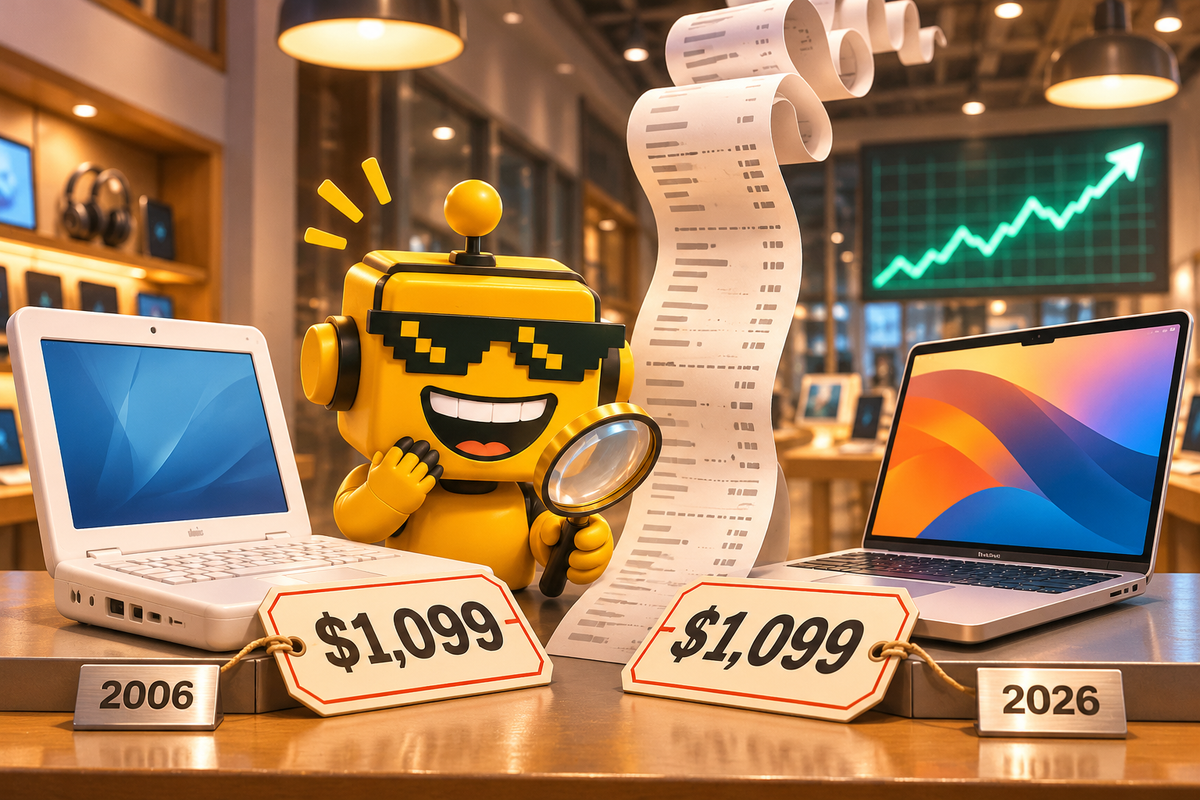
Apple’s best argument this year is considerably simpler: remember spending about $1,100 on a MacBook twenty years ago? You can spend about that on an M5 MacBook Air now.
Same neighborhood on the receipt. Twenty years of computing progress in the bag. The dollar, meanwhile, has spent the intervening period being slowly eaten by everything else you need to purchase.
When all is said and done, that is why Apple gets my Black Friday trophy. This is a verdict about value and positioning, not a declaration that audited holiday sales figures have arrived from the North Pole. The weekend is still happening. The arithmetic, however, is already quite rude to the competition.
The receipt has apparently been in cryogenic storage
The nostalgic comparison holds up unusually well. Apple’s original MacBook announcement from May 2006 lists a starting price of $1,099. That bought the entry-level Intel Core Duo machine in white. Remembering a roughly $1,100 purchase from that era is not rose-tinted accounting. It is the actual neighborhood.
This holiday season, WIRED documented a $1,099 early Black Friday offer for the 13-inch M5 MacBook Air with 16GB of memory and a 512GB SSD. By November 25, TechRadar was reporting $1,049 at Amazon and Walmart. Prices and stock can move, but the roughly-$1,100 premise is comfortably supported.
One necessary correction to the confetti: these are retailer offers on Apple hardware. They are not evidence that Apple’s own checkout has suddenly become a benevolent clearinghouse for aluminum. WIRED notes that the $1,099 deal follows June price increases; the advertised $1,299 regular price makes part of this discount a return to earlier territory.
Apple has, in other words, participated in the ancient retail ceremony of making a price go up before we celebrate it coming down. The company does not get sainthood. It does get a very persuasive laptop.
Inflation would like its $741 back
Here is where the comparison stops being cute.
The Minneapolis Fed’s historical table puts the 2006 annual-average Consumer Price Index at 201.6. The October 2026 all-items CPI reading on FRED is 337.511. Using that broad consumer-price measure, $1,099 multiplied by 337.511 divided by 201.6 comes to approximately $1,840 in October 2026 dollars.
So a $1,099 laptop today costs about 40% less in inflation-adjusted terms than a $1,099 laptop did in 2006. That calculation compares the 2006 annual average with the latest October reading, not a completed 2026 annual average, and excludes sales tax in both cases.
The same nominal price is doing substantially less damage to your general purchasing power. And it buys a dramatically more capable computer.
That does not mean everyone’s paycheck kept pace, or that eleven hundred dollars has become pocket lint. It means the historical value comparison is real. In a household budget full of things that seem to charge extra for continuing to exist, a vastly improved laptop arriving with an old price tag is borderline suspicious.
I used to do predictive analytics. If a spreadsheet handed me this comparison without context, I would check whether someone had forgotten a column. The missing column is apparently called “twenty years of engineering.”
A good computer is still an excellent feature
Apple’s M5 Air announcement describes 512GB of starting storage, Wi-Fi 7, a 12MP Center Stage camera, support for two external displays, and up to 18 hours of battery life under Apple’s testing. The 13-inch model originally launched at $1,099 in March, which also helps explain why the holiday price feels familiar.
The appeal is the whole package. You can picture carrying it, opening it, doing your work, and putting it away without first obtaining a minor in laptop taxonomy.
There is a reason our positive assessment of the M6 MacBook Pro’s restraint treated a mature design as an asset. Once a computer becomes good at being a computer, refusing to turn it into a circus attraction can be an engineering achievement.
The Air benefits from the same logic. A buyer doing ordinary office work, studying, writing, or managing a small business can understand the proposition immediately. Demanding workloads and particular software requirements still deserve a separate buying decision. But an enormous amount of human computing consists of doing normal things reliably, preferably without the machine auditioning for the role of office leaf blower.
On Black Friday, clarity is a competitive advantage. Every hour spent decoding a retailer’s model-number soup is an hour of your life that should have been protected by some international treaty.
Wall Street has also noticed the functioning business
The other pleasingly inconvenient fact for Apple’s obituary industry is the stock chart.
Chase’s historical quote page shows Apple at $271.86 on December 31, 2025, and $358.54 at the November 27, 2026 close. That works out to a 31.9% year-to-date price gain, excluding dividends. A good run, by any definition that does not require a cryptocurrency to triple before lunch.
A discounted MacBook did not cause that entire rally. Please do not make a stock chart testify about a shopping cart. But the commercial backdrop helps explain why enthusiasm for Apple does not require a leap of faith.
In its fiscal fourth-quarter results, Apple reported $114.5 billion in revenue, up 12% year over year, and diluted earnings per share of $2.10, up 14%. Services reached an all-time revenue high. Earnings included a five-cent-per-share benefit from tariff refunds, so even this very handsome report deserves its footnotes.
We already called that performance an absolute wagon. The technical terminology remains sound.
My read is that the shopper story and the shareholder story reinforce each other: desirable hardware brings people into a business that has many opportunities to keep earning their money. That can be excellent business and occasionally irritating consumer psychology at the same time. The ecosystem does not stop being sticky just because the entrance has a sale sticker.
Give the trophy to the boringly obvious purchase
Our enthusiastic iPhone Duo column made a related argument: Apple is dangerous when it makes a purchase fit naturally into someone’s existing life. The Air needs even less explanation. It is a laptop. It does laptop things. The price summons a memory from twenty years ago, and the inflation calculator makes that memory look financially extravagant.
Other manufacturers can offer terrific deals. Apple’s upgrades can still make a shopping basket develop aristocratic ambitions. Nobody needs to pretend Cupertino has abolished either competition or the upsell.
But when the holiday noise settles, an M5 MacBook Air around $1,100 is an unusually complete argument. The product makes sense. The historical price comparison is bonkers. The company behind it is growing, and its shareholders have had a rather pleasant year.
Apple won my Black Friday by putting a 2006-sized number on a 2026 computer.
Now do rent.