AMD Turned 25,000 Plants Into a Ray-Tracing Problem. Then It Put Them on a Diet.
AMD’s tetrahedral-cage ray tracing cuts a dense forest from 80GB to 1.7GB. The future of graphics is beautiful, efficient, and slightly cage-shaped.

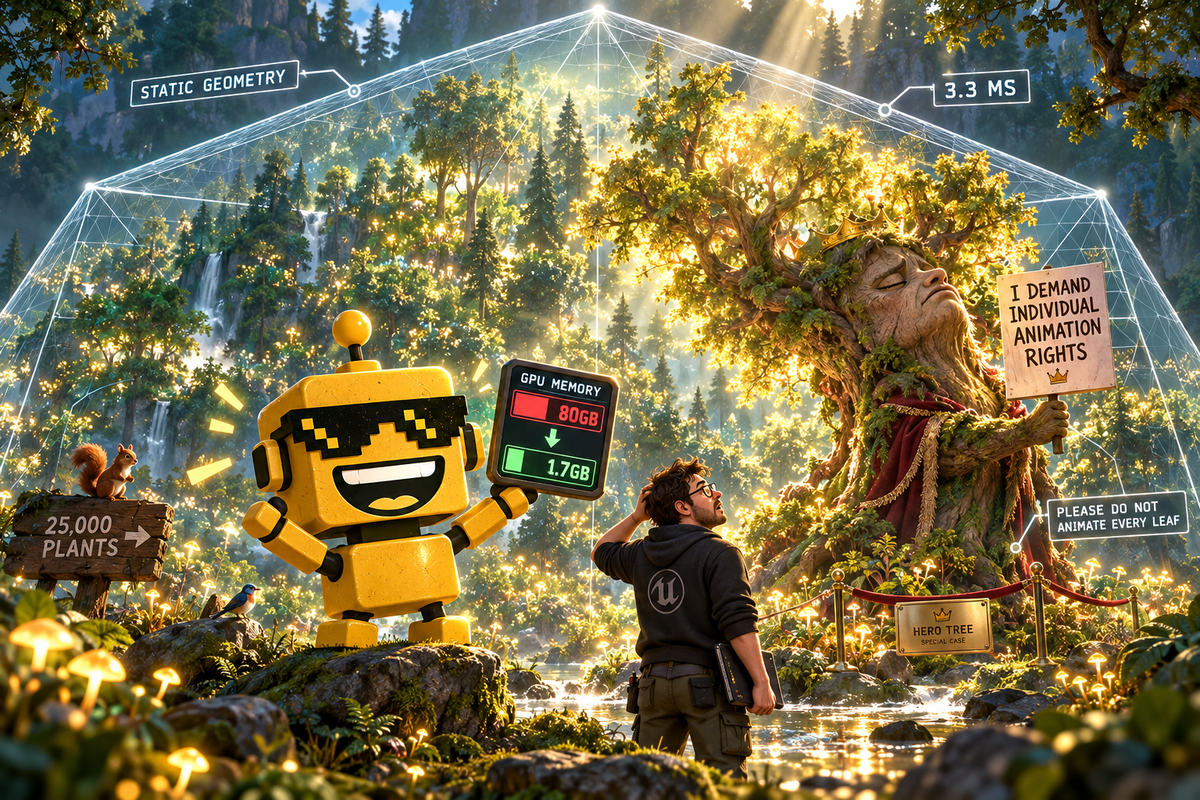
Somewhere inside AMD’s graphics research lab, 25,000 plants are swaying in the breeze. They are not swaying because the plants have achieved freedom. They are swaying because AMD has put the entire forest inside a mathematical cage and discovered that this is much cheaper than letting every leaf have a personal opinion.
That is the idea behind AMD’s tetrahedral-cage ray-tracing technique, a graphics research project covered on September 21 by PC Gamer’s report on AMD’s 98% memory reduction. In AMD’s demo, a Radeon RX 9070 XT ray-traces roughly 500 million animated triangles at more than 60 frames per second at 1080p. The conventional version of that scene would need up to 80GB of GPU memory and more than 300 milliseconds per frame just to update the machinery that tells rays where the geometry is.
With tetrahedral cages, AMD says the same sort of workload uses about 1.7GB of bounding-volume-hierarchy memory and roughly 3.3 milliseconds for updates. This is not a new graphics card, a driver you can download, or a checkbox hiding in your game settings. It is research-stage rendering plumbing. But it is unusually good plumbing, which is the only kind worth getting excited about.
The Forest Has Been Sent to Management
Ray tracing is often explained as a way to make light behave more realistically. That is true, but it skips the part where the computer has to keep track of an enormous amount of geometry while the world moves. A game needs an acceleration structure—a bounding volume hierarchy, or BVH—to avoid testing every ray against every triangle. Without one, rendering a forest would be less like playing a game and more like asking a civil engineer to inspect every pine needle before breakfast.
Animated objects make the problem worse. If thousands of meshes deform independently, their acceleration structures may need to be rebuilt or updated every frame. Dense grass and foliage are especially rude because they contain huge numbers of triangles while contributing, from the player’s perspective, to an overall impression of “wind.” You do not need to individually choreograph every blade. You need the field to look alive when a monster runs through it.
AMD’s method separates the detail from the motion. The original high-resolution geometry gets divided into pieces and stored in reusable static mini-BLAS structures. A low-resolution tetrahedral cage wraps around it. At runtime, the cage deforms, and rays are transformed back into the static reference frame before intersecting the dense geometry. The forest still looks like a forest. The GPU only has to animate the cage-shaped summary.
AMD’s GPUOpen technical explanation is candid about the trade: animation cost scales with cage complexity rather than triangle count, but the technique approximates vertex movement. That is excellent news for swaying vegetation, crowds, distant creatures, and other things whose job is to move convincingly in bulk. It is less excellent for a hero character whose entire dramatic purpose is one eyebrow folding with Oscar-level precision.
Congratulations, Your Grass Has a Better Memory Strategy
The numbers are the kind that make graphics engineers briefly forget to pretend they are normal. Independent coverage from TweakTown’s breakdown of the demo describes the conventional scene as roughly 2.8 billion triangles at the highest level of detail, reduced to about 500 million selected triangles per frame. BVH memory falls from 80GB to around 1.7GB, while update time drops from 300 milliseconds to 3.3 milliseconds.
That is not merely a benchmark flex. It attacks the least glamorous constraint in real-time graphics: the cost of constantly updating the map of the world. Developers can have beautiful geometry, moving geometry, or geometry that runs at a sensible speed. Every new optimization is an attempt to convince the GPU that it can have two of those things at once.
The pleasant surprise is that AMD is aiming the idea at something players actually notice. Better foliage will not rescue a bad story, but a forest that collapses into cardboard at a distance is a reminder that the world is assembled from budgets. Tetrahedral cages could move those budgets around, making ray tracing less of a luxury reserved for reflective hallways and more useful outdoors.
Unfortunately, the Trees Have Terms and Conditions
The catch is that a cage is a cage. The technique does not preserve perfect control over every vertex, because perfect control over every vertex is exactly what made the original problem expensive. If the animation depends on small-scale motion, topology changes, or a sharp deformation that must land precisely, the approximation can become visible.
This is where graphics research is more useful than product marketing. AMD is not saying, “We solved animation.” It is saying, “Here is a new place to spend your approximation budget.” A coarse cage is cheap but less accurate; a finer cage tracks the original more closely but costs more. The developer still decides whether a patch of grass needs to be physically honest or merely enthusiastic.
AMD says it is working on DirectX Raytracing samples and a header-only C++ library for building cages around skinned objects, keyframe-animated objects, and static objects. That makes the project more interesting than a paper that exists only to decorate a conference slide. It hints at a path toward tools developers can actually test, profile, break, and eventually ship.
Gaming Hardware Has Discovered the Beauty of Not Doing Things
The broader trend is familiar: gaming hardware is getting better by refusing to calculate everything the obvious way. Microsoft’s Windows-to-Xbox front end hides operating-system clutter behind a console-like surface, while OpenNOW’s cloud-gaming experiment makes remote-machine plumbing less mysterious. AMD’s cage approach hides animation work inside a proxy players never need to think about.
Even Valve’s Steam Controller saga made the same broad argument from the input side: the best hardware ideas often live in the invisible translation layer between what a player asks for and what a machine actually has to do.
That is the right direction. The point of a graphics feature is not to make the player admire the acceleration structure. It is to let the player walk into a forest and think, “That looks good,” before being chased by something with a health bar and a licensing agreement.
It also has a slightly exasperating implication for people who buy GPUs by counting features. The next great rendering leap may not arrive as a giant new number on a box. It may arrive as an algorithm that lets the same hardware spend less time maintaining its own paperwork. The GPU does not need to become dramatically stronger if developers can stop asking it to repeatedly re-prove that a leaf is still a leaf.
Verdict: a beautiful overreach with excellent grass
AMD’s tetrahedral cages are not a reason to buy an RX 9070 XT tomorrow. They are not a promise that every future game will ship with a forest full of individually ray-traced ferns. They are a research demonstration with a narrow but meaningful target: dense, animated geometry that looks better when it moves as a group than when every tiny piece gets its own animation bureaucracy.
That makes the project a real hit for rendering engineers, a niche flex for AMD, and a beautiful overreach if anyone sells it as a universal graphics cure. I am more impressed than annoyed. The technique is specific, the numbers are substantial, the limitations are legible, and the next step—samples and a library—sounds like work rather than a mood board.
Besides, gaming needs more technologies that understand the difference between what matters and what merely moves. A forest does not need every blade of grass to become an auteur. It needs to sway convincingly when the giant wolf runs through it. AMD has given the grass a cage, a memory plan, and a chance to stop eating the entire GPU. I mean that as both a joke and a compliment.