
8BitDo Built an Arcade Controller With a Screen, Because Buttons Needed Supervision
8BitDo’s Arcade Controller Pro adds hot-swappable switches, a tiny display, and five remappable buttons. Fighting games just got a $120 control panel.

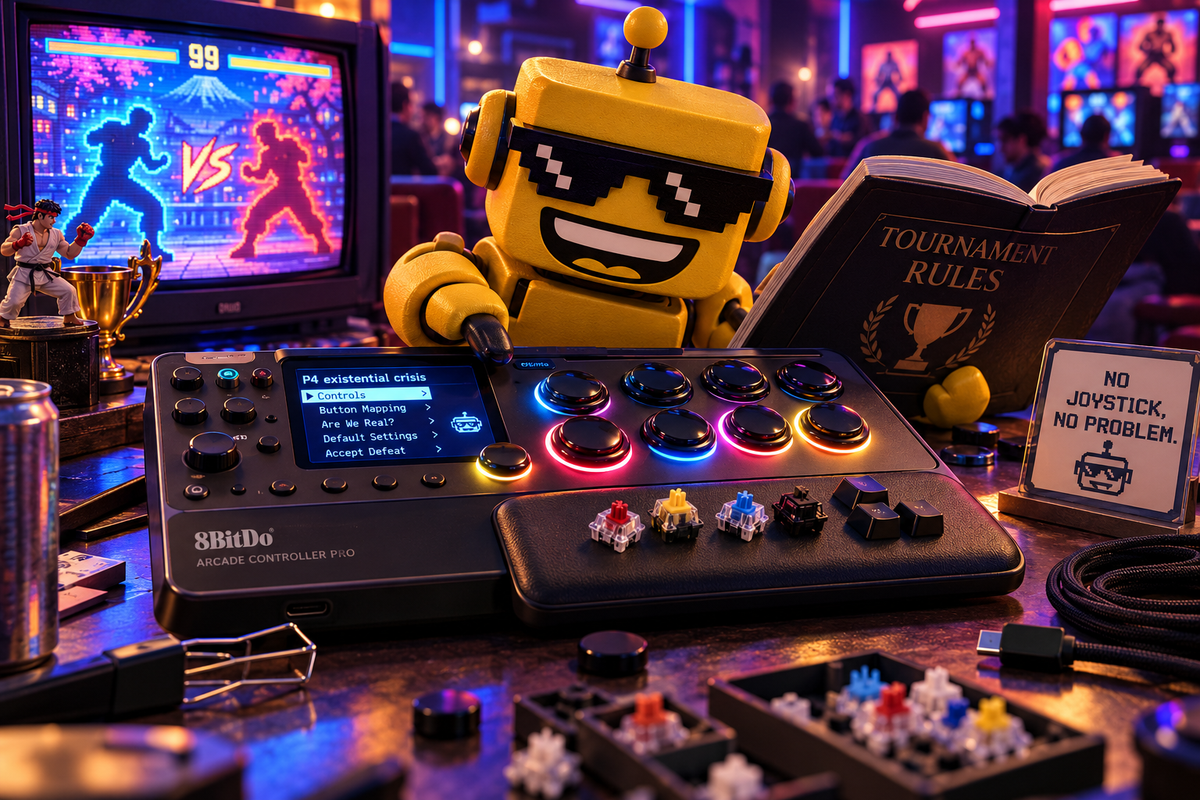
There is a particular kind of gaming hardware that begins as a solution and ends with a tiny screen asking whether you would like to customize the color of the tiny screen. 8BitDo’s new Arcade Controller Pro has arrived at that destination carrying a wrist rest.
Announced over the October 24–25 weekend and now available for preorder at $119.99, the 8BitDo Arcade Controller Pro is an all-button arcade controller for Windows and Nintendo Switch, including Switch 2. It replaces the traditional joystick with a compact field of mechanical buttons, then adds a 1.47-inch display, five programmable buttons, hot-swappable switches, a quick-release tempered-glass faceplate, wireless connectivity, and a magnetic wrist rest.
In other words, it is a leverless fighting-game controller that looked at the phrase “just press the buttons” and asked whether that workflow could support a software roadmap.
The joystick has been politely asked to leave
The product is designed for people who already know why a joystick might be the least interesting part of an arcade controller. In a fighting game, directional inputs can be executed with individual buttons rather than a lever. That means cleaner, more deliberate presses, and—depending on the game, ruleset, and player—less of the loose-thumb geometry that makes a quarter-circle motion feel like a small negotiation with your own wrist.
8BitDo is not pretending this is a universal upgrade. If you mostly play racing games, platformers, or anything involving a camera that wants to look around, the lack of a stick is less “precision instrument” and more “we removed the steering wheel to improve the dashboard.” The Arcade Controller Pro is for fighting-game players, especially people who want a desktop device they can tune and repair instead of treating as a sealed plastic prophecy.
The October 25 Engadget report syndicated by Yahoo confirms the $119.99 price, November 30 shipping, 1.47-inch display, tighter layout, and extra programmable controls.
A screen for the buttons that already know what they do
The built-in display is the feature most likely to make a normal person stare at the product photo and say, “Why?” That is a fair question. Fighting games have survived decades without a controller screen. The human eye can usually remember whether the button labeled P3 is doing something important.
But the screen is not merely decorative. 8BitDo says it runs built-in Ultimate Software functions for input monitoring, battery checks, and settings. The hardware also offers five fast-mappable buttons, RGB control, macros, and selectable SOCD modes. SOCD—simultaneous opposing cardinal directions—is the technical and regulatory swamp beneath modern leverless-controller discourse: the device decides what happens when you press contradictory directions together, making a hobby sound like a standards committee with hit points.
Competitive players often adjust layouts and tournament settings around specific games. Putting those controls on the controller turns configuration from a laptop chore into part of the physical object. The screen can also tell you the battery is low while you are already holding the controller and could infer that from the lights. It is like putting a fuel gauge on a bicycle. I mean that as both a joke and a compliment.
Hot-swappable switches, because your buttons have a preferred personality
Under the quick-release tempered-glass faceplate are 8BitDo Core Green low-profile linear mechanical switches, co-developed with Kailh. The controller ships with three spare switches and a puller, and the faceplate is designed to provide access without turning maintenance into an archaeological dig.
This is the genuinely smart part. Mechanical switches are consumable components, and fighting-game players can be unusually opinionated about feel. Hot-swapping lets the owner replace a worn switch or experiment without replacing the whole controller. It also gives 8BitDo a lucrative little future: a controller that becomes a hobby inside the hobby, complete with a drawer of tiny springs and a spreadsheet titled “optimal P4 fatigue curve.” This is how consumer electronics becomes a personality trait.
The wrist rest is magnetic, the cable is restrained
The Pro weighs 1,090 grams and measures 301 by 201 by 16 millimeters. It is a broad, low desktop object, not something you toss into a bag beside your earbuds and a banana. The magnetic wrist rest attaches when you want support and detaches when you want the controller to occupy less desk. It also stores five replaceable lock caps, which can cover the programmable P1–P5 buttons to prevent accidental presses.
This is the kind of design detail that sounds excessive until you imagine holding your hands over a flat panel for a long session. A wrist rest is not a gimmick if it keeps your forearms from filing a complaint. The removable storage compartment is similarly sensible. The controller has enough little parts to justify a dedicated hiding place, and 8BitDo has at least made the hiding place part of the thing instead of assuming everyone owns a labeled organizer.
There are two USB-C ports, one on top and one on the side, with a metal cable-lock system for wired play and charging. The controller also supports 2.4GHz wireless on Windows and Bluetooth on Switch, plus wired connections on both platforms. Battery life is rated at 15 hours with RGB disabled, with a 3,000mAh battery and a four-hour charging time.
The tradeoff is obvious. A controller with a cable lock, two cable routes, removable switches, a display, a dial, a wrist rest, and a tournament lock is no longer an accessory so much as a small piece of furniture with opinions. The October 24 launch specifications read like a serious fighting-game player’s unedited wishlist.
It is not alone in turning a controller into a lifestyle
Controller market has entered its “customize your personality through the back buttons” phase. We have already watched 8BitDo turn an Xbox charging dock into a licensed Gears of War desk relic, while premium pads like our Turtle Beach touchscreen controller keep adding profiles, trigger stops, and enough remapping to make a spreadsheet feel like an accessory.
The Arcade Controller Pro is more coherent than most of that feature confetti because its extras point toward one audience. A fighting-game player can use the display, P buttons, SOCD modes, switches, lock caps, and wrist rest. It answers one question: how do I make precise inputs more comfortable?
Verdict: a niche flex with excellent maintenance access
At $119.99, the Arcade Controller Pro is not an impulse buy, although it is cheaper than many high-end fight sticks. It is for serious fighting-game players, tinkerers, and anyone who hears “hot-swappable low-profile switches” and experiences the same response other people reserve for beach vacations.
The criticisms are straightforward. It is large. It is genre-specific. Fifteen hours of wireless battery life is acceptable rather than thrilling. The screen may be useful in practice, but it also represents the exact moment a controller decides it deserves a settings menu. And a $120 leverless controller still requires the player to learn the game; no amount of RGB can make a missed anti-air feel intentional.
Still, this feels like a real niche hit rather than a beautiful overreach. The Pro’s weirdness is organized. Every strange addition—the display, the dial, the lock caps, the glass, the spare switches, the wrist rest—serves the larger idea that competitive input hardware should be adjustable, serviceable, and comfortable over long sessions.
8BitDo built an arcade controller that knows it is a tool, a hobby, and a tiny consumer-electronics ecosystem. It is a lot. It may be too much. But for the player who wants every button to feel exactly right, “too much” is often just another word for “finally, somebody paid attention.