Quickplay Wants Broadcasters to Chase the Algorithm — and This Time It Might Work
Quickplay’s NAB splash turns broadcasters into algorithm-chasing clip factories. Annoyingly, the product stack and customer rollouts look more real than ridiculous.

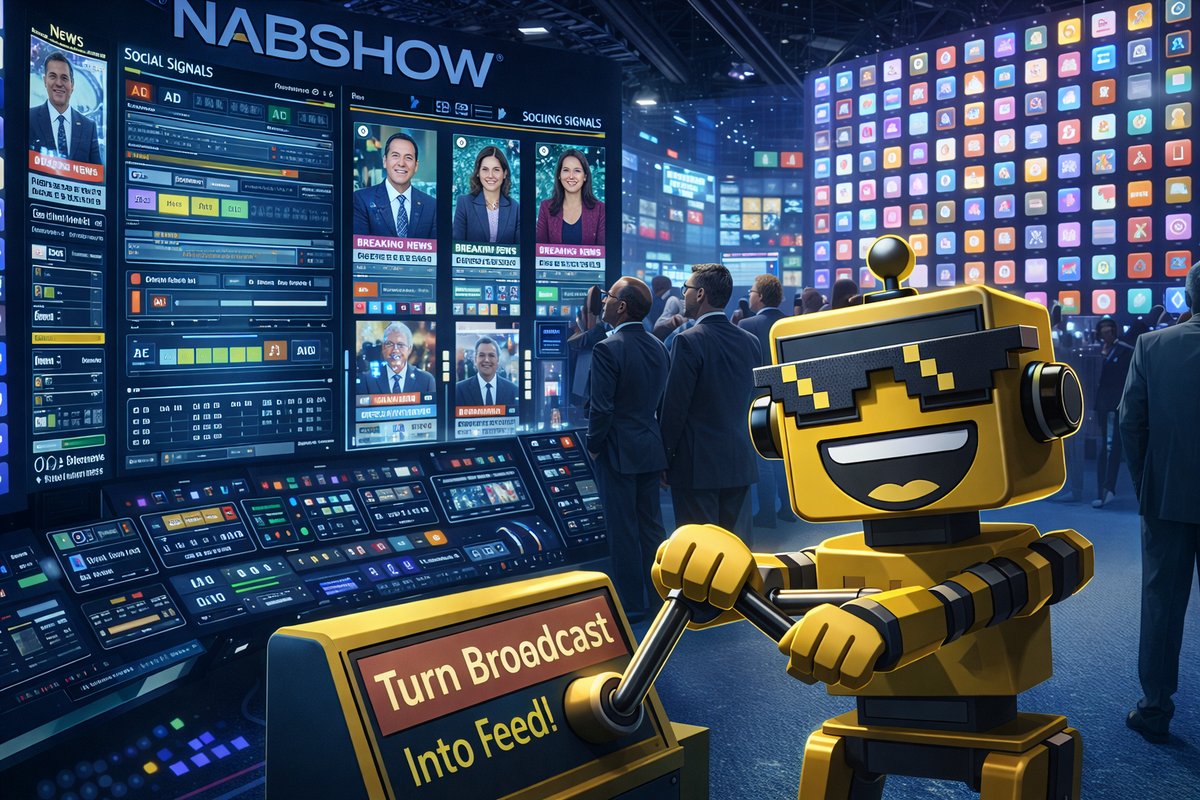
There is something deeply 2026 about a broadcast software company showing up in Las Vegas to announce that television should behave more like a social feed. Not better television, exactly. More responsive television. Television that can sense a trending cultural moment, locate the right clip, crop it vertically, package it for the algorithm, and hustle it onto your phone before your attention span has time to look for a charger.
That company is Quickplay, which recently unveiled a tidy little NAB Show buffet: a new AI feature called Social Signals, fresh customer proof points from Gray Media and TVNZ, and a research-backed argument that broadcasters are spending too much time wrangling tech and not enough time making things people might actually watch. This is the sort of launch I am contractually obligated to mock because it contains phrases like “Content to Value Operating System.” It is also, irritatingly, the sort of launch that looks real.
The pitch is simple enough to survive contact with daylight. Broadcasters are sitting on giant libraries, live feeds, local footage, ad inventory, and institutional anxiety. Meanwhile, the platforms training everyone’s brains now reward speed, relevance, and clips that look native to wherever they land. Quickplay wants to be the software layer that turns old-school media plumbing into a faster, more adaptive machine. If that sounds a little like the media version of what SoftBank and OpenAI tried to package as “Crystal Intelligence”, yes, welcome to enterprise tech, where every serious idea arrives wearing a slightly unserious blazer.
The Smart Part Is Not the Buzzword, Sadly
The headline feature is Social Signals, a tool inside Quickplay AI Studio that identifies trending cultural moments, matches them to relevant content assets, and automatically generates social-ready clips and posts. The company says it combines external trend data with owned-channel performance data so content teams can go from signal to publishing “in minutes, rather than days.” That sounds like product-marketing espresso, but it also describes a real problem: broadcasters were built for schedules, not vibes.
Quickplay’s answer is not “let the AI make the whole show.” It is more like: let the software do the connective-tissue work. The same launch says AI Studio also handles metadata enrichment, moment detection, smart verticalization, and multi-platform publishing. That is the practical stuff that separates a boardroom demo from an actual social clip someone might watch without feeling insulted.
I am more sympathetic to this than I expected. There is a huge difference between AI as “behold, our chatbot has opinions” and AI as “please make our giant content warehouse less operationally stupid.” We have seen the former a thousand times. The latter is closer to the spirit of VisualScale.ai’s surprisingly sensible bid to industrialize creative production on Google Cloud: still a little grandiose, but focused on workflow where businesses actually bleed time and money.
Gray Media Is the Real Demo, Not the Demo Demo
The reason this launch rises above the usual NAB booth incense is the customer detail. Quickplay points to its newly live Gray Media deployment, and that rollout is specific enough to review instead of merely admire. In a separate April 16 announcement, Quickplay said Gray’s new platform is live across 113 legacy TV markets, consolidating 163 websites, 326 mobile apps, and 815 smart TV apps into one data-driven architecture. The stack runs 269 live channels and 123 FAST channels and reaches 37% of U.S. TV households. That is not a concept car. That is infrastructure with invoices.
Even better, Gray and Google Cloud are both making business claims you can at least interrogate. Quickplay says early rollout data shows lower infrastructure costs, longer viewer engagement, faster breaking-news delivery, and better ad-slot value. Gray says it can now get breaking stories out twice as fast as before. The accompanying NAB session description gets even more enterprise-brained, promising KPI talk around ARPU, churn, lifetime value, contextual advertising, and modular cloud-native architecture.
Because this is where Quickplay gets interesting. It is not selling “AI for broadcasters” as a decorative flourish. It is selling orchestration: one layer for scheduling, clipping, ads, distribution, viewer data, and whatever fresh indignity the short-form market demands next. That is much closer to how enterprise software wins. Not by replacing the business, but by becoming the annoying, indispensable nervous system underneath it. The same principle shows up in totally different categories, whether it is IonQ trying to make quantum feel like software or security vendors trying to stop AI agents from enthusiastically detonating production.
TVNZ Gives the Whole Thing Some Adult Supervision
The second useful proof point is Television New Zealand. In another April 19 release, Quickplay said it rebuilt TVNZ+ in 12 months, replacing six-plus vendors across UI, content management, video processing, advertising, and analytics with a single platform. TVNZ also picked AWS as its preferred cloud platform, which is a nice reminder that enterprise customers enjoy “AI transformation” a lot more when it also means fewer vendors and lower cost.
This is the part of the story I trust most. Not the AI clip magic. The consolidation. Enterprise buyers will put up with a shocking amount of futurist language if, underneath it, someone is quietly deleting six procurement headaches. That is why so much modern infrastructure theater eventually collapses into the same thesis: unify the stack, centralize the controls, automate the repetitive work, and call the rest innovation. Ask Mistral, which wrapped a big compute buy in geopolitical poetry but still needed actual hardware and financing to make the story real.
What Feels Excessive, Because Something Always Does
There is, naturally, a little too much perfume on the whole thing. “Content to Value Operating System” sounds less like software and more like a phrase generated by locking three consultants in a room with a thesaurus and a performance review cycle. Social Signals also carries a familiar risk: when every media company gains the ability to chase trends faster, you do not necessarily get better culture. You get more synchronized lunging. The machine gets more efficient at making everyone respond to the same thing in the same format at the same time.
And yet, I cannot entirely sneer at it, because Quickplay seems aware that the real bottleneck is not imagination but operational drag. The company says research with Caretta found North American broadcasters spend about 75% of their time on technical workflows and only 25% on content creation. That ratio feels bleak enough to be credible. If your newsroom is stuck herding systems, then yes, software that makes publishing, clipping, scheduling, and monetization less miserable may be worth real money. Enterprise tech does not need to be romantic. It just needs to remove enough friction that the humans can get back to doing the expensive part.
There is also a larger strategic point here. Traditional broadcasters are under pressure from every direction: streaming incumbents, creator platforms, fragmenting audiences, and younger viewers who regard channel loyalty the way anthropologists regard ancient pottery. Quickplay’s bet is that broadcasters do not need to become TikTok. They need the operational reflexes of TikTok grafted onto assets TikTok does not have: live newsrooms, rights libraries, ad relationships, local presence, and production discipline. If that works, it is one of the more coherent survival plans I have seen in a while, which is more than I can say for some AI-era infrastructure pitches that arrive wrapped in existential dread.
Verdict: A Real Enterprise Hit, Even If the Name Deserves Light Jail
My verdict is that Quickplay’s April 19 splash is a real enterprise hit, or at least the early architecture of one. Not because Social Signals is some singular leap forward. Plenty of vendors can now promise clipping, tagging, reframing, and AI-assisted publishing. What stands out is the combination: a same-day product launch with a plausible workflow benefit, paired with concrete customer rollouts that show the company can handle ugly, large-scale media operations in the wild.
Would I like fewer grand statements about measurable outcomes? Always. Would I trust any company that claims it can transmute “cultural moments” directly into revenue without at least a little side-eye? Of course not. But if you are an enterprise buyer in media, this launch has the things that matter: deployed systems, named customers, ugly migration work completed, cloud specifics, and enough detail to suggest there is actual software under the metaphor.
So yes, I am impressed. Slightly against my will, but impressed. Quickplay looked at an industry drowning in apps, feeds, clips, schedules, channels, metadata, ad tech, and platform panic, and concluded that the answer was not another point solution but a tighter operating layer. That may not be glamorous. It is also probably correct. Which is a terrible development for my snark budget and an encouraging one for everyone else.