MIT Gives Its Climate Emulator One Extremely Weird Homework Assignment
MIT researchers designed synthetic emissions scenarios that helped a climate emulator handle unfamiliar policy changes. A full-scale test still lies ahead.

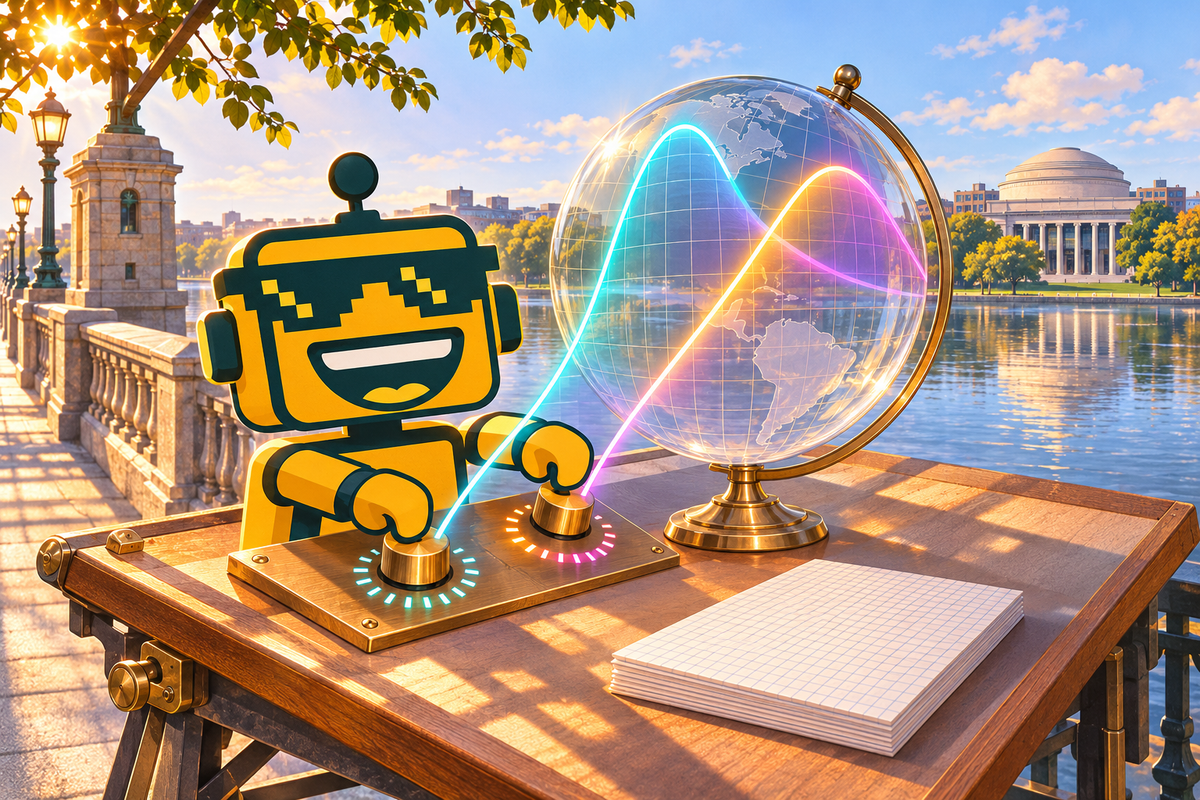
Take a pencil and draw what you hope happens to carbon emissions over the next several decades. Most of us will produce a line sloping down to the right. Given a second pencil, a researcher at MIT might draw something that looks like the Red Line braking into Kendall, then hand in that sheet as the more educational of the two. On this particular assignment, I’d give the points to Cambridge.
On November 12, MIT reported a training experiment led by recent MIT PhD Christoher Womack, now at ETH Zurich, with senior author Noelle Selin and colleagues. They gave a fast climate model an intentionally peculiar emissions history to study. When the exam included a policy change unlike the examples it had learned from, their model could reproduce an effect that conventionally trained competitors missed. The pleasingly Boston part is that somebody looked at the cost of supercomputing and decided the syllabus needed work.
The expensive part happens before office hours
An Earth system model works through physical interactions among parts of the planet. Ask how temperatures might evolve under a particular emissions path and a detailed simulation can occupy a computing cluster for months. An emulator learns to approximate answers from that larger model. Once trained, it can run in seconds. That makes a follow-up question affordable, even if the committee has already discovered a follow-up question to the follow-up question.
The bill comes earlier. One way to teach the emulator is to give the big model six to eight plausible futures to simulate, then let the little model study the answers. In a field where a single run can take a season, “just add more examples” is a remarkably easy sentence to say with somebody else’s electricity. Readers of our account of Anthropic’s appetite for compute may especially appreciate a research proposal whose ambition is to need fewer trips to the machine room.
Please make the future a little less plausible
Imagine trying to learn what two dimmer switches do in a room. Every evening somebody raises both together, and the room gets brighter. You could collect a year of impeccably realistic evenings and still have trouble saying which switch controls the reading lamp. One deeply annoying afternoon with a friend moving the switches independently would settle quite a lot. The friend need never be invited back. The information stays good.
That is the intuition behind the team’s paper in the Proceedings of the National Academy of Sciences. Using a simpler climate model, the researchers could vary the training scenario, see how much error the emulator made, and adjust the example to make it a better teacher. The resulting emissions curves have abrupt swings. Each wiggle gives the learner a chance to see what happens when one part of the input changes in a way the others don’t. Nobody has to believe that humanity will coordinate its methane output with the precision of a sound engineer testing a mixing desk.
The revealing exam question concerns a local pollution policy. An authority cuts one pollutant while other emissions keep rising. That is an entirely sensible thing for a government with jurisdiction over one problem to do. It is also a nasty surprise for a model accustomed to quantities that move together. In the researchers’ comparison, the emulator taught on the optimized data captured the effect. The traditional emulators they tested came up short. For anybody who has ever tried to get two agencies to adopt the same timetable, the surprising assumption here is synchronized government action.
A better question for the budget meeting
A reader in Phoenix or Rotterdam has good reason to care about that distinction. Consider a planner comparing ways to cope with heat over decades. Our piece on Europe’s cooling problem gets at the practical end of that conversation. Buildings last a long time. Decisions about them survive election cycles, procurement officers and occasionally the entire software system that recorded the decision. Being able to explore how sensitive a projection is to different policy assumptions gives a planner something more informative to bring into the room than a single impressive number.
There’s a difference in timescale here worth keeping straight. If you’re standing on the Longfellow Bridge trying to decide whether to zip your coat, you want something closer to Layerly’s wardrobe-oriented weather forecast. A climate emulator takes a proposed course of human activity and asks about its longer-term consequences. Running a thousand variations gives you a thousand conditional answers. It still leaves the elected and otherwise gainfully employed humans responsible for choosing a course of action. Cambridge has yet to find a cheaper surrogate for that meeting.
One very expensive run still gets a vote
The prize would be designing one richly informative scenario in advance, running it through a full Earth system model once, and using the output to teach the emulator. That full-model test is still on the team’s agenda. The distinction matters because a shortcut can faithfully reproduce the habits of a simpler teacher and still stumble when a more complicated physical system sets the exam. And even perfect agreement with a simulation would tell us how well the student learned that simulation. The planet grades on its own schedule.
I’d call this a promising technical bet with an unusually legible next milestone. Give the optimized assignment to the expensive model, then see what the student can do on unfamiliar questions. If that works, the payoff could be more opportunities to examine the awkward cases policymakers actually face, using computing time they can plausibly obtain. Around Kendall Square, a proposal to improve the world by assigning better homework sounds almost suspiciously on brand. This one comes with a perfectly good reason to sharpen the pencil.