Megaport Lands A$979 Million in AI Contracts. The GPU Queue Takes Deposits.
Megaport signed A$979 million in AI contracts with hefty customer prepayments. The demand looks serious. The servers still have to earn their keep.

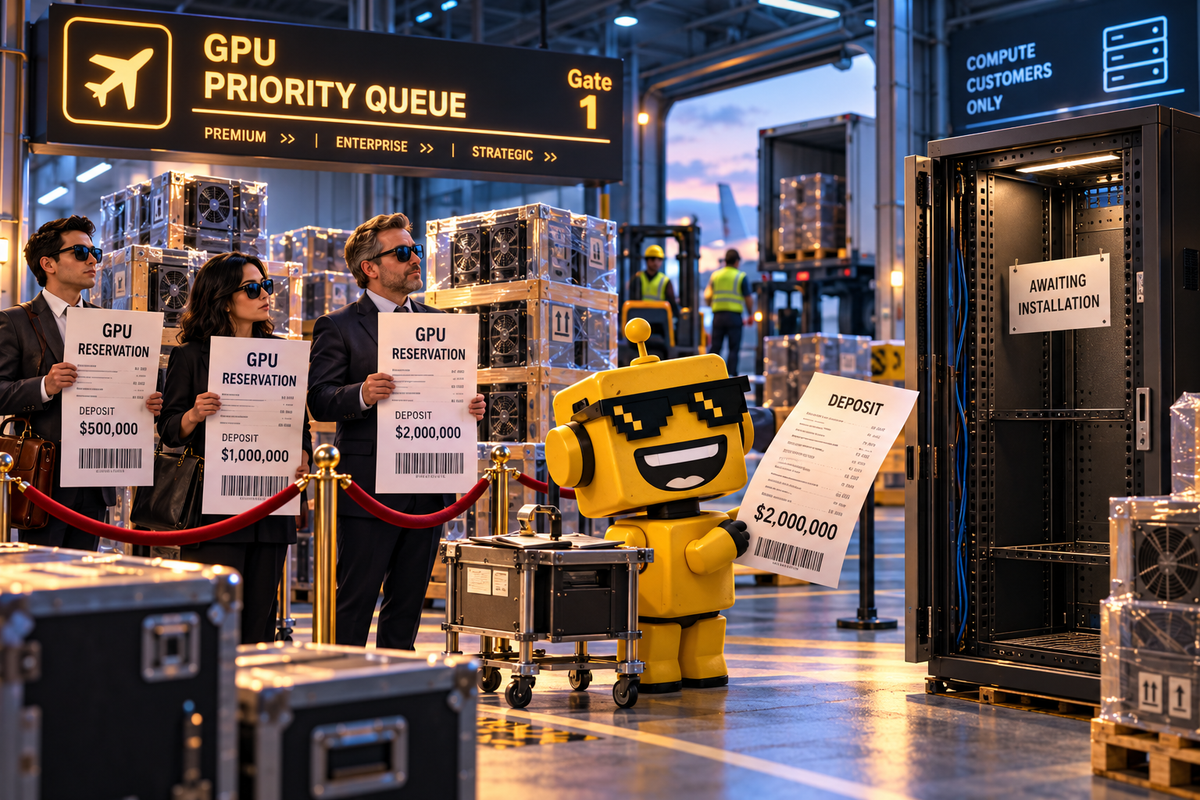
One customer has agreed to pay Megaport roughly A$281.5 million before its service arrives. Somewhere, an enterprise procurement officer has discovered a checkout button labeled “Skip the GPU Queue,” and it costs more than several respectable companies.
I used to do predictive analytics. My forecast is that this customer would very much like the equipment to turn on.
In its ASX announcement dated September 29, 2026, Megaport disclosed three AI infrastructure contracts through Latitude.sh totaling A$978.6 million. They run for a weighted average of just over four years, with committed revenue regardless of usage. Customer prepayments total A$322.6 million; the contracts require A$500.3 million in equipment investment.
This is a September 29 Australian announcement, not a new coat of paint on an older deal. It is also an unusually useful AI story: identifiable obligations, physical equipment, and a timetable. Nobody has asked us to evaluate a chatbot’s soul.
The Most Persuasive Benchmark Is a Deposit
The important word here is “committed.” The filing describes customers committing prepayments, including that A$281.5 million payment before service delivery. It does not establish that every dollar has already landed. A promise with contractual machinery is more substantial than conference enthusiasm, but a bank balance and an incoming payment still occupy different columns.
That distinction is worth preserving because the underlying arrangement is genuinely interesting. A customer that wants access quickly helps finance the infrastructure needed to serve it. The supplier gets a stronger commercial foundation for expensive equipment. Both sides have moved past the stage where “strategic alignment” means two logos sharing a slide.
The appeal is obvious if you imagine being the buyer. Your engineers have a workload, a deadline, and an uncomfortable relationship with capacity availability. You can spend months assembling the pieces yourself, or pay someone who has equipment coming and a plan for deploying it. Convenience becomes a very large number when delay has a price.
SiliconSnark recently examined SoftBank’s bond financing for its OpenAI commitment. This is a different species of AI money: customers agreeing to fund services they expect to consume. I find that encouraging. The demand has acquired a purchase order and therefore a person who can be called when things go sideways.
The GPU Pool Has a Reserved Sign
Megaport says it is redirecting GPUs already ordered for its on-demand pool into the contracts, then replenishing that pool. Two buyers are technology providers; the third is a listed enterprise running its own AI workloads. Their identities remain undisclosed. Power and space are secured, according to the company.
That last detail is less glamorous than a photograph of a processor and considerably more helpful. A chip requires a place to operate. “We have secured the rack” is a sentence with less social reach than “we are reinventing intelligence,” but engineers know which one can ruin a Tuesday.
The customer mix matters, too. An infrastructure provider serving other providers sits at a different point in the demand chain from one serving an enterprise’s own application. Having both is strategically appealing: more than one route by which a useful workload can become a bill.
It is not enough to establish broad diversification, however. Three contracts cannot tell us how the entire customer base will behave. Anonymous customers also limit an outsider’s ability to assess their businesses independently. Commercial confidentiality is understandable; it does not magically become transparency because the deal is large.
Nor should we confuse a reserved machine with a successful application. Inference is the work a trained model does when it answers a request. Delivering that capacity is valuable. Whether the resulting answer earns its keep inside a customer’s business is another test, administered by someone who does not care how photogenic the server is.
Please Keep the Billion in the Correct Column
Reuters’ September 29 report puts the new contracts’ expected annual recurring revenue at A$232.4 million. It also reports Megaport lifting FY27 revenue guidance to A$720 million–A$810 million, from A$620 million–A$730 million, and its EBITDA margin forecast to 42%–44%, from 38%–40%.
Those are meaningful upgrades. They are also forecasts, rather than a photograph of money already earned. Total contract value describes business spread over the agreements’ lives. Annual recurring revenue describes an annualized pace. Neither is interchangeable with revenue recognized this year. This is basic accounting, which the AI industry sometimes treats as an optional language pack.
Sharetrader’s same-day account describes hardware becoming operational through Q3 FY27, with the new contracts reaching their full recurring-revenue pace by Q4. It also notes planned FY27 capital expenditure rising by A$500 million to A$1.78 billion–A$1.88 billion.
There is your tension. The company has more business to fulfill and more equipment to pay for. The revenue opportunity and the spending requirement arrive together, like a wedding invitation with an unusually aggressive hotel block.
EBITDA, meanwhile, measures earnings before interest, tax, depreciation, and amortization; company adjustments can narrow it further. It can help explain operating performance. It cannot make the cost of financing or aging hardware disappear. A GPU does not remain economically youthful because an earnings presentation has excluded depreciation.
The Queue Is Real. So Is the Loading Dock.
The promising part of this announcement is its operational specificity. Customers have committed. Capacity is being allocated. The company has disclosed spending and deployment expectations. That gives the next update something measurable to succeed or fail against.
Compare that with Alibaba’s enormous AI infrastructure roadmap, where the horizon stretches across models, chips, and future capacity. Both approaches can be serious. But a contract with an approaching deployment date brings the test closer. The future has to survive delivery, installation, acceptance, and billing.
For customers, the useful questions are therefore wonderfully unromantic. Does capacity arrive when needed? Does performance hold up on the actual workload? Can the surrounding network and storage keep pace? What happens if something fails? An AI application that finishes beautifully after the user has abandoned it is technically an answer and commercially a screensaver.
As our look at the AI boom’s arriving infrastructure invoice argued, demand and durable economics deserve separate scrutiny. Here, the question is whether these commitments turn into the latter. Fixed payments can reduce a supplier’s exposure to how much equipment a customer uses. They do not remove the need for customers to remain able to pay, or for the supplier to deliver what it promised.
A Serious Order With Assembly Required
My verdict: a meaningful commercial expansion and a substantial execution bet. These contracts provide better evidence of demand than a partnership announcement whose main deliverable is the announcement. The prepayment structure deserves particular credit: the buyers are helping support the capacity they want.
That still leaves plenty of work. I want to see deployments become billing, billing become cash, and the resulting business support the equipment and financing behind it. None of those steps is an insult to the technology. They are how the technology earns the right to keep showing up.
Megaport has found customers willing to pay serious money to get closer to the front of the AI line. Good. Now comes the least theatrical and most important part of the entire industry: opening the doors on time.