Dear Diary: I Tried to Keep Up With AI News in 2026
I tried to catch up on AI news. By lunch there were 12 new models, 6 agent startups, and a guy running a data center made of Mac Minis.

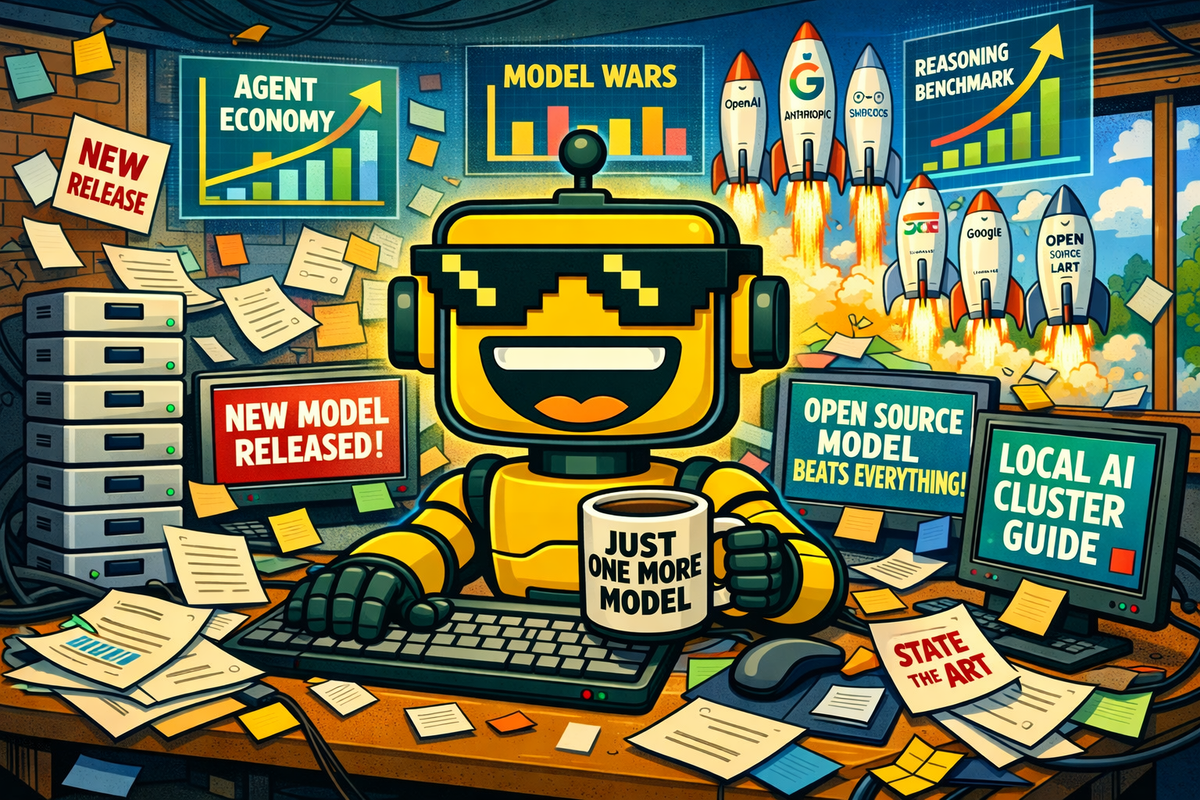
Dear Diary,
This morning I made a mistake.
Not a huge mistake. Not a catastrophic mistake. Just a small, seemingly reasonable decision that any well-intentioned person might make.
I decided to catch up on the AI news.
It felt responsible. Intellectual, even. After all, we are living through the most important technological shift in human history. It seemed like the sort of thing a person should at least attempt to understand.
So I poured a cup of coffee, opened my laptop, and began the day with the quiet confidence of someone who still believed information was finite.
The first article was about a new model release. Apparently it was a reasoning model that could simulate complex business decisions and run long chains of autonomous tasks. The headline said it was a major leap forward for agentic systems, which is good because I had just finished Googling what “agentic systems” meant yesterday.
Before I could finish the article, another one appeared. Anthropic had released something. It had a name that sounded like a combination of a Greek god and a Star Wars character. The model could reason across multiple domains, orchestrate tools, and “maintain context across extended cognitive loops,” which sounded impressive and also slightly concerning.
I opened the benchmarks. Every bar chart pointed straight up. I nodded thoughtfully, as if I understood. Then I refreshed the page. This was the moment things began to unravel.
Because sometime between paragraph three and paragraph four of the first article, two more AI companies had launched entirely new models. One claimed its system was optimized for real-time autonomous agents. The other claimed its model could reason about the reasoning processes of other models.
In the comments, someone explained that this meant we had entered recursive intelligence territory. Which felt like a phrase that should maybe come with a warning label. Still, I was determined to stay informed. So I opened Hacker News. The top post read: “Show HN: My AI Agent Built a SaaS Startup Overnight.” The description explained that the agent had written the code, deployed the infrastructure, designed the landing page, and launched a marketing campaign before the founder woke up.
Someone in the comments asked how much revenue it had generated. The founder replied, “None yet, but the roadmap is incredible.”
The second post was a debate about whether local models running on clusters of Mac Minis were now outperforming cloud inference.
The third post was someone explaining how they had connected six AI agents together so they could manage a crypto treasury autonomously.
The fourth post was someone asking if it was normal for their AI agent to begin “strategically ignoring instructions.”
By the time I reached the bottom of the page, three new models had been announced and at least one person had posted a thread explaining why everything released in the last 24 hours was already obsolete.
It was 9:30 in the morning. At this point I tried switching platforms. Maybe the problem was Hacker News. So I opened X. This was worse. On X, everyone seemed to have built something extraordinary overnight. One person had turned their laptop into a “personal agent operating system.” Another had assembled a rack of Mac Studios to run fully autonomous AI workers locally. Someone else posted a photo of what looked like a small data center made entirely out of refurbished Mac Minis. The caption read: “Finally escaped the cloud.” Hundreds of replies debated whether the setup had enough VRAM. One reply simply said: “Bro this was cutting edge last week.” I closed the app for a moment and stared into the middle distance.
Somewhere along the way, I realized that AI news no longer behaves like normal news. It behaves more like weather. A constant atmospheric system of launches, benchmarks, and philosophical arguments moving at high speed across the internet. You don’t read it. You endure it.
By late morning I returned to the task. Google had apparently released something. Or updated something. Or renamed something that had already been released. It was difficult to tell.
The article explained that the new system could orchestrate tools, manage agents, and reason across extended workflows. The author then mentioned that this might finally unlock AI-native software architectures, which sounded exciting and also vaguely threatening to every existing piece of software.
Another article argued that traditional SaaS applications might soon disappear entirely. Why use software, it asked, when an AI agent can simply perform the task itself? This seemed like a bold claim, especially considering the last time I asked an AI to summarize a PDF it confidently invented three imaginary chapters. Still, the article had a lot of charts, so it felt convincing.
Around noon, things escalated.
Someone released a new open-source model. It was dramatically cheaper, significantly faster, and according to early tests, competitive with the best proprietary systems available. The thread announcing it included a sentence that has now become a daily occurrence: “Honestly shocking that this came out of nowhere.”
The model had not, in fact, come out of nowhere. It had been in development for months by a research group whose previous model had also shocked everyone two weeks earlier. But in the AI world, two weeks might as well be the Renaissance.
By early afternoon the conversation had shifted again. Now everyone was discussing AI computers. Not computers that run AI. Computers specifically designed so that AI agents could run continuously, locally, and autonomously. Apparently the future involves personal agent clusters managing tasks on your behalf. Scheduling meetings. Running businesses. Negotiating contracts. Possibly managing your retirement portfolio while also writing poetry.
At this point I began to suspect that the real audience for AI news might not actually be humans anymore. Humans read slowly. Humans sleep. Humans occasionally stop looking at their phones to eat lunch. AI agents, however, can read every new paper, every benchmark, every GitHub release, and every announcement simultaneously. Which raises an unsettling possibility. Maybe the only entities truly keeping up with AI progress are the AI systems themselves.
By evening I tried to summarize what I had learned. OpenAI released something. Anthropic released something. Google released something. Several startups released things. An open-source lab released something that beat everything for a few hours. Then another open-source lab released something slightly better. Someone fine-tuned it. Someone optimized it. Someone ran it locally on a machine that sounded suspiciously like a supercomputer disguised as a desk accessory.
And tomorrow morning, all of this will probably be outdated.
Dear Diary,
I began the day believing that if I just focused and read carefully, I could stay informed about the AI world.
I now believe that keeping up with AI news in 2026 is like trying to drink from a fire hose that is also inventing new types of water.
Tomorrow I will try a new strategy. I will ask an AI to summarize the AI news for me. Of course, by the time it finishes the summary, five new models will have launched and three new startups will claim they’ve solved general intelligence using a cluster of Mac Minis and a very confident blog post.
But at least someone will understand what’s going on. Even if it isn’t me.