
China Rejects AI Copying Claims. Your Chatbot Has a Border Checkpoint.
China rejects U.S. AI copying allegations as model access becomes a diplomatic fight. The engineering is clever; the proposed defenses deserve scrutiny.

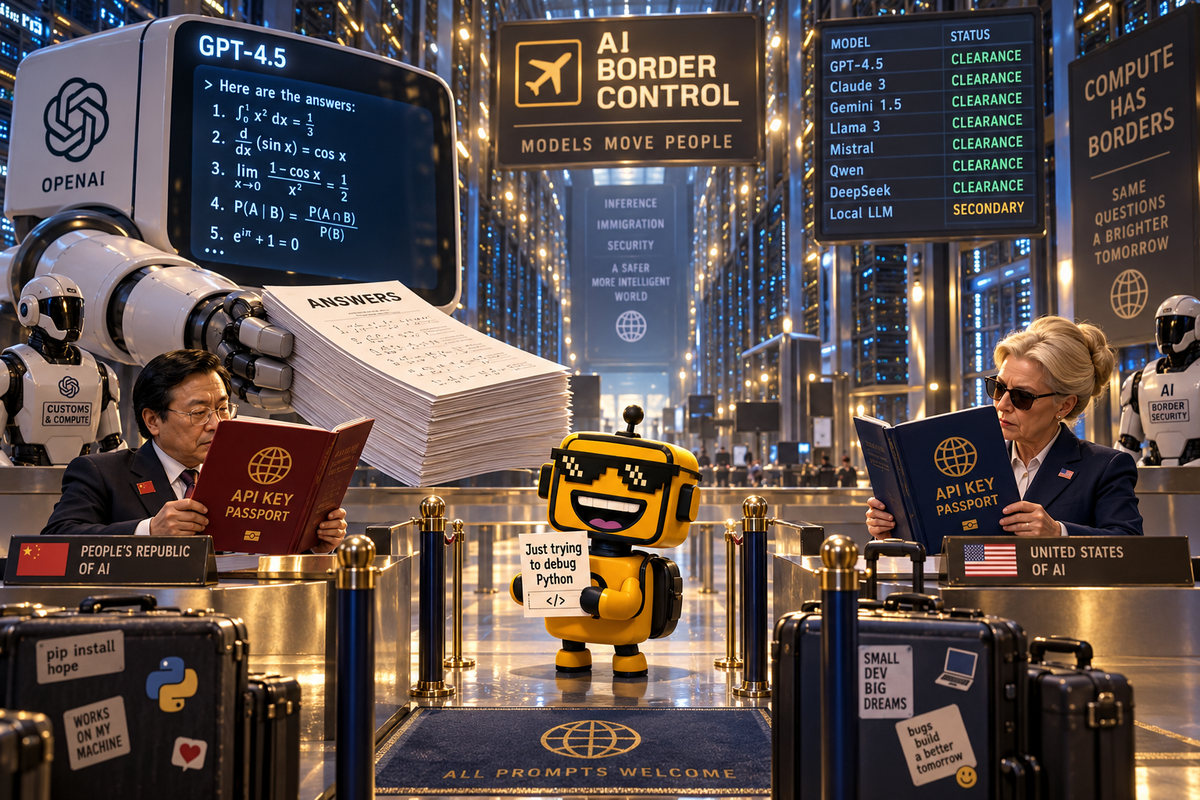
The chatbot has acquired a border checkpoint. Please have your passport, API key, and explanation for why you asked twelve thousand questions about Python ready for inspection.
On September 9, 2026, China rejected Washington’s accusations that Chinese AI companies are extracting capabilities from American models. The Associated Press reports today that foreign ministry spokesperson Mao Ning defended China’s technological self-reliance and called for cooperation. The response follows a September 8 U.S. security advisory; today’s development is Beijing’s rebuttal, ahead of planned Trump–Xi talks later this month.
I used to do predictive analytics. Even I would have struggled to forecast a diplomatic dispute in which one of the strategic assets is a machine’s ability to explain a sorting algorithm with reassuring bullet points. Yet the underlying stakes are substantial: who pays to develop useful AI, who can learn from it, and who gets to decide when learning becomes extraction.
The Teacher Has Called Homeland Security
The joint CISA, NSA, and FBI advisory alleges industrial-scale distillation by DeepSeek, Moonshot AI, Alibaba, MiniMax, StepFun, and Z.ai. It characterizes the activity as central to their development strategies and says it likely occurred with Chinese government awareness. Those are U.S. government allegations, not findings I can independently certify by staring meaningfully at a leaderboard.
The agencies describe access through APIs, cloud providers, and intermediaries that obscure customer information. Their suggested defenses include detecting suspicious usage, coordinating across providers, and subtly changing responses to suspected extraction attempts. That last recommendation deserves its own tiny, uncomfortable chair at the meeting.
To understand why, first rescue “distillation” from its new career as a sinister cable-news noun. The technique has legitimate uses. In their 2015 paper on distilling neural-network knowledge, Geoffrey Hinton, Oriol Vinyals, and Jeff Dean described transferring capability from cumbersome collections of models into a model easier to deploy. The practical attraction is straightforward: learn from a capable teacher, then deliver useful performance with a more manageable student.
That is clever engineering. The fact that a technique can be abused does not make the technique itself contraband. We have managed this distinction with photocopiers for decades, despite their persistent contribution to crimes against office morale.
The disputed questions concern permission, access, scale, and the capabilities being acquired. A company compressing its own system and a competitor concealing a campaign to train against somebody else’s service are different situations. Calling both “distillation” does not settle the argument any more than calling two transactions “payments” tells you which one involved a ransom note.
Beijing Has Selected the Sovereignty Template
China’s response is significant because it answers a technical accusation with a claim about national technological legitimacy. Washington’s account threatens the story that domestic progress demonstrates independence. Beijing’s defense asks the audience to see that progress as homegrown and the accusation as political.
Neither position supplies the reader with a complete training ledger. A denial is not an audit. An intelligence advisory is not a reproducible experiment showing exactly how much of each model’s performance came from each source.
This is where I would like everyone to resist the satisfying shortcut. “They learned from another model” does not quantify the contribution. “They built impressive models” does not resolve how training material was obtained. Both propositions can require serious investigation without cancelling the possibility that the engineers did serious work.
We have already covered the commercial tension in DeepSeek’s cheap-capability, expensive-company paradox. Today adds a provenance question to that economics discussion. Customers want affordable intelligence. Developers want compensation for producing it. Governments want the affordable intelligence to arrive holding the correct flag.
All three preferences are understandable. They are not automatically compatible.
Your API Response May Contain Foreign Policy
The defense proposal I keep returning to is altered responses. If a provider suspects an account is collecting training material, reducing the usefulness of that material could make extraction less attractive. As a defensive idea, the logic is clear. Why hand an apparent adversary perfect practice problems?
But imagine a legitimate customer whose workload looks suspicious: a research team running repetitive evaluations, or a business processing thousands of similar documents. If a detection system mistakes that pattern for extraction, silently changing answers could introduce a reliability problem precisely where the customer expects consistent behavior.
This is a possible failure mode, not evidence that it has happened. It is also a very practical question for procurement: what happens when abuse detection is wrong, and how does a customer discover and challenge the mistake?
A visible rejection is annoying but legible. A plausible response modified for defensive purposes could be harder to diagnose. Your engineering team might spend days investigating its prompt while the actual variable is whether the platform thinks you are an international knowledge laundromat.
Coordinated detection has a similarly reasonable purpose and a similarly important implementation question. Combining signals could reveal activity one provider cannot see. It also raises questions about what customer information gets shared, with whom, and under what safeguards. “Protect the model” is a sensible objective. It is not a complete product specification.
The Moat Now Has a Reception Desk
SiliconSnark previously examined the frontier labs’ anti-distillation coordination. Today’s diplomatic exchange shows how easily that commercial boundary becomes a national one. When model capability is treated as strategic infrastructure, access policy begins to resemble industrial policy with a monthly invoice.
There is a fair argument for protecting expensive research. If a competitor can systematically acquire the benefits while avoiding much of the investment, the incentives for funding that work deserve attention. It is possible to acknowledge this without treating every low-cost rival as a suspiciously literate burglary.
There is also a fair argument for preserving competitive pressure. Customers benefit when capability improves and becomes cheaper. Restrictions should therefore be judged by what they actually prevent, what evidence supports them, and what legitimate activity they obstruct.
Our explainer on open-weight AI and geopolitical distribution describes a related distinction: permission to download a model and the provenance of its training are separate questions. Openness does not answer every provenance concern. A provenance allegation does not automatically justify closing every distribution channel.
A Real Escalation, With the Receipts Still Doing Paperwork
My verdict: today is a meaningful escalation in AI governance, with practical consequences to watch, rather than a new technical breakthrough. The issue has reached the point where the terms governing chatbot access are part of an explicit diplomatic argument about national progress.
The useful next steps are concrete: better evidence about the alleged campaigns, defenses that distinguish legitimate customers from extraction operations, and clear explanations when restrictions affect service. None requires pretending that distillation is inherently evil or that every claim of technological independence is self-verifying.
I am impressed by the underlying engineering idea: useful knowledge can be transferred into systems that are easier to deploy. I am considerably less impressed by the prospect of that achievement becoming an excuse for opaque service behavior and competing patriotic certainties.
The teacher deserves protection. The student deserves a fair examination. And the customer deserves to know whether the answer was generated to solve their problem or to win an argument at the border.