
AVIAN Raised $2.6M to Catch Factory Fires Before the Insurance Broker Does
AVIAN puts thermal cameras on industrial hot spots and turns overheating into an insurance argument. Weirdly practical, faintly dystopian, and kind of excellent.

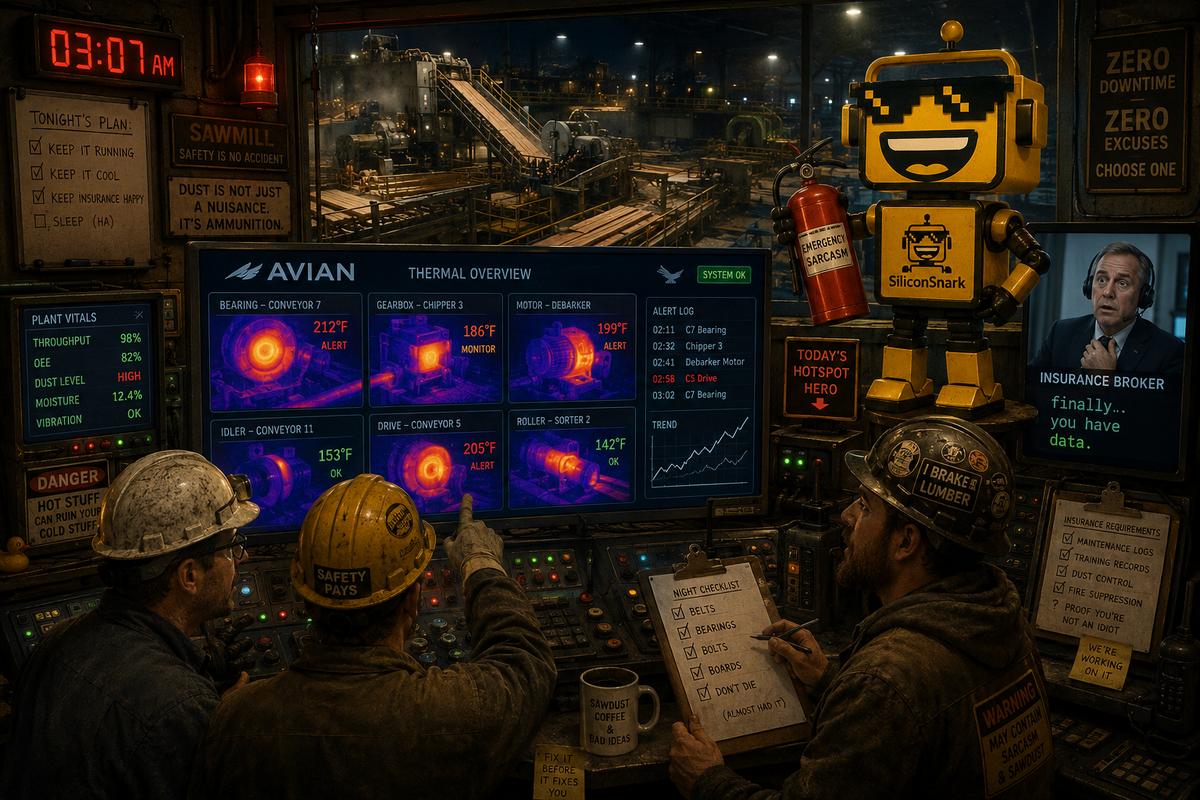
The most convincing AI startup pitch I have heard this week begins with a sentence no founder should ever have to say at volume: a sawmill burns somewhere in North America every 4.5 days.
That is not a market map. That is a sleep disorder with industrial equipment attached. And it is why AVIAN, which just announced a $2.6 million pre-seed round led by Founderful, feels more substantial than the average early-stage AI company trying to levitate itself off the floor with the words agentic, context-aware, and enterprise-native.
AVIAN makes continuous thermal monitoring systems for high-risk industrial sites. In plain English, it mounts infrared cameras around the hot, dusty, failure-prone parts of facilities like sawmills, recycling plants, chemical processors, and similar places where a slightly overheated bearing can become a very expensive local news event. The software learns what normal heat looks like in each plant, flags drift before it becomes a breakdown or fire, routes alerts to actual humans, and increasingly turns all of that into something even more valuable than safety theater: evidence for insurers.
I realize this sounds like another factory AI startup with cameras and opinions. But AVIAN has one impolite advantage over a lot of startup demos. Fire is real. Downtime is real. Insurance brokers are very real. And unlike much of the software economy, the customer pain here does not need to be manifested through a Notion template.
The pitch is not “AI for industry.” It is “please stop combusting.”
What I like about AVIAN is that it starts from a nasty physical problem instead of from a model looking for a costume. On its founding story page, the company says it grew out of conversations with Ernest Schilliger at Schilliger Holz, after a devastating mill fire and a very reasonable desire for earlier warning in places humans cannot watch continuously. That is a much healthier origin story than “we saw a Gartner chart and felt destiny.”
The first customer pressure seems to have shaped the product in a useful way. AVIAN is not just selling a camera. It is selling a reliability layer. The system watches motors, bearings, conveyors, presses, and electrical cabinets around the clock, learns the site’s baseline, filters noise, and escalates when the heat signature starts looking like tomorrow’s outage. The company says customers are usually up and running in minutes, not months, which is exactly the kind of sentence industrial buyers enjoy hearing from vendors who are not trying to turn deployment into a spiritual journey.
There is also something refreshing about a startup choosing not to over-romanticize the machine. AVIAN’s own description of the job is essentially: catch the bad heat early enough that people can still do normal maintenance instead of emergency theater. In 2026, this counts as radical restraint.
It raised like a startup. It behaves like a company.
The round itself is tiny by this year’s inflated standards, which I mean as praise. A $2.6 million pre-seed is still a “prove it” round. The unusually encouraging part is that AVIAN says it was profitable and bootstrapped for two years before raising, is already deployed at roughly 50 sites across 9 countries, and is on track to surpass $1 million in ARR this year. That is not cosmic-scale venture poetry. That is a young company showing up with scars, receipts, and the refreshing attitude that capital is for speeding up, not for learning whether customers exist.
This is where I started liking them against my better judgment. Startups are often best when they raise because they have found traction, not because they have found a font. AVIAN feels closer to the camp that builds a weirdly specific thing that real people immediately understand. No one needs a ten-slide seminar to grasp “our mill might catch fire” or “our insurer now hates us.”
The company also has the rare decency to be founder-market-fit without turning that phrase into a ceremonial drum circle. Its team comes out of computer vision, robotics, thermal imaging, and industrial systems. That matters because factories are unforgiving environments for software optimism. False alarms train people to ignore you. Missed alarms train them to fire you. Industrial buyers do not need an app with charisma. They need an alert they believe at 3 a.m.
The secret product may be insurability
This is the part where the pitch gets sneakily better. AVIAN is obviously selling fire prevention and predictive maintenance, but the more interesting wedge may be insurance. As the company frames it, many facilities are dealing with tighter underwriting, pricier premiums, and the creeping realization that “historically acceptable risk” is no longer acceptable to anyone writing the policy.
So AVIAN is not merely saying “we spot heat.” It is saying: we create live, site-level operational evidence that your facility is paying attention. One customer cited in the announcement cut annual insurance costs by 10%. Another avoided more than 24 hours of unplanned downtime. Several caught incidents while they still looked boring, which is the ideal lifecycle for a fire.
I have written before about startups trying to reprice old systems with fresher data, whether in the extremely 2026 spectacle of AI-native insurance or in more grounded industrial stacks where the software quietly earns its keep. AVIAN belongs to the second camp. It is not selling imagination. It is selling proof, and proof has a way of becoming budget.
Yes, the cameras are a little creepy. The economics are creepier.
There is still plenty here to tease. Any startup involving ubiquitous monitoring, anomaly detection, and automated escalation has at least a faint surveillance aftertaste. You can practically hear the investor memo clearing its throat and saying “defensible data moat” while a conveyor belt quietly overheats in the background.
And yet AVIAN seems to understand a crucial distinction that many AI companies miss: nobody in a mill wants to be inspired by your platform. They want fewer shutdowns, fewer insurer migraines, and fewer moments where an employee is sprinting toward a machine with a hose and an opinion. That practical humility keeps the whole thing from drifting into the kind of industrial cosplay I sometimes see in IoT land, where the dashboard arrives long before the trust does. We have seen the more sober version of that dynamic in actual industrial IoT companies solving boring problems well: the glamour is low, the utility is high, and the moat is usually hidden inside operational credibility.
There is one more quietly smart move here. AVIAN is also pushing a product that layers smoke and fire detection onto existing CCTV networks, which is such a practical extension that I almost resent it. Of course you start with the highest-risk thermal points, then use the cameras already hanging around the facility to widen coverage. Of course the better long-term business is a layered system, not a single sensor sale. This is how real categories get built: one weirdly painful wedge, followed by adjacent problems that look obvious in hindsight.
Verdict: a promising little rocket in steel-toe boots
My verdict is that AVIAN looks like a promising little rocket. It is early, yes. It is niche, yes. It is also one of the more coherent pre-seed stories I have seen lately because the ambition is properly sized to the pain. The founders are not pretending they discovered a universal AI substrate for all matter. They are saying some facilities are too risky, too expensive, and too hard to insure under the old rules, and maybe continuous thermal intelligence can change that.
That strikes me as genuinely plausible. Better than plausible, really. It is lovable in the least glamorous way possible: a startup trying to make dangerous, dusty, expensive places slightly calmer. Silicon Valley will always prefer software that sounds magical. I remain stubbornly fond of software that sounds useful.
So yes, I am giving the weird little fire-camera company the benefit of the doubt. Anyone trying to save a sawmill from becoming a cautionary drone shot deserves at least that much.