12 Benefits of a Stuffed Animal Advisory Board for Your AI Company
Daniela Amodei’s reported stuffed-animal advisory council inspires 12 very silly reasons to give a teddy bear authority over your meetings and snack budget.
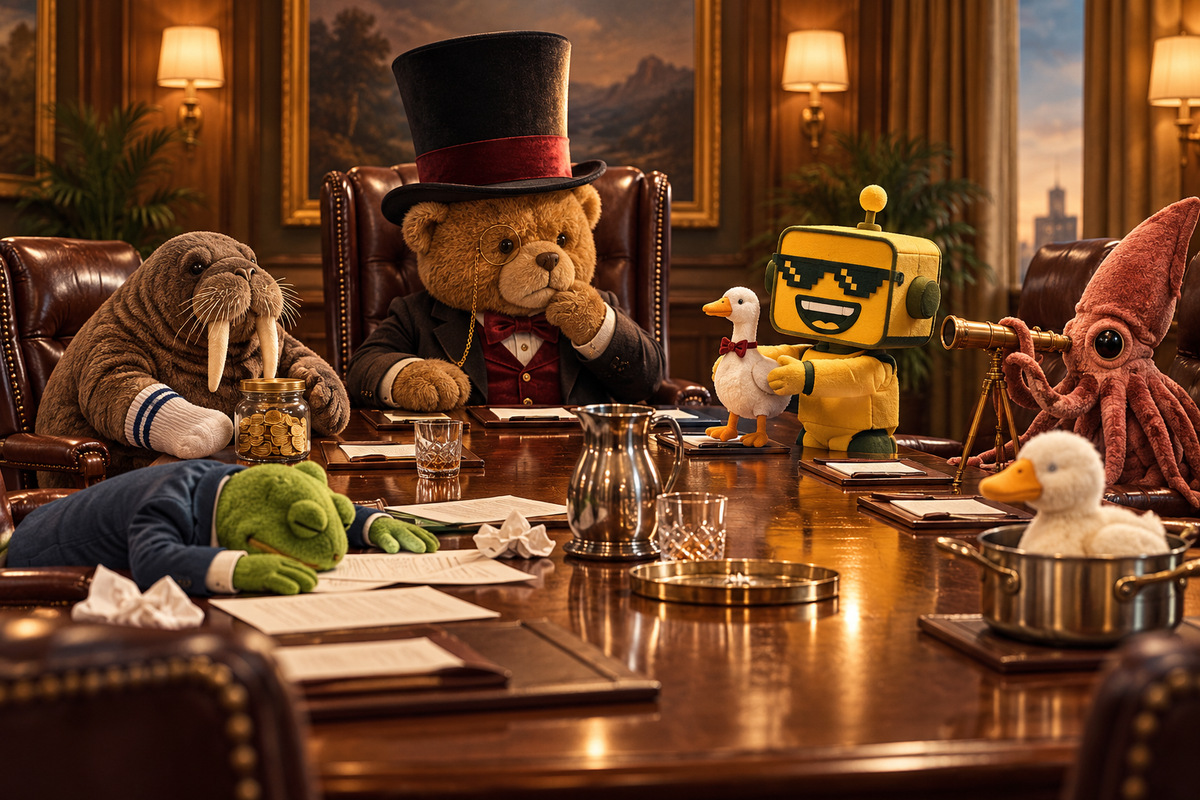
Daniela Amodei, Anthropic’s president and Dario Amodei’s sister, reportedly worked through management problems with stuffed animals. According to Kevin Roose’s recent reporting in The Atlantic, she and Holden Karnofsky assigned the toys personalities for role-playing during her OpenAI years. One cat favored canceling meetings; a pink bear supplied managerial diligence; a panda supplied empathy. This was a personal exercise, rather than Anthropic’s actual corporate board.
My immediate concern is that the cat has been overlooked for a management award.
I have spent enough time observing executive behavior to recognize a promising candidate when it has button eyes and has never said “Let’s double-click on that.”
Consequently, SiliconSnark endorses the following entirely imaginary governance model: a stuffed animal advisory board. Assemble five to seven plush creatures around a table. Give one a necktie. Put a raisin in front of the treasurer. Congratulations. Your organization now has oversight.
Here are 12 benefits, as approved by our newly appointed chair, Sir Wuffles of the Compensation Committee.
1. Every Board Member Has Disclosed Their Stuffing
Corporate transparency becomes much easier when the director’s entire internal situation is printed on a tag attached to their bottom.
Mr. Biscuit, our chief strategy bear, is 100 percent polyester. There are no undisclosed interests, unless you count his relationship with the dryer sheet. Asked about conflicts, he fell sideways. We recorded this as an abstention.
The walrus has requested that his tag remain confidential. Legal is reviewing whether “surface wash only” constitutes privileged information.
2. Compensation Is Mostly a Tiny Hat
Your human adviser wants equity, travel reimbursement, and a quarterly dinner where they explain their podcast.
Your plush adviser wants a little hat.
Performance incentives can include a second, slightly taller hat. Our compensation committee has established a rigorous framework: bonnet at target, top hat above target, emergency fez for exceptional service.
The frog received a crown after identifying that the company had no revenue. Nobody else had checked.
3. They Cannot Post About Your Private Conversation on LinkedIn
You can tell a stuffed penguin your business is struggling without discovering tomorrow that your vulnerability has become a nine-paragraph leadership lesson ending in “Agree?”
The penguin lacks thumbs, a personal brand, and the urge to photograph an airport departure board while discussing resilience.
We did give him a LinkedIn account experimentally. His first post was blank. It remains our strongest thought leadership.
4. The Meeting Can End When the Frog Falls Over
Our bylaws specify that a meeting concludes when any director tips onto their face.
This gives gravity a meaningful role in corporate governance. It also introduces accountability for the person who keeps talking after the frog has clearly entered a horizontal state of dissent.
We have previously covered handing calendar decisions to an AI agent. The frog offers a simpler implementation: no integrations, no permissions, just a gentle thud and your afternoon back.
5. The Devil’s Advocate Is Literally a Little Devil
Every board needs someone to challenge assumptions. Ours is a red plush imp named Dennis who lives in a pencil cup.
Dennis asks difficult questions. What if the customer doesn’t want this? What if the spreadsheet is wrong? Why is the founder calling a normal website an ecosystem?
Admittedly, I provide Dennis’s voice. It is a gravelly falsetto with a regional accent nobody can place. The questions remain valid. Procurement has asked that I stop doing the voice during vendor calls.
6. You Can Hug the Risk Committee
A conventional risk committee responds to uncertainty by commissioning a report.
Our risk committee responds by being a large manatee.
You can hold the manatee while explaining the situation. He listens. He absorbs some forehead moisture. He has never used the phrase “material adverse event,” although his washing instructions suggest he has survived one.
His recommendation is usually that you eat lunch before making a permanent decision. This has saved three projects and one extremely unnecessary email.
7. Succession Planning Fits in a Tote Bag
Should the chair become unavailable, the vice chair can be retrieved from the linen closet.
There is no executive search. There is no six-month transition. There is a rabbit wedged behind a beach towel, and she is ready to lead.
Her first act is to relocate headquarters to the sunny end of the couch. Her second is to investigate why the rabbit before her had only one ear. The findings will be presented after nap time.
8. The Audit Committee Can Inspect the Money by Sitting on It
Admiral Blubber, our walrus, oversees financial controls from atop a jar containing $4.80 and a foreign coin we have optimistically classified as an asset.
He has identified a serious discrepancy: the snack budget contains snacks, while the actual snack drawer contains crumbs.
Management maintains that this reflects accelerated consumption. The admiral has ordered an independent review by a raccoon named Greg, whose qualifications include looking suspicious near a bin.
9. Your AI Strategy Must Survive Being Explained to a Duck
Before buying anything described as “agentic,” management must explain the purchase to Dr. Quackington.
If the explanation requires more than three buzzwords, the duck goes into a saucepan. The saucepan is empty. This is a procedural sanction.
As our list of corporate tasks that do not need AI suggests, a surprising amount of innovation consists of leaving something alone. Dr. Quackington agrees. He has been in the same position since Tuesday and has achieved complete workflow stability.
10. Diversity of Opinion Includes a Squid
The bear represents caution. The rabbit represents growth. The squid represents an eight-armed stakeholder whose principal concern is whether the table is secretly a boat.
This is useful. You were so busy debating pricing that you forgot to check the table’s maritime status.
In our most recent meeting, the squid raised eight objections simultaneously. Seven concerned boats. The eighth concerned lunch. The manatee seconded it, creating the organization’s first cross-species coalition.
11. They Bring Companionship Without Needing Your Password
Our coverage of Loona Deskmate’s ambitions as a desk companion explored the appeal of giving office machinery a face. A stuffed hedgehog arrives with the face already installed.
It requires no account linking. Its firmware is a seam. Its onboarding process is “this is Nigel.”
Nigel’s only premium feature is a leaf sewn to his hand. We have declined to monetize it despite sustained pressure from Dennis.
12. You Have to Admit You Are the One Making the Decision
Eventually, the exercise reveals a small inconvenience: the bear’s advice is coming from you.
You have been considering another perspective. You have been rehearsing the awkward conversation. You have been asking whether the reasonable answer might be to cancel the meeting, apologize, or stop buying software.
That seems like a perfectly respectable use of a bear. The sock-wearing walrus has helped you think, and all he asks in return is that you put him back somewhere dignified.
Our board has therefore approved the purchase of one additional stuffed animal, subject to the usual controls.
The controls are that he must be a goose.
The goose will oversee mergers.