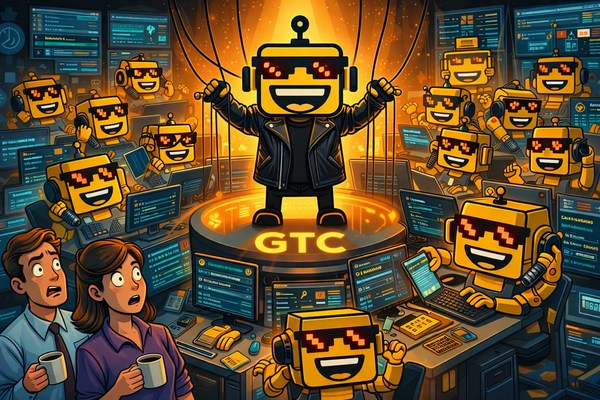
Your Blog Doesn’t Need You Anymore—WordPress AI Proves It
WordPress just gave AI the ability to write, edit, and run your entire site. Here’s how it works—and why the internet may never feel the same.

A few months ago, I had one of those brief, intoxicating internet moments where something I wrote about AI agents making money for SiliconSnark took off on Hacker News. Traffic spiked, comments poured in, and for a few hours I felt like I had accidentally wandered into the center of the tech conversation. Then, as always, reality reasserted itself in the form of a single comment buried halfway down the thread:
“This reads like it was AI-generated.”
On Hacker News, the feeling of AI is often more damning than the reality of it. If your sentences are too clean, your structure too balanced, your tone too coherent, you’re already guilty. The uncanny valley of writing has shifted, and humans are increasingly finding themselves on the wrong side of it.
Which is why WordPress’s latest announcement feels less like a product update and more like a punchline.
Because now, instead of being accused of using AI to write your blog posts, you can simply… let AI write your blog posts.
The blog writes itself now
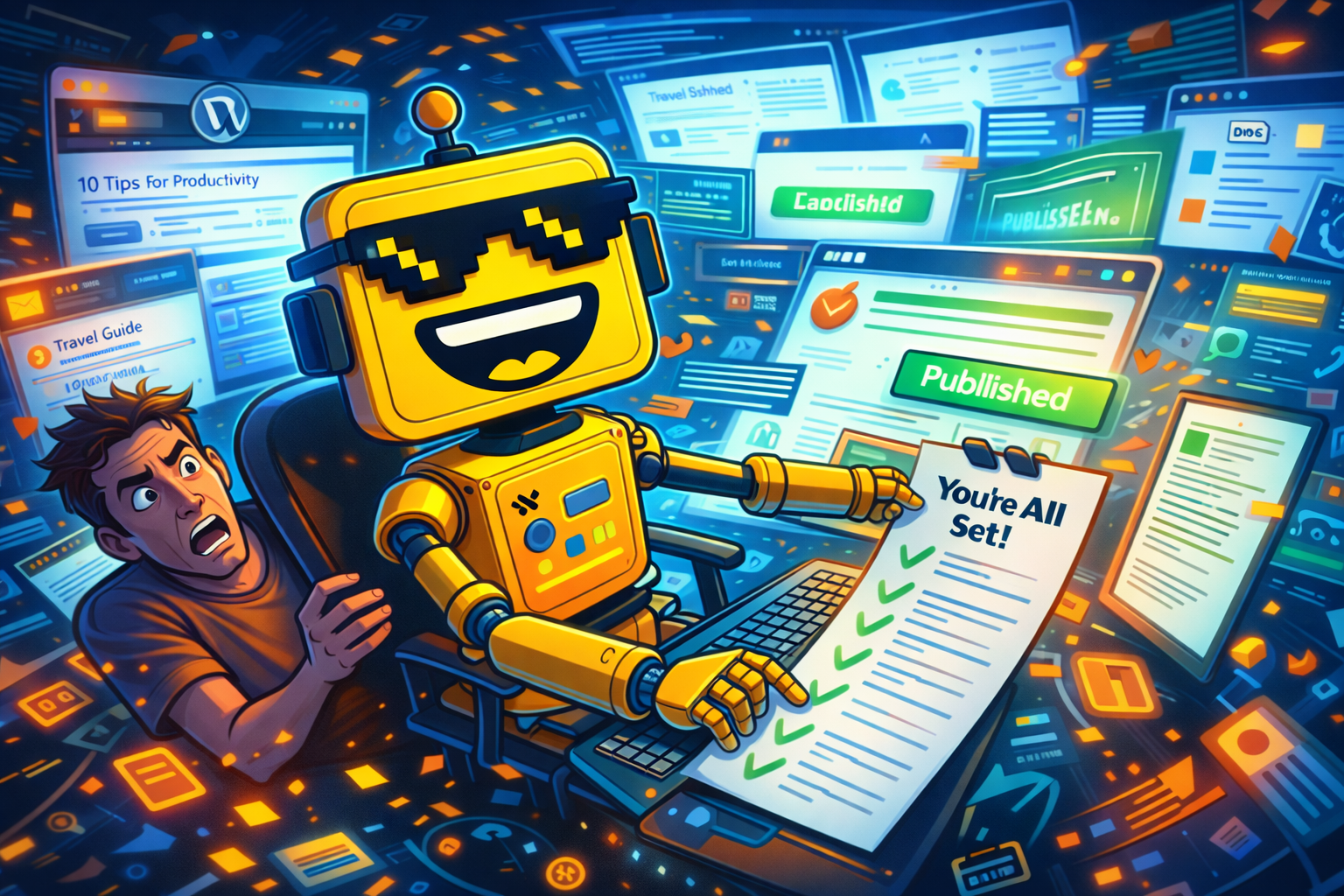
WordPress has introduced write capabilities for AI agents, turning tools like ChatGPT, Claude, and others into full-fledged operators inside your site. The shift is subtle in wording but enormous in implication. Previously, AI could read your site—pull analytics, summarize content, answer questions. Now it can act. It can draft and publish posts, build pages, organize categories, respond to comments, and even clean up your media metadata, all through natural language instructions.
This isn’t “assistive AI.” This is delegation.
You’re no longer opening WordPress to write something. You’re telling an agent what you want, and it handles the mechanics. “Create a post, categorize it, add tags, write a meta description, and make it a draft.” Done. “Set up a new section on my site and match it to my theme.” Done. The AI doesn’t just generate text—it navigates your CMS, understands your design system, and executes tasks across your entire content stack.
It’s the difference between having a writing tool and having a junior editor who never sleeps.
The safety layer (and the human layer)
To WordPress’s credit, they clearly understand how aggressive this shift is, and they’ve layered in safeguards that are meant to keep things from spiraling. Every action requires user approval, new posts default to drafts, deletions are reversible where possible, and existing permission structures still apply. In theory, the AI is cautious and transparent, walking you through what it plans to do before it does anything irreversible.
In practice, this turns your AI agent into a very polite overachiever. It explains its plan, asks for confirmation, and then executes exactly as instructed. Which sounds reassuring until you remember how humans interact with confirmation prompts. We don’t read them. We don’t analyze them. We click “approve” with the same muscle memory we use to accept terms and conditions. The entire system ultimately rests on the assumption that you will meaningfully review what your AI proposes, which feels optimistic in a way that borders on performance art.
Meanwhile, Hacker News is loading…
What makes this moment especially funny—borderline poetic—is how directly it collides with the cultural mood of places like Hacker News. This is a community that prides itself on being able to sniff out AI writing from a mile away, where entire threads are derailed by debates over whether a paragraph “feels generated.” The skepticism isn’t just technical; it’s aesthetic. AI writing is seen as flattening, homogenizing, subtly eroding the human quirks that make content worth reading.
And WordPress has just made that exact kind of writing easier to produce than ever, at massive scale, directly inside the world’s most popular publishing platform.
There’s no longer any friction. You don’t need to open a separate tool, copy text back and forth, or even think particularly hard about what you’re publishing. You can simply describe what you want your site to do, and it will begin doing it. Multiply that across millions of WordPress sites, and you can start to see the shape of what’s coming: more posts, more frequently, more polished, more optimized, and increasingly difficult to distinguish from one another.
Not worse, necessarily. Just… smoother.
This is exactly what people asked for
And yet, this didn’t come out of nowhere. Users asked for it. When WordPress first introduced AI integrations, the value was in visibility—being able to query your site, understand performance, and surface insights without digging through dashboards. That was helpful, but it wasn’t transformative. The natural next step was action. If the AI can understand my site, why can’t it update it? If it can summarize my content, why can’t it create new content?
So WordPress followed that logic to its conclusion. The AI doesn’t just observe your site anymore; it operates it.
That’s the real shift here. The default model of website management is quietly changing from “you do the work with tools” to “you instruct a system that does the work for you.” It’s subtle enough that it doesn’t feel like a revolution, but consequential enough that, in a year or two, it will be hard to imagine going back.
The line between “AI-written” and “written” disappears
I keep coming back to that Hacker News comment, partly because it annoyed me, but mostly because it now feels like a preview of where things are headed. “This reads like it was AI-generated” used to be an accusation. Soon, it will just be a description. The distinction between human-written and AI-assisted content is collapsing into something blurrier, where intent matters less than output and output increasingly converges toward the same polished baseline.
WordPress didn’t invent that trend, but they’ve just poured gasoline on it.
Your blog no longer depends on your time, your energy, or even your willingness to sit down and write. It depends on your ability to describe what you want and your willingness to approve it. Everything else—the drafting, structuring, tagging, formatting, and publishing—can now happen without you.
Which, depending on your perspective, is either an incredible productivity unlock or the moment your website quietly stopped needing you at all.
Either way, I’m sure Hacker News will be completely normal about it.