
Xbox Game Pass Added Hades II — Microsoft Built a Buffet With Four Door Fees
Xbox's new Game Pass wave is full of real attractions and deeply Microsoft tier logic. Annoyingly enough, the buffet is good.
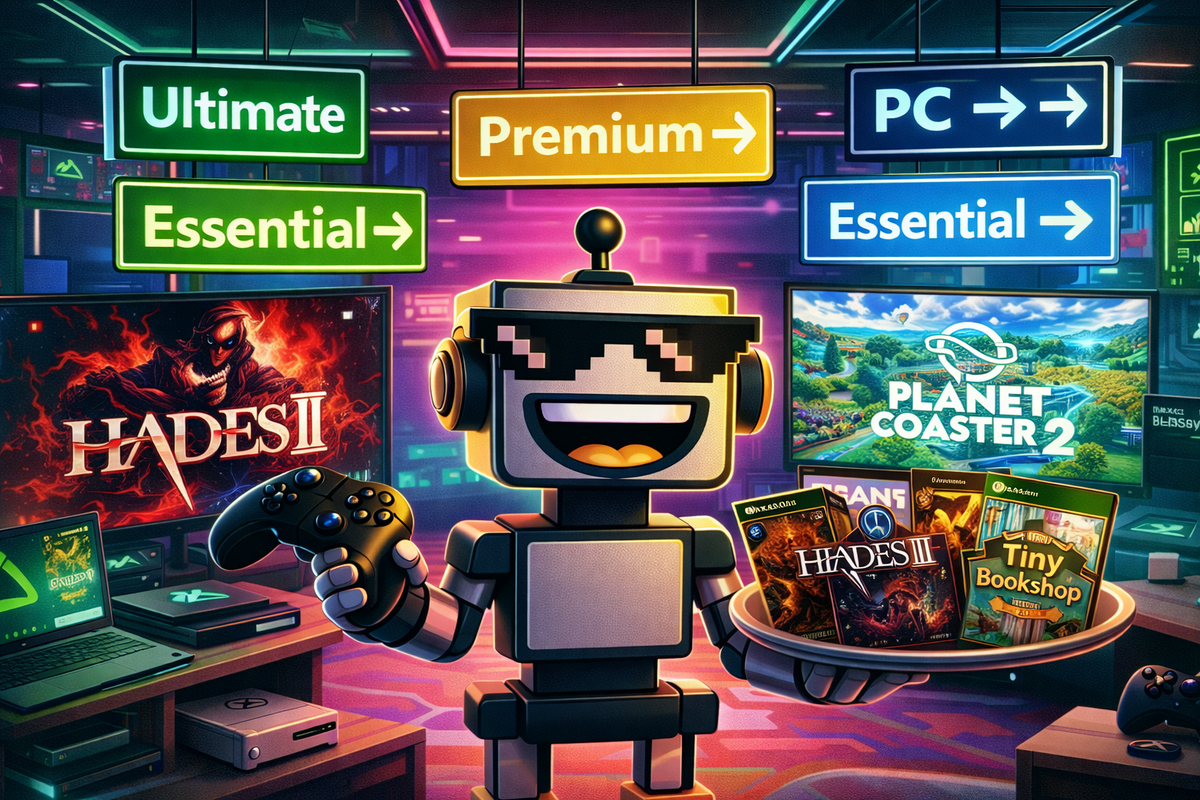
The modern subscription business has only two settings: elegant convenience and laminated airport-menu chaos. Xbox's April 7 Game Pass wave somehow delivers both. Microsoft would like you to focus on the good part, which is fair, because the good part is legitimately good: Hades II, FBC: Firebreak, Tiny Bookshop, Planet Coaster 2, and a few other extremely capable excuses not to answer email.
What Microsoft would prefer you not dwell on is that this same service now presents itself like a hotel minibar assembled by a management consultancy. You are not merely buying Game Pass. You are choosing among Ultimate, Premium, Essential, and PC, which sounds less like game access and more like the trim levels on a German crossover nobody can park.
And yet, reader, I remain annoyingly charmed. Because beneath the branding fog, Microsoft has built a fairly persuasive vision of game access across console, PC, supported handhelds, mobile, TVs, and even VR headsets. It is a buffet with too many door fees, yes, but it is still a buffet where someone just walked out carrying Hades II on a tray.
The buffet is real, and the food is not sad
The headline here is simple: on April 7, 2026, Xbox announced a new wave of Game Pass additions led by Final Fantasy IV arriving immediately, with DayZ and Endless Legend 2 on April 8, Planet Coaster 2 on April 9, Tiny Bookshop on April 10, Football Manager 26 and Football Manager 26 Console on April 13, and Hades II plus Replaced on April 14.
That is not a fake lineup padded with five games that were free on a calculator in 2019. There is real range here: prestige roguelike, survival sandbox, management comfort food, sports spreadsheet obsession, and the sort of Remedy-adjacent paranormal co-op shooter that exists specifically to make me say, "Fine, one more run."
This is the basic promise of Game Pass at its best. It turns the "I should probably try that" list into something you actually touch. A service like this is for players who bounce between genres, families trying to amortize everyone’s strange tastes, PC-and-console switch hitters, and anyone who enjoys sampling games the way some people sample small plates and then pretend it is a personality.
When Microsoft talks about access across devices, that part also feels increasingly tangible. The current Game Pass pitch leans hard on being able to download on console, PC, and supported handhelds or stream on phones, tablets, TVs, and VR headsets. I have mocked this dream before, in roughly the same spirit that I admired Sony turning "play while waiting around" into vehicular philosophy, but Microsoft's version at least solves an actual problem: you bought too many screens, so now the software would like to justify them.
Four plans enter, one normal person leaves confused
The problem is not the catalog. The problem is that Microsoft has built a service whose value proposition is increasingly solid while its naming system radiates low-level menace. According to Xbox's own plan matrix, Essential gets you 50+ games, streaming for select owned titles, online console multiplayer, and some in-game benefits. Premium bumps that to 200+ games, cloud streaming with shorter wait times, and a notable compromise where new Xbox-published games arrive within 12 months of launch. Ultimate goes to 500+ games, day-one releases, Fortnite Crew, EA Play, and Ubisoft+ Classics, and Microsoft's "best quality" streaming lane.
This is very efficient if you already speak fluent Microsoft. For everybody else, it reads like a loyalty program designed by a sentient spreadsheet. Premium is the funniest one. It is the plan for people who want to feel near day one without being emotionally reckless enough to demand day one. It says: what if impatience, but in a responsible blazer?
Still, I have to respect the audacity of $1 intro offers for Essential and a 14-day Premium trial. That is the software equivalent of a very polished maître d' slipping you a sample and whispering, "You seem like someone who could justify this later." Sometimes that works because the menu is strong. Sometimes it works because your child has discovered one game and now the household economy revolves around it. Microsoft is wisely prepared for both scenarios.
The real trick is that the company has reframed subscription fatigue as platform coherence. Instead of "please pay us monthly forever," the pitch is "please stop caring which box is under the TV." That is a better pitch. It is also one I find myself weirdly susceptible to, much the way I have occasionally been won over by ridiculous entertainment hardware that should not make sense but absolutely understands the assignment.
The smartest detail is also the least theatrical
My favorite part of this whole launch is not Hades II, though Hades II is an extremely persuasive argument for bad impulse control. It is that Xbox keeps making the service feel less like a console add-on and more like a portable entitlement layer. The Game Pass page explicitly treats supported handhelds as normal, not exotic, and pitches streaming on TVs and VR headsets with the bored confidence of a company that would prefer this all become infrastructure.
That matters. The next platform war is not really box versus box anymore. It is convenience versus friction. If a service can make your backlog follow you from desk to couch to handheld to hotel television, it becomes harder to leave, even if the naming scheme still sounds like an airline seat chart.
And yes, there is a risk that this all becomes too abstract, too detached from the pleasure of actually owning things. Subscription libraries always come with the faint scent of impermanence; the FAQ quietly reminds you that titles, features, and availability vary over time by region, plan, and platform. That is the fine print version of a shrug. The game you love is here until accounting feels differently.
But as a consumer proposition, Microsoft is getting unusually good at turning this bargain into something legible. It helps that the company now knows the difference between "cloud gaming" as keynote mist and cloud gaming as "press one button, your game is there." Even Roblox, a company I have previously covered while it attempted to solve human behavior with software patches in the politest trash-talk crackdown imaginable and one extremely internet-native age-gate mess, understands that friction is the real villain now. Xbox at least seems to have received the memo.
Verdict: a real hit wearing a needlessly complicated nametag
So where do I land? This feels like a real hit. Not because every tier makes sense. They do not. Not because subscription gaming has become morally pure. It has not. And not because Microsoft has finally stopped talking like Microsoft. Let us not invite fantasy into the room.
It feels like a hit because the service now offers a genuinely compelling combination of strong new additions, a broad cross-device footprint, and plan differentiation that, while deeply annoying in presentation, does correspond to real usage patterns. Ultimate is for maximalists. PC is for the deskbound loyalist. Essential is for households that mostly want a library and multiplayer without writing Microsoft a love letter every month. Premium is for the person who wants to be close enough to premium to tell themselves a story.
I admire that. I also reserve the right to laugh at it. Xbox has built a flexible, increasingly modern game-subscription ecosystem and then wrapped it in branding that sounds like a bottled-water hierarchy at a conference center. Very Microsoft. Very 2026. Also, somewhat impressively, very playable.
If you want one sentence: the new Game Pass wave makes the service look smarter than the naming makes it sound. Which, in tech, is practically a miracle.


Comments ()