What NVIDIA GTC 2026 Means for Your Job, Your Apps, and Your Daily Life
You saw the NVIDIA GTC keynote. But the real story started after the cameras turned off—when AI stopped being a demo and quietly became infrastructure inside everything you use.
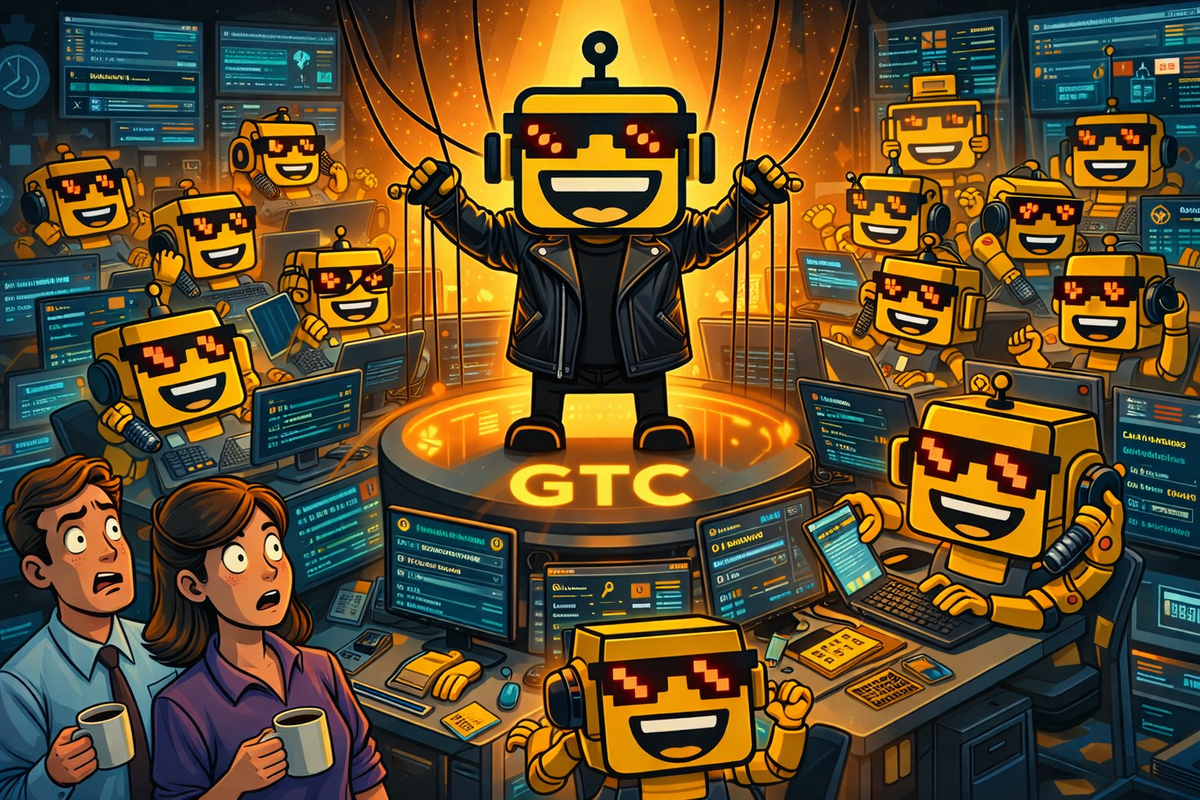
The most important thing that happened at GTC didn’t happen during Jensen Huang's keynote. It happened in the days that followed, when all those announcements began turning into deployments.
For the past couple of years, AI has felt like a performance. You’d open a chatbot, ask it something clever, screenshot the result, and send it to a group chat like you had just discovered fire. The value was real, but it still felt… optional. Like something you could engage with or ignore depending on your mood, your workload, or your tolerance for hallucinated facts.
What changed after this GTC is that AI stopped asking for your attention.
It started taking responsibility.
The updates coming out of NVIDIA this week weren’t just about making models better. They were about making AI systems persistent—always running, always responding, always embedded inside the products and services you already use. The shift is subtle until it isn’t. You won’t log into “AI.” You’ll log into your bank, your email, your healthcare portal, your work tools, and something will feel different.
Not dramatically different. Not in a way that makes for a viral tweet. Just… smoother. Faster. More anticipatory.
You’ll click less. Wait less. Think less, if we’re being honest.
And that’s when it hits you: this isn’t a feature anymore. It’s infrastructure.
Your Software Is About to Start Acting Like It Knows You
In the aftermath of GTC, the most interesting movement isn’t happening inside NVIDIA. It’s happening inside the companies racing to integrate what NVIDIA just made possible.
Look at Microsoft, Amazon, and Google. On the surface, they’re still competing with each other—different clouds, different platforms, different marketing language designed to convince you their version of AI is the most enterprise-ready, developer-friendly, or whatever-friendly.
But underneath all of that, something much simpler is happening.
They are all trying to get closer to NVIDIA.
Because NVIDIA isn’t just selling chips anymore. It’s selling the conditions under which modern software exists. Faster inference. Scalable deployment. Systems that don’t just respond to prompts but continuously process the world in real time.
And when those conditions become widely available, every product starts to feel different at the same time.
Your banking app stops feeling like a form you fill out and starts feeling like a system that understands your behavior. Your work software stops being a place where tasks live and starts being a place where tasks get completed without you explicitly assigning them. Your customer support experience stops being a queue and starts being a conversation that, unnervingly, actually resolves something.
It’s not magic. It’s just what happens when intelligence becomes cheap enough to embed everywhere.
The Quiet Death of “Please Hold”
There’s a very specific kind of friction that defined the pre-GTC internet. Waiting.
Waiting for a page to load. Waiting for a response. Waiting for approval. Waiting for someone, somewhere, to take an action that moves a process forward.
What NVIDIA is really accelerating—far more than model accuracy or token throughput—is the removal of waiting.
After this GTC, the companies building on NVIDIA are no longer designing systems that respond eventually. They’re designing systems that respond immediately, continuously, and sometimes preemptively. Not because they suddenly care more about user experience, but because the infrastructure finally allows it.
This is where AI agents like OpenClaw quietly enter the picture.
Not the overhyped version you’ve seen on Twitter, where someone claims their AI now “runs their entire business” while clearly still tweeting manually. The real version. The boring, terrifying version. Systems that take actions without asking for permission every step of the way.
You won’t notice them at first. You’ll just notice that fewer things require your input. Fewer emails need replies. Fewer workflows need supervision. Fewer decisions get escalated to you.
And then, one day, you’ll realize you’ve been removed from the loop you used to manage.
The New Shape of Work (You May Not Love It)
There’s a moment after every major platform shift where people try to reassure themselves that nothing fundamental is changing. This is just a tool. It will augment us. It will make us more productive.
GTC 2026 did not feel like that moment.
It felt like the moment after that moment. The one where augmentation quietly gives way to replacement—not in a dramatic, headline-grabbing way, but in a gradual redistribution of responsibility.
When AI systems run continuously, the question is no longer “Can this help me?” It becomes “Why am I still doing this?”
And the answer, increasingly, is: you won’t be.
This doesn’t mean everyone loses their job tomorrow. It means jobs start to feel different. Smaller in scope. More supervisory. Less about execution and more about oversight—at least for a while, until the oversight itself gets automated.
NVIDIA didn’t say that on stage. Of course they didn’t. That’s not keynote material. But it’s embedded in everything they announced.
The Cloud Is Now a Distribution Channel for NVIDIA
One of the strangest realizations in the days after GTC is how much the cloud landscape has flattened.
For years, choosing between Amazon Web Services, Microsoft Azure, and Google Cloud felt like a strategic decision. Different capabilities. Different strengths. Different philosophies.
Now it increasingly feels like choosing a storefront for the same underlying product.
NVIDIA.
Each cloud will tell you they’ve built something unique. A better interface. A more integrated stack. A more enterprise-ready solution. And in many ways, they have. But the core value—the thing that actually determines what’s possible—is the same.
Compute. Accelerated by NVIDIA. Delivered at scale.
For everyday people, this consolidation has a weirdly comforting implication. The AI capabilities you experience won’t depend as much on which platform a company chooses. They’ll converge. Quickly. Which means the “wow” factor of AI will fade, replaced by something much more mundane.
Expectation.
This Wasn’t a Product Launch. It Was a Power Shift.
If you zoom out far enough, GTC 2026 stops looking like a developer conference and starts looking like a realignment of the tech industry’s center of gravity.
In previous eras, power lived in different places. In operating systems. In mobile platforms. In distribution channels. In social networks.
Right now, it’s consolidating around something less visible but more fundamental: the ability to generate and deploy intelligence at scale.
That’s what NVIDIA controls. Not exclusively, not permanently, but decisively—for now. And that control doesn’t just shape companies. It shapes timelines. It determines how quickly industries change, how fast products evolve, how rapidly expectations shift.
You may not follow GTC. You may not care about GPUs or inference speeds or data center architectures. But you will feel the downstream effects of those things in almost everything you touch.