UiPath Earnings 2026: The Robots Are Doing Great, and They’d Like a $500 Million Buyback
UiPath’s latest earnings prove the robots aren’t coming for Wall Street—they’ve already learned capital allocation, discovered buybacks, and started speaking fluent “agentic automation.”

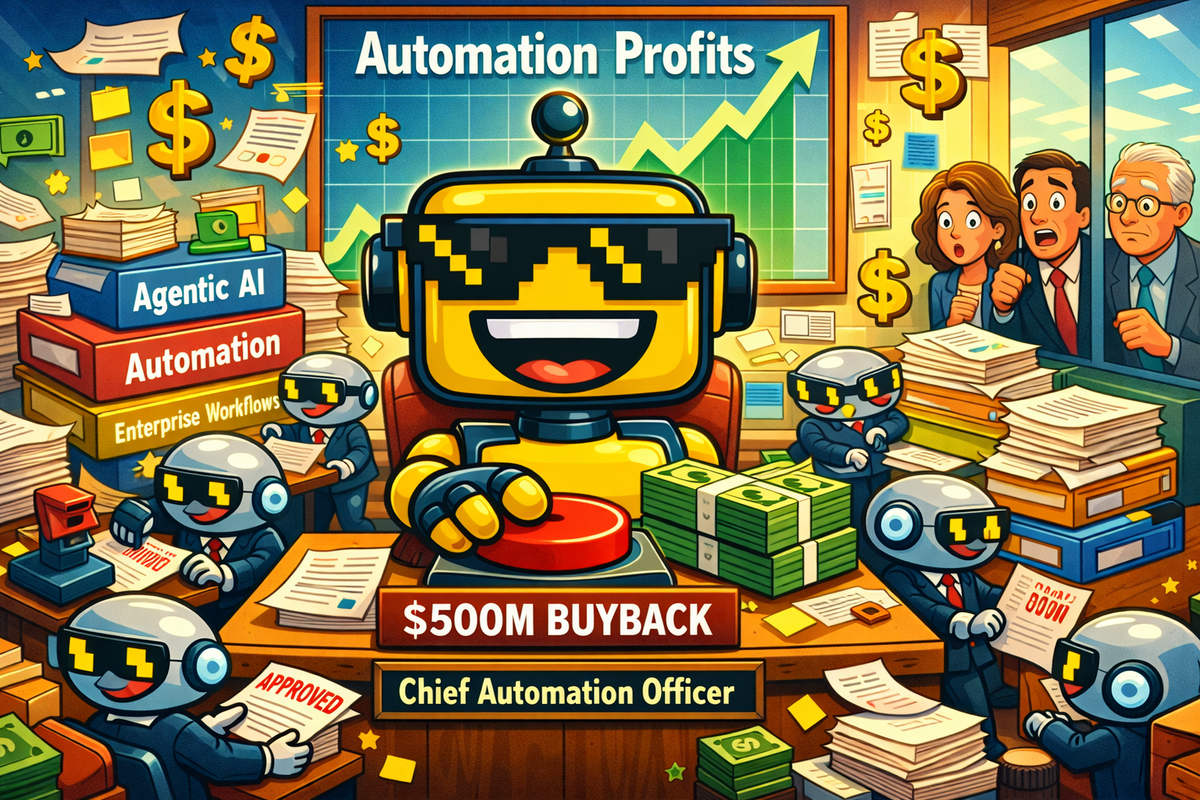
There are few things more comforting in enterprise tech than a company announcing it has officially entered the agentic era while also making the oldest, most human signal possible: “By the way, we make real money now.”
That, in essence, was the vibe of UiPath’s (NYSE: PATH) fourth-quarter and full-year fiscal 2026 results on Wednesday. The company reported fourth-quarter revenue of $481 million, up 14% year over year, with ARR reaching $1.853 billion, up 11%. It also said it achieved full-year GAAP profitability for the first time in company history, then topped off the whole presentation with news of a fresh $500 million stock repurchase authorization after finishing a prior $1 billion buyback program. In other words, the bots are not just automating workflows anymore. They are now participating in that most sacred public-company workflow of all: reassuring investors.
And honestly, good for them. In a market where every software company now sounds like it was bitten by a radioactive large language model, UiPath has chosen a slightly more mature strategy. Yes, it said “agentic” roughly the number of times you would expect from a company trying to convince Wall Street it is not your father’s robotic process automation vendor. But unlike some AI-adjacent earnings releases that read like a spiritual manifesto written by a McKinsey deck generator, this one had the decency to come with margins, cash flow, and a giant pile of securities.
From RPA nostalgia to agentic adulthood
There was a time when UiPath’s story was simpler. It made software robots to click through repetitive corporate tasks nobody wanted to do. It was the digital equivalent of hiring a very patient intern who never asked for a promotion and loved moving data between unloved systems from 2004.
Now, of course, nobody wants to be just an automation company. That sounds quaint. That sounds almost practical. So UiPath is now selling itself as a leader in “agentic automation,” which is a phrase that means the old bots have gone to business school, discovered orchestration, and started speaking in keynote language about enterprise transformation.
Still, underneath the AI gloss, the numbers suggest something genuinely solid is happening. Full-year revenue came in at $1.611 billion, up 13% year over year, while non-GAAP operating income hit $370 million. The company also generated $372 million in adjusted free cash flow for the year. That is not the profile of a company vaporizing cash in pursuit of an AI costume change. That is the profile of a company trying to convince investors it can be both relevant in the AI boom and annoyingly disciplined at the same time.
Which, to be fair, is probably the correct strategy. Anyone can say “AI agents.” Fewer companies can say “AI agents, but with governance, compliance, and operating leverage.” That last phrase may not get standing ovations on X, but it does tend to help when the market is in one of its occasional moods about whether software valuations should be based on vibes or arithmetic.
The most beautiful phrase in enterprise software: first-ever GAAP profitability
If you really want to understand the tone of this release, ignore the futuristic language for a second and focus on the line from CFO Ashim Gupta calling out full-year GAAP profitability for the first time in company history. That is the sentence that probably got printed out somewhere and slid across a polished conference-room table with the reverence usually reserved for peace treaties.
Public software companies love to tell stories about innovation. Investors, especially lately, also enjoy hearing stories about restraint, discipline, and the radical idea that revenue should at some point exceed expenses in a legally recognized manner. UiPath appears to have noticed.
GAAP operating income for the quarter was $80 million, up from $34 million a year earlier. Full-year GAAP operating income was $57 million, a dramatic swing from a loss of $163 million the year before. The company’s dollar-based net retention rate was 107%, which is respectable, though not exactly the sort of number that causes growth investors to throw their laptops into the air in ecstasy. This is not a “hypergrowth at any cost” story anymore. It is a “grown-up software company trying to squeeze durable value out of a huge installed base while rebranding the next chapter around AI” story.
And perhaps that is more impressive. Plenty of companies can sound visionary when money is free and everyone is drunk on TAM slides. It takes a different kind of corporate maturity to say: we are still here, we still have customers, we are making the pivot, and also we would like credit for behaving like adults.
Wall Street hears “agentic,” but it really loves “buyback”
The release also included one of the least subtle confidence signals in corporate America: a new $500 million stock repurchase authorization. There is nothing quite like a buyback to cut through a thousand words of enterprise positioning. You can say “controlled agency” and “mission-critical processes in the agentic era” all afternoon, but a buyback says something much plainer: we think our stock is worth owning, including by us.
Investors seemed to appreciate the performance. UiPath shares were trading around $12.38 late Wednesday, up about 6.7% from the prior close after the earnings release.
That does not mean every concern has vanished. UiPath’s first-quarter fiscal 2027 guidance calls for revenue between $395 million and $400 million, while full-year guidance lands between $1.754 billion and $1.759 billion. Those are healthy numbers, but they are also the kind of forecasts that suggest steady execution rather than cinematic AI moonshots. UiPath is not promising to reinvent civilization by Labor Day. It is promising to keep growing, keep expanding ARR, and keep selling a platform enterprises trust enough to let near their ugly, deeply regulated workflows.
That may be why the company’s messaging now leans so heavily on healthcare, financial crime compliance, life sciences, and regulated customer service use cases. This is not the consumer AI game, where you throw out a voice demo and watch the internet declare you a god for 36 hours. This is the enterprise AI game, where success means a claims process breaks less often and nobody goes to prison because the compliance workflow hallucinated.
The great enterprise AI land grab arrives at the cubicle farm
UiPath’s recent business highlights read like a corporate attempt to plant flags across every board-approved corner of the AI map. Healthcare agents. Financial crime compliance through the WorkFusion acquisition. Life sciences testing with Veeva. Customer experience integration with Talkdesk. Security certification. Industry foundations. Benchmarks. Rankings. Awards. Memberships. There is enough here to suggest UiPath has no intention of being remembered as “that RPA company from before the LLMs.”
And yet the funniest part of the whole enterprise AI race is how much of it still comes down to the same ancient office pain. Claims. Records. Testing. Authorizations. Compliance. Documentation. Validation. Somewhere, buried beneath all the grand talk of agentic systems, is the truth that the modern economy still runs on miserable process spaghetti, and the winners may be the companies best positioned to untangle it without setting the building on fire.
That is where UiPath still has an edge. It does not have to invent enterprise mess. Enterprise mess is already here. It just has to persuade customers that the next generation of AI-powered automation can manage that mess more intelligently than the last generation did. The pitch is not “look at this magic.” The pitch is “you already trusted us with your broken workflows, so perhaps now you will trust us with the upgraded robots.”
The real story: boring may be back, and boring pays
There is a version of this earnings report that is easy to mock, mostly because “agentic automation” sounds like something created when three consultants were trapped in an elevator with a thesaurus and a Series C term sheet. But there is also a version that deserves some credit.
UiPath did not just show up and yell “AI” into a microphone. It posted credible growth, expanded profitability, maintained strong gross margins, generated substantial cash flow, and used the occasion to remind everyone it still has serious scale. Revenue is up. ARR is up. Operating discipline is up. The buyback is on. The cash pile is still hefty. For a company that has had to fight through shifting narratives, a cooling software market, and the eternal risk of being labeled yesterday’s automation story, that is a pretty good day at the office.
So yes, the press release is drenched in enough enterprise AI terminology to make a procurement team briefly lose consciousness. But once you rinse off the buzzwords, the basic message is surprisingly old-fashioned: UiPath had a solid quarter, a profitable year, and a convincing argument that the road from RPA to AI agent orchestration may be less glamorous than Silicon Valley likes to pretend, but a lot more monetizable.
Which is maybe the most agentic thing of all.