Transfyr’s Allston Lab Coach Takes On the Teacher-to-Elbow Ratio
BioBuilder is piloting Transfyr’s AI video coach at its Allston lab to see whether more students can get useful feedback while practicing hands-on biotech skills.

BioBuilder has a room full of aspiring scientists and a finite supply of teacher eyeballs. A Cambridge startup is auditioning for the second pair.
Consider the geography of a classroom with 24 students. From any one point in the room, an instructor has an excellent view of somebody’s elbow. The interesting work is happening approximately six inches beyond it. Massachusetts can put an extraordinary number of life sciences companies within walking distance of a Red Line stop. It has yet to repeal this particular law of optics.
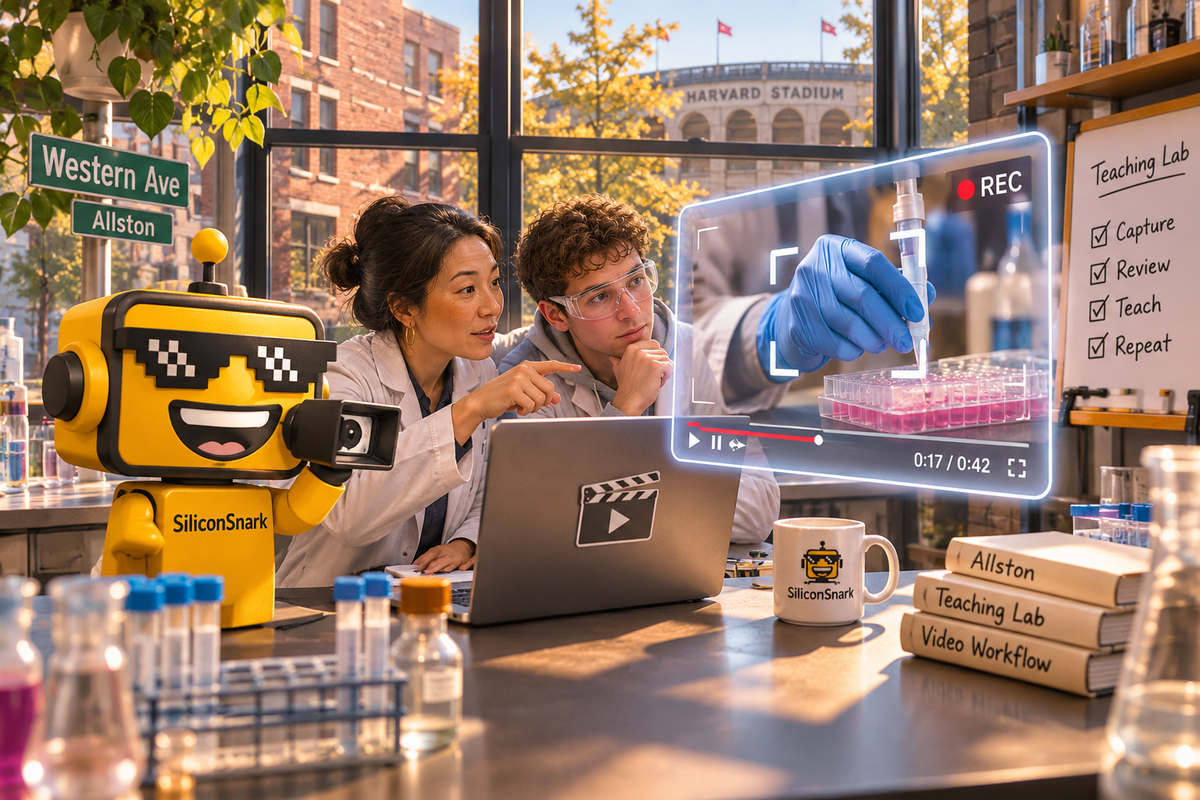
On November 16, the Boston Business Journal reported that pilots are underway for a video coaching tool being developed by Cambridge startup Transfyr with the BioBuilder Educational Foundation. One pilot site is BioBuilder’s Learning Lab on Western Avenue in Allston. A student performs an experiment, the app uses video of the work to provide feedback, and an instructor might finally get to spend a little longer with the student at the far bench.
That last part is the hypothesis. BioBuilder founder and executive director Natalie Kuldell told the Journal she hopes to begin a study in January as the program reaches more schools. How teachers use it in different classrooms, and what happens in a college setting, are questions she wants to investigate. The modest grammatical distance between “piloting” and “proved” contains roughly an entire education technology industry.
The seed round already had its turn at the microphone
Transfyr announced its $25 million seed round on August 26. General Catalyst led it. The company’s broad ambition is to capture the physical details of scientific work that rarely survive the journey into a written record. We covered the lab replay idea when Transfyr launched. The money has aged a perfectly respectable couple of months. Please let it enjoy a quiet autumn.
The classroom project also predates this week. BioBuilder had already announced support from the Massachusetts Life Sciences Center for its collaboration with Transfyr. The roughly $1 million grant backs training and credentialing work. What has changed in the public account is that we can now point to a place where the idea is being tried and hear from the educator who has to decide whether it earns its square footage.
A finished worksheet has a terrible camera angle
Imagine two students handing in identical observations. One is confident with the equipment. The other has spent the last several minutes carefully copying a neighbor and has an excellent question they never quite found a moment to ask. A written answer gives the instructor precious little basis for telling those afternoons apart. Catch the second student during the work and the next few minutes of teaching can be quite different.
That is the opening for video. It preserves a moment long enough for someone to point to it. A useful coach could direct attention to a specific movement and give the learner a reason to try again while the equipment is still on the bench. Even a student who disagrees with the feedback has something concrete to discuss with the teacher. Compare that with my least favorite educational interface, a red check mark whose author has already left for lunch.
There’s a family resemblance to Walden Robotics’ interest in learning factory work. In both cases a demonstration contains information a set of written instructions leaves out. The educational twist is that two people can perform the same motion for different reasons. A camera might record a pause beautifully. A teacher can ask what the student was thinking. For a product team, knowing when to hand that conversation back is a fairly sophisticated technical achievement.
Western Avenue gets the hard assignment
Allston gives this project a particularly good reality check. Across the river, a startup can design a system around the data it expects to see. In a teaching lab the person doing the work is, by design, still learning how to do it. A hand blocks the view. Someone turns to ask a question. The camera gets an intimate portrait of a sleeve. Those are entirely ordinary classroom events. The app’s handling of them belongs in the evaluation right alongside its finest unobstructed footage.
I’d like to see the January study, if it proceeds, count instructor minutes. Count the time a teacher spends setting up the recording, sorting out ambiguous feedback and helping a student make sense of a correction. Then count how many students get a useful second attempt during the same class period. A tool that gives a teacher an extra ten minutes with beginners would have a persuasive sales argument. A tool that sends the teacher ten minutes of homework has successfully identified the person least in need of more.
The credentialing ambition raises the stakes. Advice a learner can ignore is one thing. A judgment that travels with the learner deserves a clear account of what was visible, what skill was assessed and who can correct a mistake. Biotech already understands the value of tracing a physical object through a system, as anyone acquainted with Azenta’s sample-management business can attest. A judgment about somebody’s competence merits at least as much care as a tube in a freezer.
My verdict is a promising experiment with a sensible first customer for its evidence—the teacher. Schools far from Kendall Square have the same arithmetic of hands, benches and minutes. If a student at the far end of the room gets to see what happened, ask a better question and try once more before the bell, that is a result worth exporting. The teacher who finally got around the elbow will know exactly how much it was worth.