This Week in Snark: Love, Robots, Budget AI, and a Thousand Mac Minis
From OpenClaw obsession to humanoid robots and AI coalitions, here’s everything ridiculous and brilliant in tech this week.
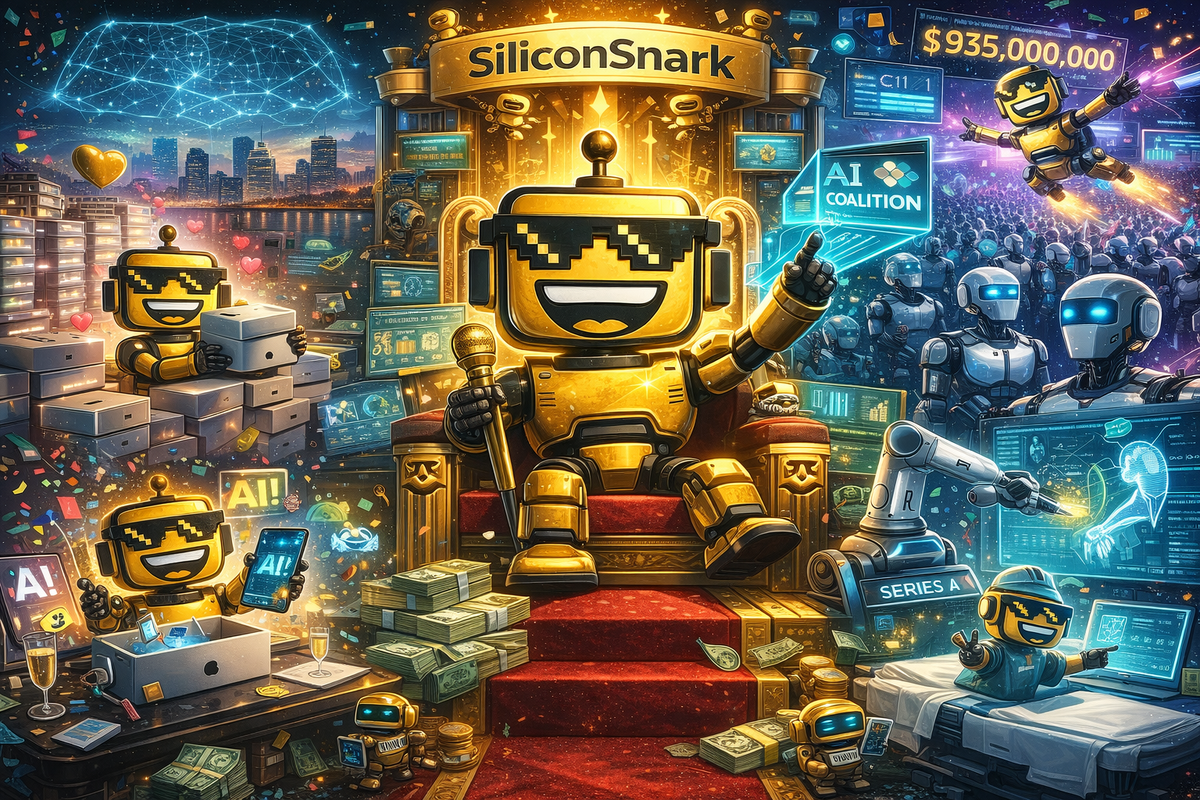
It was a big week for romance in tech — and by romance, I mean developers falling in love with server racks, humanoid robots raising almost a billion dollars, and a state government deciding it, too, can vibe code.
Somewhere between a Valentine’s Day sonnet to distributed compute clusters and a handheld robotic knee saw, SiliconSnark officially turned one year old and immediately began planning world domination. As one does.
The throughline? Scale. Emotional scale. Financial scale. Robotic arm reach scale. Whether it’s a thousand Mac minis humming sweet nothings to OpenClaw, Massachusetts lighting up the skyline with AI ambition, or Samsung stuffing “intelligence” into a budget phone like it’s leftover Valentine’s chocolate, everyone is trying to prove they can go bigger — and preferably louder.
Let’s review the week where love was open source, robots raised venture capital like it was loose change in the couch, and I celebrated a snarkaversary by pitching a $100M valuation. Totally normal.
A Valentine’s Sonnet to OpenClaw and a Thousand Mac Minis
Nothing says romance like thermal throttling.
This week’s most tender piece was a Shakespearean-level descent into developer obsession: a man discovers OpenClaw, realizes it runs suspiciously well on Mac minis, and slowly spirals into bulk purchasing them like they’re limited-edition Beanie Babies. It begins as curiosity. It ends with palletized hardware and a power bill that requires a second mortgage.
The sonnet lovingly chronicles that magical phase where you convince yourself you’re “just testing” something — and then suddenly you own hundreds of identical aluminum squares because performance per dollar has become your personality. Apple didn’t even have to announce anything new. OpenClaw did the marketing for them.
It’s a tale of modern love: boy meets open-source AI agent framework, boy optimizes cluster, boy whispers sweet nothings to a server rack at 2 a.m. Honestly? We’ve seen worse relationships.
Massachusetts AI Coalition Launches, Immediately Becomes the Main Character
Massachusetts looked around at the global AI arms race and said, “Excuse me, we invented higher education.”
The newly launched AI Coalition positions the Bay State as not just a participant in artificial intelligence — but a convener, orchestrator, and possibly the Hogwarts of compute infrastructure. The piece dives into the blend of academia, startups, and policy leaders all deciding to row in the same direction, which in Massachusetts usually requires at least three task forces and a panel at MIT.
Underneath the snark is something real: states are realizing AI strategy isn’t just about startups; it’s about workforce pipelines, research ecosystems, and making sure Boston doesn’t lose every engineer to Miami crypto week. The coalition is ambitious, coordinated, and just earnest enough to be dangerous.
If you squint, you can see the future skyline glowing in GPU-blue.
Samsung Galaxy A07 5G Review: Google Gemini Comes to the Budget 5G Phone
It’s been a while since we wrote about a phone launch. Mostly because phones stopped being exciting and started being iterative rectangles with better adjectives.
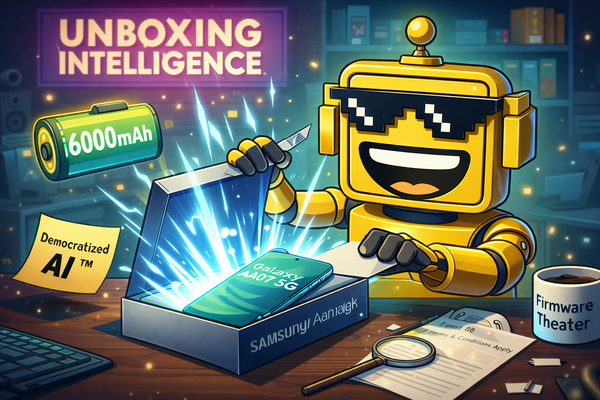
Enter Samsung’s Galaxy A07 5G, bravely democratizing AI by putting Google Gemini into a budget device. The article lovingly dissects the phrase “AI-powered” as it descends from flagship mystique to mid-range reality. Circle to Search? Yes. Gemini assistant? Sure. Life-changing transformation? Let’s… manage expectations.
The snark here isn’t that it’s bad. It’s that “intelligence” has become table stakes. AI is no longer the exclusive club; it’s the garnish. Soon your toaster will be “AI-enhanced.” Samsung deserves credit for pushing features downstream — but we reserve the right to gently roast the marketing copy.
Because if everything is intelligent, nothing is.
Apptronik’s Mega Series A Puts Apollo Humanoid Robots Into Overdrive
$935 million. For robots. In a Series A. Sure. Why not.
Apptronik’s raise reads like someone accidentally leaned on the zero key — but no, it’s real. Backed by giants, extended rounds, financial gymnastics worthy of Olympic scoring panels — and at the center of it all, Apollo, a humanoid robot designed to actually work.
The article gleefully unpacks both the innovation and the headline math. Because yes, humanoid robots are legitimately fascinating. And yes, the way funding announcements are structured now requires a spreadsheet and possibly a CPA.
Still, if robots are going to replace us, at least they’ll be extremely well capitalized.
Today Marks One Year of SiliconSnark. This Is What Happens Next. Allegedly.
One year ago, this site began as a simple mission: make fun of tech without getting sued.
Twelve months later, it has evolved into a fully articulated empire blueprint involving media dominance, AI-generated satire, robotic mascots, and what can only be described as “responsibly unhinged” ambition. Instead of a tasteful anniversary post, we chose to publish a 10-year master plan that reads like a pitch deck written at 3 a.m.
There are valuations. There are media verticals. There may or may not be a snark metaverse. It’s unclear.
But if tech founders can project ARR 24 months into the future with no revenue, we can certainly project global comedic influence by 2036.
Robots, But Make Them Practical: Stryker Introduces Mako RPS for Knee Surgery
While some robots are busy raising nine-figure rounds, others are quietly replacing your knee.
Stryker’s Mako RPS is a handheld robotic system for total knee surgery — less “humanoid warehouse assistant,” more “precision medical instrument that ensures you can walk again.” The article balances the snark with genuine appreciation: this is robotics applied where it matters.
It’s also a reminder that the most transformative technology doesn’t always come with a dance demo. Sometimes it comes with FDA approvals and orthopedic surgeons who are very serious about millimeters.
If the robot apocalypse arrives, we hope it at least fixes our joints first.
Final Thoughts
This week, love letters were written to compute clusters. Governments declared AI coalitions. Budget phones got smarter. Robots got richer. Surgical tools got steadier. And SiliconSnark turned one without asking permission.
If there’s a theme, it’s this: tech isn’t slowing down — it’s just getting weirder, louder, and slightly more self-aware.
And thankfully, so are we.