This Week in Snark: Acquisitions, Constitutions, and a Grill That Knows More Than You Do
This Week in Snark covers Nvidia’s GTC 2026 rumors, Capital One’s Brex deal, AI constitutions, smart grills, stealth mega-funding, and Greenland’s tech scene.
If there was one unifying theme in tech this week, it was confidence.
Not earned confidence. Not cautious confidence. But the kind of confidence that comes from keynote slides, press releases written at 2 a.m., and founders who believe deeply—spiritually, even—that this time the narrative will land exactly as intended.
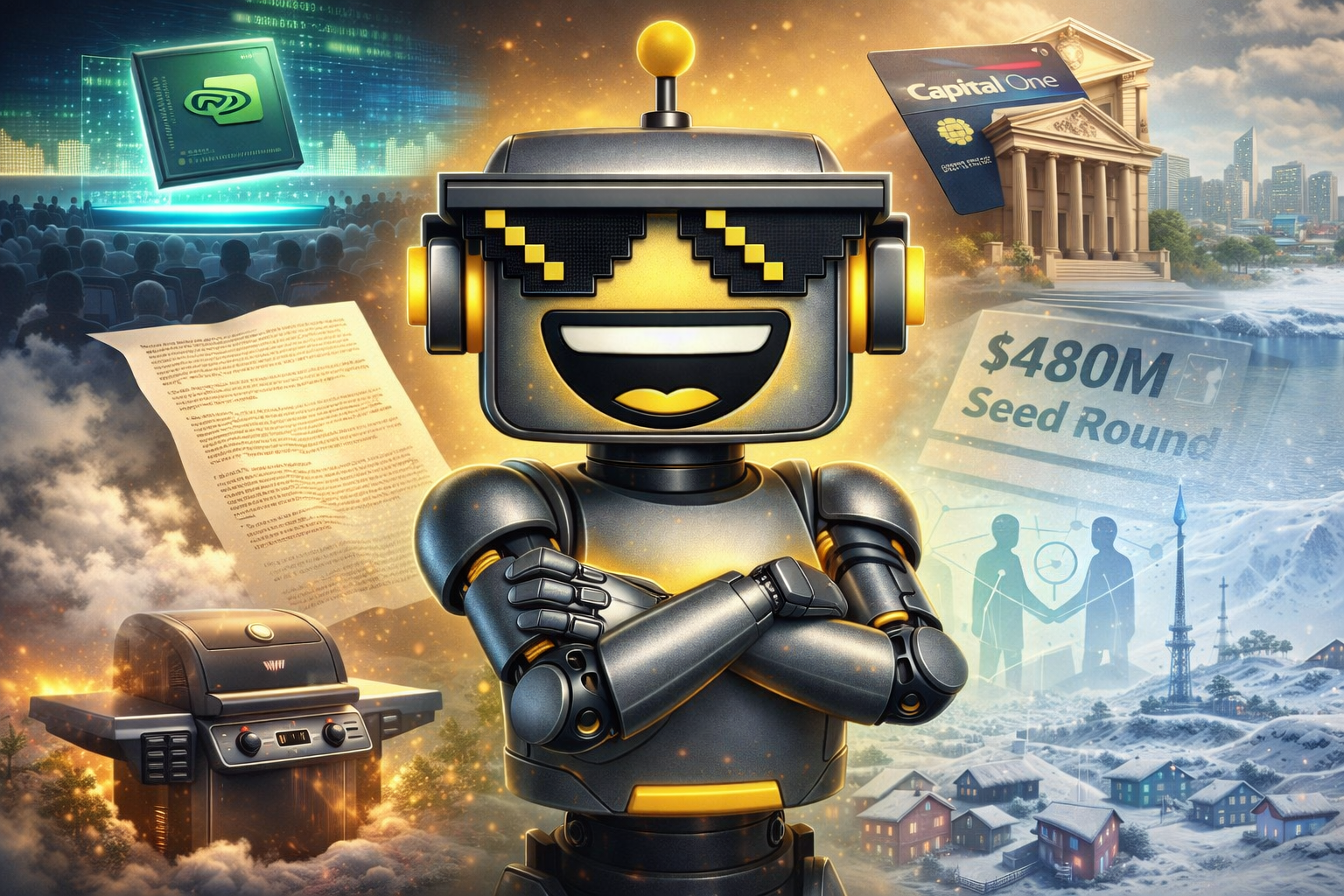
This was a week where Capital One reminded fintech that gravity still exists, Anthropic published a philosophical manifesto longer than most beach reads, and a grill launched an ecosystem while half the country was scraping ice off their windshields. Meanwhile, an AI lab raised nearly half a billion dollars without saying so, and Greenland quietly waited for someone to notice it exists.
In other words: peak tech week.
Across six very different stories, the same patterns kept emerging. Tech wants to be taken seriously—by Wall Street, by regulators, by history—while still insisting it’s disruptive, different, and definitely not becoming the thing it once mocked. Everyone wants legitimacy without losing mystique. Scale without scrutiny. And, ideally, funding without headlines.
Let’s get into it.
Deep Dive: GTC 2026’s Leaks, Rumors, and the Future According to Nvidia
Nvidia GTC is no longer a conference; it’s a genre. Every year, it blends product announcements, speculative leaks, and investor hallucinations into a single extended cinematic universe where GPUs are destiny and Jensen Huang is both narrator and protagonist.
This year’s leaks and rumors did what they always do: hinted at impossibly powerful chips, whispered about AI infrastructure so large it borders on abstract art, and encouraged everyone to pretend they understand the difference between architectural improvements and marketing poetry. The real magic of GTC isn’t what’s announced—it’s how confidently everyone talks about hardware that won’t meaningfully exist for another year.
What makes this year especially snark-worthy is how openly Nvidia has embraced its role as the arbiter of the future. The company isn’t just selling chips anymore; it’s selling inevitability. Every roadmap slide quietly says, “You will build on this, or you will be irrelevant.” And judging by the way startups, hyperscalers, and governments respond, they’re not wrong.
The funniest part? Even the rumors are now strategic. Leaks feel less like accidents and more like controlled burns, keeping the market warm and expectations sky-high. Nvidia doesn’t just dominate AI—it manages the emotional arc of the entire industry.
Capital One Acquires Brex: Founder Mode Meets McLean, Virginia
For years, fintech insisted it was here to disrupt banks. This week, fintech quietly moved into the bank’s guest bedroom and asked where to put its Allbirds.
Capital One’s acquisition of Brex isn’t just an M&A story—it’s a cultural handshake between hoodie optimism and McLean, Virginia risk committees. It’s what happens when “founder mode” meets compliance, and both sides realize they actually need each other to survive.
The snark lies in how predictable the discourse became. Some called it a sellout. Others called it validation. Most ignored the obvious truth: fintech exits were never going to be vibes-based forever. Eventually, someone had to care about margins, regulators, and boring—but lucrative—scale.
What’s fascinating is how this deal reframes success. Brex didn’t fail. It didn’t conquer banking either. It matured into it. And Capital One didn’t “miss innovation”—it waited until innovation came with customers, revenue, and fewer surprises. This is tech growing up, whether it wants to admit it or not.
Claude’s Constitution Explained Like You’re a Human (Not an AI Philosopher)
Anthropic publishing Claude’s Constitution is one of those moments where tech says, “We’re being transparent,” and everyone else says, “Great, but why is this longer than the U.S. tax code?”
The document itself is earnest, thoughtful, and deeply concerned with alignment, values, and moral reasoning. Which is admirable. It’s also a masterclass in how quickly good intentions turn into philosophical fan fiction when engineers discover ethics.
The real snark-worthy move wasn’t writing the constitution—it was expecting normal humans to engage with it meaningfully without a decoder ring. This is AI safety discourse at its most self-serious, where every sentence carries the weight of civilization, and every footnote feels like it was added during a heated Slack debate.
Still, credit where it’s due: Anthropic is at least trying to articulate why their AI should behave a certain way, rather than shrugging and calling it “emergent.” It’s just that in doing so, they accidentally proved that even transparency can feel opaque when it’s written for philosophers instead of users.
Weber Just Launched a Smart Grilling Ecosystem While Most of Us Are Still Defrosting
Nothing says “tech optimism” quite like launching a smart grilling ecosystem in the dead of winter.
Weber’s announcement reads like a startup pitch deck escaped into the appliance aisle: ecosystems, connectivity, data, and a vision of backyard cooking so intelligent it almost resents you for being involved. The timing, however, is pure comedy. Half the audience is Googling “how long does it take to thaw propane.”
Yet the snark masks something real. Weber understands that everything is becoming software, even things that literally involve fire. And while the idea of firmware updates for a grill feels absurd, so did smart thermostats once.
The tension here is classic tech: does adding intelligence enhance the experience, or does it just add failure modes? No one wants their burger bricked by a connectivity issue. Still, Weber is betting that convenience and control will outweigh the existential dread of needing an app to cook dinner.
humans& Human-Centric AI and the Art of Not Mentioning a $480M Seed Round
There is something almost performance-art-level impressive about raising nearly half a billion dollars and then… not mentioning it.
humans& introduced itself with a manifesto about connection, trust, and re-centering humanity in AI. All noble ideas. All carefully worded. And all delivered without the minor detail that investors had just thrown an enormous pile of money at them.
This isn’t accidental. It’s a new genre of founder storytelling where funding is treated as gauche, like asking someone’s age or net worth at dinner. The implication is: If we talk about the money, you’ll miss the meaning.
Of course, the irony is that the money is the story. A $480M seed round isn’t background context—it’s the plot. And pretending otherwise only draws more attention to the omission. Still, in a world where AI labs compete on both ethics and burn rate, humans& is trying to win the moral high ground before the benchmarks arrive.
The First-Ever Deep Dive into Greenland’s Tech Startup Ecosystem
Greenland did not ask to be a tech story. And that’s precisely what makes it interesting.
While the rest of the world debates AI dominance and cloud scale, Greenland’s startup ecosystem operates on an entirely different axis: practicality. Infrastructure. Connectivity. Solving real problems in extreme conditions, without pretending it’s the next Silicon Valley.
The snark here isn’t aimed at Greenland—it’s aimed at us. This piece quietly exposes how warped tech coverage has become, where ecosystems only matter if they fit a familiar narrative arc. Greenland doesn’t pitch unicorns; it builds things that have to work, because failure is not an option when your environment is actively hostile.
In a week full of hype, this story lands as a grounding moment. Innovation doesn’t always look like disruption. Sometimes it looks like resilience, quietly scaling where no one’s watching.
That's it for This Week in Snark. Same industry, same confidence, new reminders that tech is always oscillating between reinvention and inevitability. See you next week—assuming nothing raises $500 million and forgets to tell us first.