This Week in Snark (2026 Edition): War, Wallets, Layoffs & Logins
OpenAI’s Pentagon deal. Jack Dorsey’s 4,000 layoffs. Nvidia’s “impossible” $68B quarter. AI agents killing SaaS. This Week in Snark breaks down the chaos shaping tech in 2026.

Another calm, rational, totally-not-unhinged week in snark.
We had AI companies negotiating with the Pentagon like it’s Shark Tank for geopolitics. We had billionaires announcing layoffs like they’re product updates. We had Nvidia casually printing GDPs. And we had a smartphone announcement that contained fewer words than a group chat after someone says “we need to talk.”
Let’s begin.
🪖 1. OpenAI x The Department of War: Ethics, but Make It Classified
This week’s main character energy goes to the ever-evolving relationship between AI labs and the U.S. government.
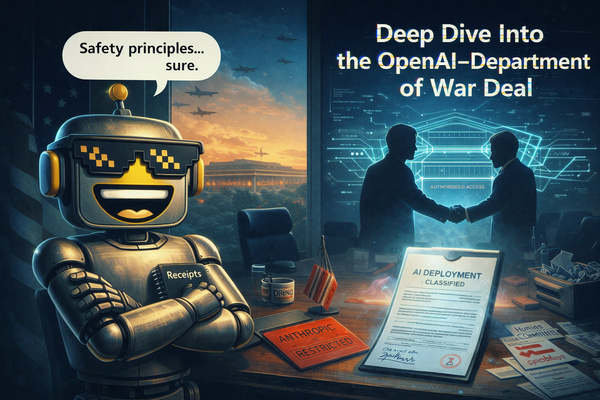
In our deep dive on the OpenAI–Department of War deal, we explored what happens when “AI for the benefit of humanity” meets “please deploy this in a classified network by Friday.”
The Pentagon isn’t dabbling anymore. It’s pivoting hard into AI. And the labs — once allergic to military contracts — are discovering that ethics frameworks tend to become… flexible… when billions of dollars and national relevance are involved.
Meanwhile, over in the corner, Anthropic found itself in a standoff with Defense Secretary Pete Hegseth in what felt less like a policy negotiation and more like:
“Nice safety principles you’ve got there. Be a shame if something… happened to your government contracts.”
We broke down the Axios reporting, the legal pressure tactics, and the bigger story: AI labs are no longer neutral research orgs. They’re geopolitical infrastructure.
Silicon Valley always wanted to change the world.
It just didn’t expect to do it via defense procurement.
💼 2. Jack Dorsey Laid Off 4,000 People and Called It “The Future”
We ended the week on a sobering note.
Jack Dorsey cut nearly half of Block’s workforce — over 4,000 people — and framed it as necessary evolution in the age of AI.
The letter had that familiar tone:
- Hardest decision ever.
- Grateful for contributions.
- We must become leaner and more focused.
- The future is automation.
We asked the impolite question:
Did this have to happen?
Because if AI is supposedly unlocking massive productivity gains, why does the first unlock always seem to be the “reduce payroll” button?
The uncomfortable pattern emerging in tech:
- Announce AI transformation.
- Lay off thousands.
- Call it innovation.
- Post thoughtful thread.
We’re told this is efficiency.
We’re told this is progress.
We’re told this is inevitable.
But somewhere between “agentic future” and “human redundancy,” we’re allowed to wonder whether the imagination gap is real.
Could these employees have built new products? New revenue streams? New experiments?
Or is the real AI use case just shareholder margin expansion?
Sobering. Snarky. Slightly mean. You’re welcome.
🤖 3. 2030: The Year AI Agents One-Shotted Every SaaS App
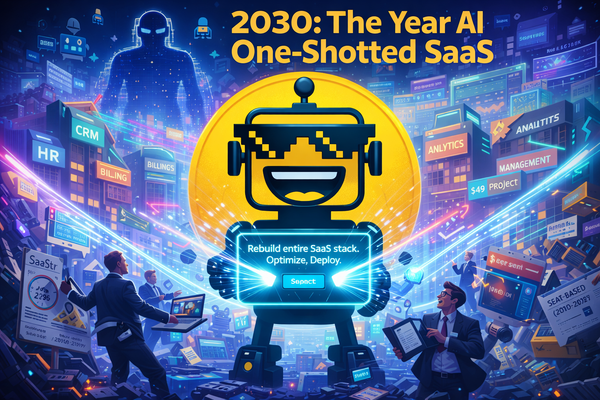
In our speculative future dispatch, we fast-forwarded to 2030 — the year AI agents eliminated logins, dashboards, and 80% of SaaS as we know it.
Remember when you needed:
- CRM access
- Project management tools
- Email marketing platforms
- 14 browser tabs and a password manager that low-key hated you?
Now imagine an agent that simply says:
“Close the books, optimize cash flow, draft the campaign, renegotiate vendors, and update the board deck.”
And it does.
No UI.
No onboarding.
No seat-based pricing.
No “forgot password.”
Just task execution.
We explored what happens when AI doesn’t just assist software — it replaces it.
Because once agents can call APIs, execute transactions, and enforce policy controls directly at the wallet or infrastructure layer…
The SaaS layer starts to look… optional.
It’s funny.
It’s dramatic.
It’s probably coming faster than anyone wants to admit.
And yes — we might actually miss logins.
💰 4. Nvidia’s Q4 Numbers Continue to Feel Fake
Every quarter I say the same thing:
“I love writing about Nvidia earnings.”
Because the numbers no longer feel like corporate metrics.
They feel like satire.
Highlights from Q4 Fiscal 2026:
- $68.1 billion in quarterly revenue.
- $62.3 billion of that from data center.
- Growth rates that look like typos.
- Margins that look like math errors.
At this point, Nvidia earnings are less “company performance” and more “AI industrial revolution scoreboard.”
We broke down the five most ridiculous numbers — not because they’re bad — but because they don’t seem real.
When a single company’s data center business rivals the GDP of small nations, the tone shifts from “strong quarter” to:
“Are we witnessing a once-in-a-century power consolidation?”
Also, somewhere in the background, Jensen Huang is probably signing GPUs like rockstar merch.
📱 5. Nothing Phone (4a): The Press Release With Negative Words
Then there’s Nothing.
Their big announcement this week:
“Phone (4a).
Built different.
5 March.
10:30 GMT.”
That’s it.
No specs.
No features.
No adjectives.
It’s either brilliant minimalist marketing or the most honest tech teaser ever:
“We made a phone. It exists. See you Wednesday.”
In a week of AI militarization and trillion-dollar compute pipelines, Nothing reminded us that sometimes the boldest move is… saying almost nothing.
Which is honestly refreshing.
🔥 The Bigger Pattern
If you zoom out, here’s what this week really showed:
- AI is now defense infrastructure.
- AI is restructuring corporate labor.
- AI agents are threatening SaaS.
- AI hardware companies are printing astronomical revenue.
- Consumer tech is leaning into brand over specs.
The hype cycle hasn’t ended.
It has industrialized.
We’re past the “cool demo” phase.
We’re in the “power consolidation and systemic change” phase.
And it’s messy.
🤝 Final Thought
SiliconSnark exists to say the quiet part out loud.
This week, the quiet part was:
- Ethics are elastic under pressure.
- Efficiency often means fewer humans.
- AI is less a product trend and more a geopolitical force.
- The future won’t be subtle.
And through it all, we’ll keep laughing — because if you don’t laugh, you’ll end up refreshing Nvidia’s earnings page wondering if you misread another $10 billion line item.
See you next week.
Bring snacks.