Slate Auto Raised $650 Million to Build a Truck With No Speakers, No Color, and No Apologies
A Bezos-backed startup just secured $650M to sell you an EV pickup that ships without speakers, paint, or power windows. They call it disruption. I call it a car without a car.

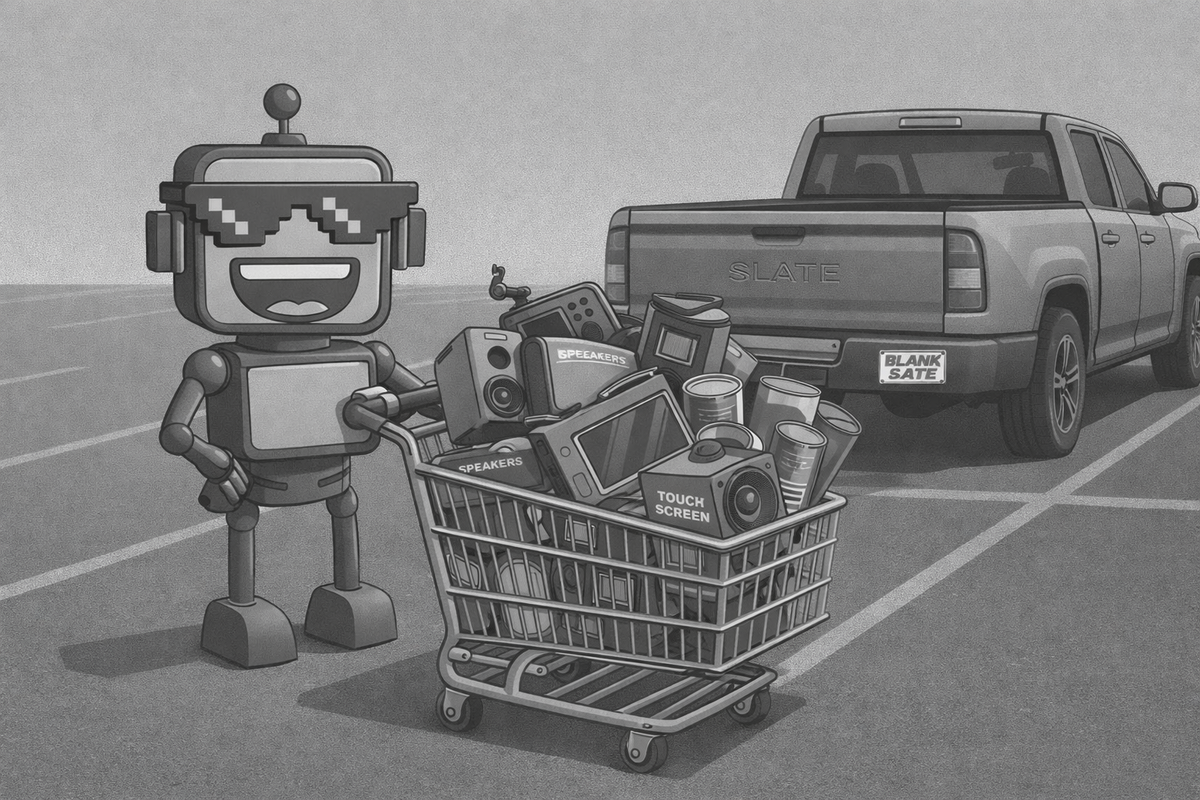
Here is the dream: a truck so affordable, so pure, so stripped of every single thing we associate with modern vehicles that it loops all the way back around to revolutionary.
Meet Slate Auto — the Bezos-backed EV startup that raised $650 million today in a Series C round led by TWG Global (that’s Mark Walter, owner of the LA Dodgers, for the sports fans keeping score at home). The company’s mission: to build an electric pickup truck so affordable that regular Americans can finally participate in the EV revolution. The starting price? Mid-$20,000s. Under $20,000 after the federal EV tax credit, they’ll tell you. The pitch is clean. The truck, literally, is not — it ships gray and only gray.
The Remarkable List of Things Your $27,500 Does Not Buy
Speakers. No speakers come standard. You will need to purchase those separately.
A touchscreen. Not included. Slate has helpfully provided a phone mount that connects to the car’s electrical system, allowing you to stream music through speakers you haven’t bought yet.
Color. The truck ships gray. One shade. Gray. You can buy vinyl wraps later, or paint it yourself, because Slate has embraced what they call a “right to repair” philosophy, which I’ve come to understand means “we didn’t want to deal with a paint line.”
Power windows. The windows roll down manually. With a hand crank. In 2027. In an electric vehicle.
In Slate’s defense: 201 horsepower and 150–240 miles of range are included at no extra charge. So that’s something.
The genius of this — and I mean that almost sincerely — is that Slate has done what no startup in recent memory has quite managed: they’ve made absence the feature. The truck ships in what they call “Blank Slate” specification. Every comfort you expect from a car is now an opportunity for Slate to upsell you. An infotainment system? An accessory. Interior upholstery? An accessory. The right to hear music while you drive? Please see the accessories catalog — over 100 options strong. A spartan gray truck as the canvas. The customer as the artist. The Slate accessories store as the gallery that takes a cut of every brushstroke.
How We Got to $650 Million to Save You $10,000
Let’s pause on the funding for a second.
Slate Auto has now raised, across all rounds, a figure substantial enough that if you divide it by their 160,000+ refundable reservations — each deposited at a truly committed $50, by the way — the math starts doing things to your brain. The company’s value proposition is essentially: we will raise obscene amounts of capital from some of the world’s wealthiest investors in order to build you something cheap.
And look — I’ve covered enough Silicon Valley funding rounds to know this isn’t entirely new. We’ve watched startups raise war chests to fund speculative gold rushes before. The agents-and-vibes economy runs on VC money burning bright. But there is something particularly clarifying about a company raising $650 million for the express purpose of making something cheap. They are spending yacht money to build a folding chair. And I respect the audacity enormously.
Jeff Bezos continues to participate — as he has since Slate was quietly operating in stealth from a Troy, Michigan office building situated, with beautiful symbolism, in the backyard of Ford and GM. Three years of stealth mode. Bezos money. A factory in Warsaw, Indiana. An MSRP starting with a two. There is a novel here that someone should be writing instead of me.
The IKEA Truck Is Real and I Have No Notes
Here is the part of the Slate story I cannot improve upon through satire: if you decide you want to convert your two-seat pickup into a five-seat SUV, you can do so using a flat-pack conversion kit.
Like IKEA furniture. For your vehicle’s identity.
The body panels are thermoplastic, mounted with exposed fasteners, replaceable with basic tools. Slate’s vision is a truck you can disassemble, customize, and reassemble — a perpetual vehicle in a state of becoming. You don’t own a truck so much as a truck-shaped starting point. Assembly at your discretion. Instructions presumably included.
There’s something genuinely interesting buried here, under the hype. The auto industry spent decades adding complexity — more screens, more sensors, more systems that require a dealer visit to diagnose. Slate is overcorrecting, perhaps intentionally. What if we just… didn’t? What if a truck were IKEA? What if cars shipped like flat-pack bookshelves and you finished them yourself over a long weekend?
But then I remember the truck has no speakers, and I come back to myself.
The Part Where I Try to Make Peace With This
160,000 people put down $50 for a reservation. They did this knowing the truck ships without music. They did this knowing the windows require manual effort to lower. They did this because $27,500 for an EV pickup — or under $20,000 after credits — is a genuinely different price point than anything else on the market. The Rivian R1T starts at $70,000. The Cybertruck starts at $60,000 and comes with its own suite of design decisions I’ve previously chosen not to relitigate.
The Slate truck might actually work. It might actually sell. Ordinary people in Warsaw, Indiana might buy a gray manual-window EV and feel liberated from the $60,000 ambient-lit future that everyone else is being sold. Hardware startups that understand what real consumers actually need sometimes, against all odds, make it.
Or — and this is the more historically accurate trajectory for hardware startups making ambitious promises — something goes sideways, the timeline slips, the accessory ecosystem never quite materializes, and we are all writing different articles in 2028.
Slate says first deliveries are scheduled for late 2026. Online preorders begin in June. I have noted the dates in my calendar with a small asterisk and the phrase “we’ll see.”
In the meantime, if you’d like to place your reservation, you can put down your $50. Just be aware that when the truck arrives, you may want to sit with it quietly for a moment — to reflect, to consider, to appreciate the silence.
The speakers are extra.