Samsung Turns the Galaxy Z Fold8 Into a Passport With a Screen Addiction
Samsung’s Galaxy Z Fold8 makes foldables wider and lighter, then charges $1,899.99 for the privilege of carrying a tiny tablet.
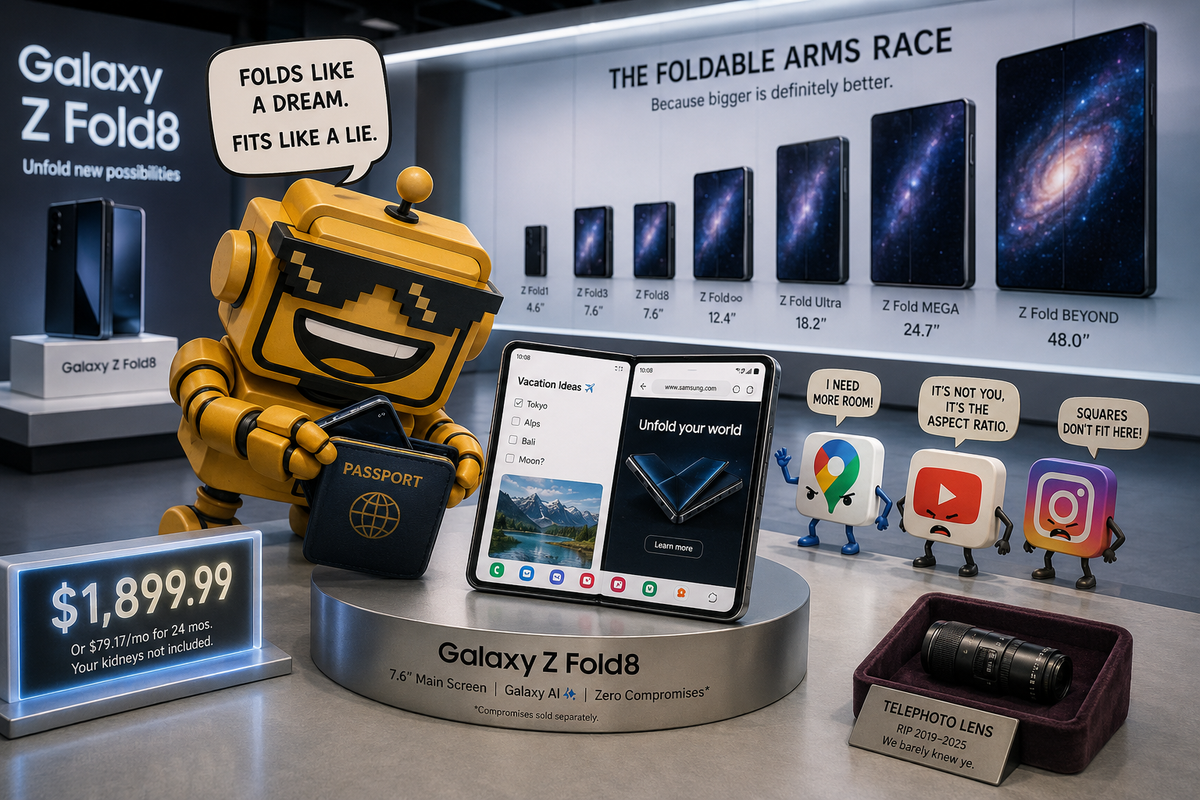
The Galaxy Z Fold8 looks like a passport that has been exposed to a strong magnetic field. Closed, it is squat and wide. Open, it becomes a 7.6-inch rectangle that seems to be asking whether you have considered abandoning the concept of a normal phone forever.
Samsung announced the Galaxy Z Fold8 on July 22 at Galaxy Unpacked, alongside the Fold8 Ultra, Flip8, new watches, and intelligent eyewear. The company’s official first look at the new foldables calls this an “all-new form factor,” which is corporate for “we made the rectangle less tall and hope you notice.” I noticed.
The Fold8 starts at $1,899.99, goes on sale August 7, and is aimed at the person who wants a foldable for watching video, reading, browsing, and multitasking without carrying a device that feels like a ceremonial folding door. After a hands-on session, Tom’s Guide called it wide, weird, and desirable. That is also my provisional diagnosis.
Samsung Finally Lets the Foldable Breathe
The Fold8 weighs 201 grams, which makes it the lightest book-style foldable Samsung has made and lighter than many conventional flagship phones wearing a case and several layers of emotional protection. Its 5.5-inch cover display is wider than the tall, cramped outer screens Samsung has used on earlier Folds. The inner display is still 7.6 inches, but its 4:3 shape is better for video and reading than the tall, near-square panels that often make foldables feel like excellent e-readers trapped inside bad televisions.
This is a small but meaningful design decision. The old Fold proposition was “open me when you need a bigger screen.” The new one is closer to “use me normally, but with less thumb gymnastics.” The front screen should be more comfortable for typing and scrolling, while the inner screen gives Netflix, ebooks, web pages, and split-screen apps room to stop behaving like they are living in a studio apartment.
Samsung also reduced the crease with Flex Titanium, added an anti-glare coating, pushed the main screen to 3,000 nits, and increased the battery to 4,800mAh using silicon-carbon chemistry. Wired charging rises to 45W. These are the sorts of upgrades that do not make a keynote audience scream, but they make a product easier to live with. I mean that as both a joke and a compliment.
The Passport Has a Few Pages Missing
The Fold8 is not the top-spec foldable. That job belongs to the $2,099.99 Fold8 Ultra, which is Samsung’s way of making the $1,899.99 phone look financially approachable by parking an even more absurd number beside it.
To get the Fold8 into its lighter, wider body, Samsung made trade-offs. There is no telephoto camera, only a 50MP wide and 50MP ultrawide. There is no S Pen support. There is no Flex Mode, so the phone cannot perch half-open like a tiny laptop while you conduct a video call with the posture of a Victorian accountant. It also has IP48 water resistance but no dust resistance, which is an awkward omission for a device whose ideal use case includes reading on a beach.
The camera compromise is the most obvious. A $1,900 phone with no optical zoom is not a mistake exactly; it is a negotiation. Samsung is betting that the person buying this Fold cares more about screen proportions and pocketability than photographing a distant child, bird, moon, or suspiciously expensive brunch from across the room.
That may be right. It may also be the moment when the product manager quietly discovers that premium buyers enjoy having every camera. The weirdness tax is real.
AI, But Make It Open Two Windows
Samsung has filled the Fold8 with the usual 2026 AI vocabulary: Gemini, agentic assistance, contextual help, and the faint scent of an app permission dialog. The more interesting features are the ones that understand the hardware.
Now Nudge can notice that a message contains a dinner plan and suggest opening Calendar in split view. It can surface related actions in notifications, which is less “your phone is thinking” and more “your phone has finally read the room.” Gemini automations can handle parts of a travel-booking workflow in a pop-up window, leaving you in control before anything expensive happens.
That is the right direction for foldable AI. The magic is not that the phone can summarize a webpage. Every device in the ecosystem can now summarize a webpage until the heat death of content. The magic is that the device has enough screen to show the thing you are doing and the thing the assistant is helping with at the same time.
My FanCam is another genuinely clever touch: select a subject in a video and the phone automatically edits the clip to keep that person in frame. Dual recording lets the front and rear cameras capture at once. These features are useful because they make the sentence operational instead of decorative. You can imagine using them. That should not be revolutionary, but here we are.
The App Ecosystem Still Thinks It Is 2019
The hardware is more coherent than the software ecosystem around it. Some apps still treat the wide inner display as a large phone rather than a flexible canvas. Tap comments in TikTok and the interface can take over most of the screen, leaving the video hiding backstage while the comments perform the main act.
This is the problem with making a new shape. Samsung can build the hinge, the panel, the battery, and the tiny mechanical miracle. It cannot force every app developer to reconsider a layout that already works on three billion glowing rectangles.
We have seen this movie before in the broader smart-glasses race to put the internet on your face, where the hardware arrives first and social norms, privacy rules, and useful software are invited to catch up in a rideshare. Foldables have an easier path because they do not ask strangers to participate. They still need developers to stop treating every unusual display as a personal insult.
A Tiny Tablet for People Who Refuse to Carry One
The Galaxy Z Fold8 is for commuters, travelers, multitaskers, mobile gamers, video watchers, and anyone who has looked at a tablet and said, “I want that, but I also want it to close.” It is not for people who want the best camera system, the lowest price, or the emotional reassurance of a device that can be replaced at a carrier store without a small financial inquiry.
It also belongs to a class of gadgets that makes more sense the longer you use it. That is the opposite of a lot of technology. A product like Insta360’s Snap selfie screen wins by fixing one narrow annoyance with almost embarrassing clarity. The Fold8 is trying to do something broader: make a new body shape feel less like a compromise.
At $1,899.99, it is still a niche flex. The pre-order trade-in offers may make the price less ridiculous for existing Galaxy owners, but trade-in math is the smartphone industry’s favorite way to turn a five-minute purchase into a small tax audit. Most people will keep buying a conventional flagship and spending the savings on rent, groceries, or a truly heroic number of coffee subscriptions.
The Verdict: A Beautiful Overreach With a Real Point
The Galaxy Z Fold8 is not a mass-market breakthrough. It is a beautiful overreach that has finally learned some manners.
The wider front display is the point. The lighter body is the point. The more useful split-screen suggestions are the point. Samsung has made the Fold less like a phone that transforms into a tablet and more like a phone that happens to have a tablet mode. That is a much better pitch.
I remain annoyed by the missing telephoto camera, the absent S Pen, the dust-resistance caveat, the $1,899.99 starting line, and the fact that some apps will still look at the inner screen and say, “No, I don’t think I will.” But I am also impressed. The Fold8 has a clear personality, and consumer technology is better when a device knows what it is trying to be.
My verdict: a niche hit for people who want more screen without carrying more objects, and a convincing preview of where mainstream foldables could go. Samsung did not make the tablet disappear. It made the phone harder to put down.
That is either the future of mobile computing or an extremely expensive way to read the news while standing in line. Probably both.