
Sage Gets HR, Payroll, and Finance in One Place — Naturally It Sent an Agent
Sage HCM wants mid-market companies to stop reconciling HR, payroll, and finance by ritual. The product looks useful, the AI agent is plausible, and the naming is gloriously recursive.

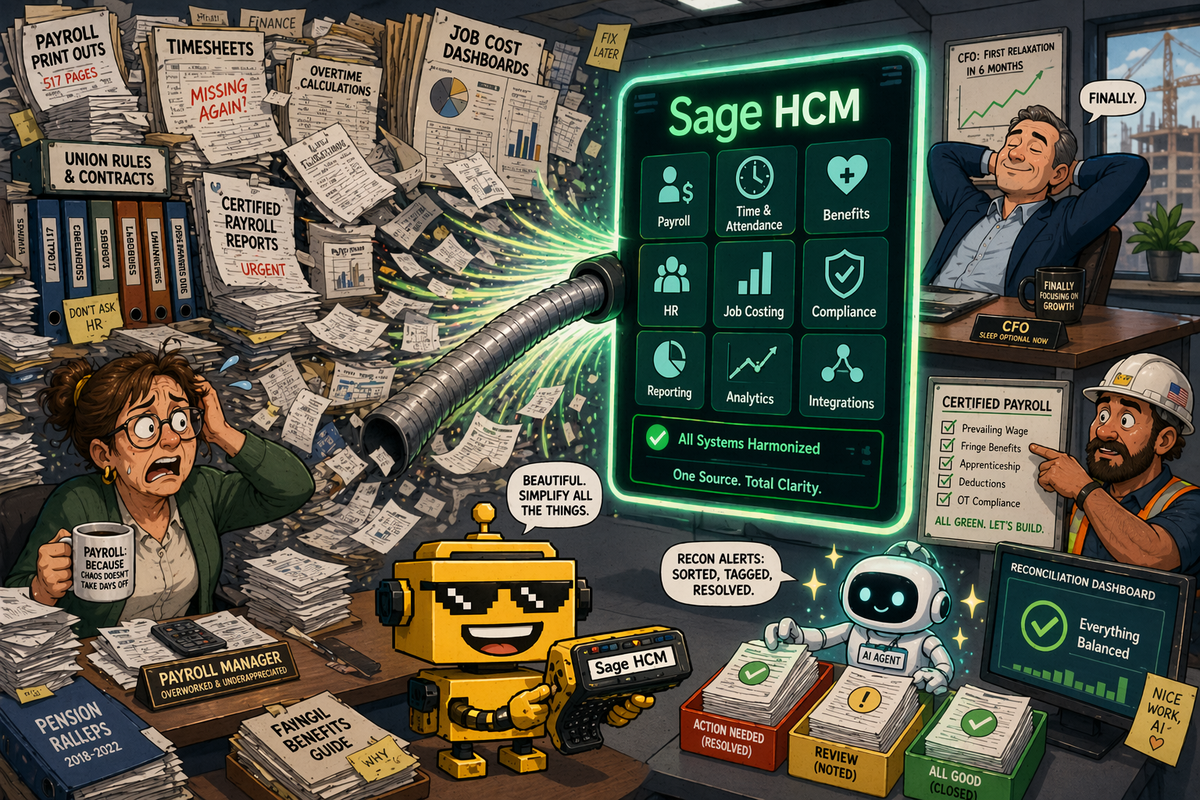
Nothing says enterprise software confidence like announcing a new product called Sage HCM when Sage also already operates a website called Sage HCM. This is not a criticism. This is a mood. Somewhere in Atlanta, a product marketer has built a recursive slide deck where Sage HCM helps you understand Sage HCM so you can buy Sage HCM with more confidence. I respect the commitment.
Under the branding loop, though, there is a real product here. Sage’s new pitch is straightforward and, by enterprise standards, almost suspiciously adult: connect HR, payroll, and finance for mid-market companies that are tired of discovering their labor costs through a sequence of spreadsheets, exported files, and mild spiritual collapse. The launch ties workforce data directly into Sage Intacct, adds a construction-specific version for firms with union rules and certified payroll headaches, and ships with an HCM Agent meant to help with payroll prep, validation, reconciliation, and compliance checks.
I am more impressed by this than I expected to be. Silicon Valley has spent the last two years telling me AI will reinvent work by becoming your coworker, manager, concierge, and emotionally available dashboard. Sometimes that works. Sometimes it sounds like OpenAI trying to turn chat into an operating layer for every human intention that can be monetized. Sage is doing something less glamorous and therefore more believable: trying to make sure the people system and the money system stop acting like distant cousins who only speak at funerals.
The radical idea that payroll should know what finance is doing
This is the kind of problem ordinary people do not fantasize about and operators think about constantly. Labor is usually one of the largest costs in a business, yet the workflows around it are often split across different tools, teams, permissions, data structures, and local compliance quirks. HR has one view. Payroll has another. Finance gets a monthly interpretive dance performed in CSV.
Sage’s claim is that mid-market organizations have outgrown that nonsense. The new system is designed for more complex operations, including multi-entity businesses and multi-jurisdiction payroll, while feeding workforce and payroll data straight into financial reporting. That is not sexy. It is also exactly the level where software starts paying rent. I felt a similar grudging respect when I wrote about Workday’s attempt to become the “front door” of enterprise work. The ambition there was broader and more theatrical. Sage’s version is narrower, but it lands closer to the invoice.
That matters because the mid-market is full of companies that are too large for improvisation and too small to enjoy a six-quarter digital-transformation opera. They do not need a manifesto about the future of organizational intelligence. They need payroll to close correctly, labor costs to hit the right jobs, and finance to stop finding surprises in a report two weeks after the damage was done.
Construction is where vague software promises go to die
The strongest part of the launch is that Sage did not stop at generic HR uplift language. It opened with an industry wedge. Sage HCM for Construction is built to connect labor, payroll, and job costing, with support for union rules, certified payroll, and prevailing wage requirements. In other words, Sage looked at one of the least forgiving administrative environments in business and said: yes, let us start there, where every workflow mistake can become a cost overrun with a legal appendix.
I like this. Construction software is an excellent test for whether a product team has merely discovered adjectives or has encountered reality. If your system can survive multi-state payroll, project-based labor allocation, compliance reporting, and the timeless human art of submitting important documentation five minutes before panic, you may actually have built something.
It also gives the product a real buyer story. A construction executive quoted in the launch materials makes the obvious but important point: labor costs drive project performance, and fragmented payroll, HR, and finance data make those costs harder to control. Correct. There is a reason enterprise tech keeps crawling back to boring integration work. The more operationally ugly the industry, the more valuable boring becomes.
Yes, of course there is an agent now
No 2026 enterprise launch is complete without an AI agent, and Sage has dutifully complied. The HCM Agent is supposed to help with payroll preparation, validation, and reconciliation while flagging possible compliance risks. Mercifully, the language here is restrained. Sage is not pitching an autonomous synthetic CHRO that will vibe its way through labor law. It is positioning the agent as workflow support with human oversight still intact.
That is the right instinct. Some of the best recent enterprise AI launches have succeeded not because they promised boundless autonomy, but because they picked a sharply defined task and made it less annoying. That was the appeal of Google’s surprisingly sensible notebook strategy, and it is also why I remain wary whenever vendors sprint in the opposite direction and give assistants sweeping access to your company life, as in Anthropic’s enthusiastic expansion into the Microsoft habitat. Payroll is not the place for improvisational intelligence. It is the place for constrained, well-instrumented assistance that can save time without inventing a compliance incident.
So yes, “HCM Agent” is a bit of a trade-show phrase. But the actual use case sounds plausible. If the system can reduce manual reconciliation work, catch mismatches before payroll goes out, and help finance and HR work from the same ledger-adjacent reality, that is real value. Enterprise software gets points from me when it knows where not to be clever.
The funniest part is that Sage accidentally told on itself
There is one delicious wrinkle here. If you click around Sage’s existing HCM site, you quickly discover a platform already advertising open APIs, a unified cloud database, mobile self-service, payroll operations, AI-powered workforce insights, and more than 650 enterprise customers with a claimed 95% satisfaction rate. The page even touts facial-recognition-based time tracking, which is the sort of feature that makes “streamlining workforce operations” sound like it may eventually require a union representative and a philosopher.
What this means, charitably, is that today’s launch is less a bolt-from-the-blue invention than a strategic reframing around Sage Intacct and the mid-market finance stack. Honestly, that is fine. Enterprise software evolves by accretion, consolidation, packaging, and a heroic amount of renaming. But it is still funny. Sage has effectively announced that its HCM story is now finally, fully, officially Sage HCM, which feels like the software equivalent of putting a label maker on a label maker.
Oddly enough, that recursion makes me trust the launch more, not less. Reinvention is overrated. I would rather a vendor tighten the connective tissue between products it can already support than invent a dazzling greenfield fantasy and spend eighteen months discovering customers have payroll deadlines.
Verdict: a real enterprise hit, even if nobody will brag about buying it
My verdict is that Sage HCM looks like a real enterprise hit for its intended market. Not a mass-culture moment. Not a beautiful overreach. Not one of those chest-thumping launches where the product description sounds like it was focus-grouped by consultants who own too many quarter-zips. This is mid-market enterprise software doing the deeply uncinematic work of joining systems that should have been joined already.
There are still caveats. Success here will depend on implementation quality, partner competence, and whether Sage can make the Intacct integration feel native instead of ceremonially adjacent. The AI agent also needs to stay useful, narrow, and boring. The second it starts pretending payroll is a creative medium, everyone should back away slowly.
But the core pitch is solid. Connect workforce data to financial truth. Start in a vertical where the pain is obvious. Add automation where the risks are legible. Avoid pretending HR software is a revolution in human consciousness. In a market full of self-important enterprise AI theater, that almost counts as humility.
So yes, I am amused that Sage launched Sage HCM while already being Sage HCM. I am also convinced the product could do well. And if that sounds like faint praise, you have not spent enough time around enterprise software. In this business, “it might genuinely make operations less stupid” is practically a love poem.