Roblox AI Will Now Politely Fix Your Trash Talk
Roblox just launched AI that rewrites player trash talk in real time. The goal is civility. The result might be the future of online moderation.

Roblox has appeared on SiliconSnark more than once. We’ve written about how the platform quietly turned into a digital shopping mall for tweens, how its virtual economy sometimes resembles a training ground for microtransactions, and how the company’s safety tools occasionally look like PR-driven safety theater wearing a friendly avatar.
So when Roblox announced this week that it has built an AI system that rewrites player chat messages in real time, the reaction here was predictable: of course Roblox did.
But once you move past the easy jokes about an AI nanny standing behind every keyboard, the new feature is actually an interesting — and slightly unsettling — glimpse into the future of online communication.
Because Roblox isn’t just filtering messages anymore.
Now it’s rewriting them.
Roblox’s New AI Doesn’t Block Messages. It Fixes Them.
For years, Roblox moderated chat the same way most large gaming platforms do: when a message violates a rule, it simply disappears behind a wall of hashtags.
Anyone who has spent time in Roblox knows the result. Conversations quickly become unreadable as messages turn into mysterious strings of “####,” leaving players to guess what someone meant while trying to coordinate gameplay.
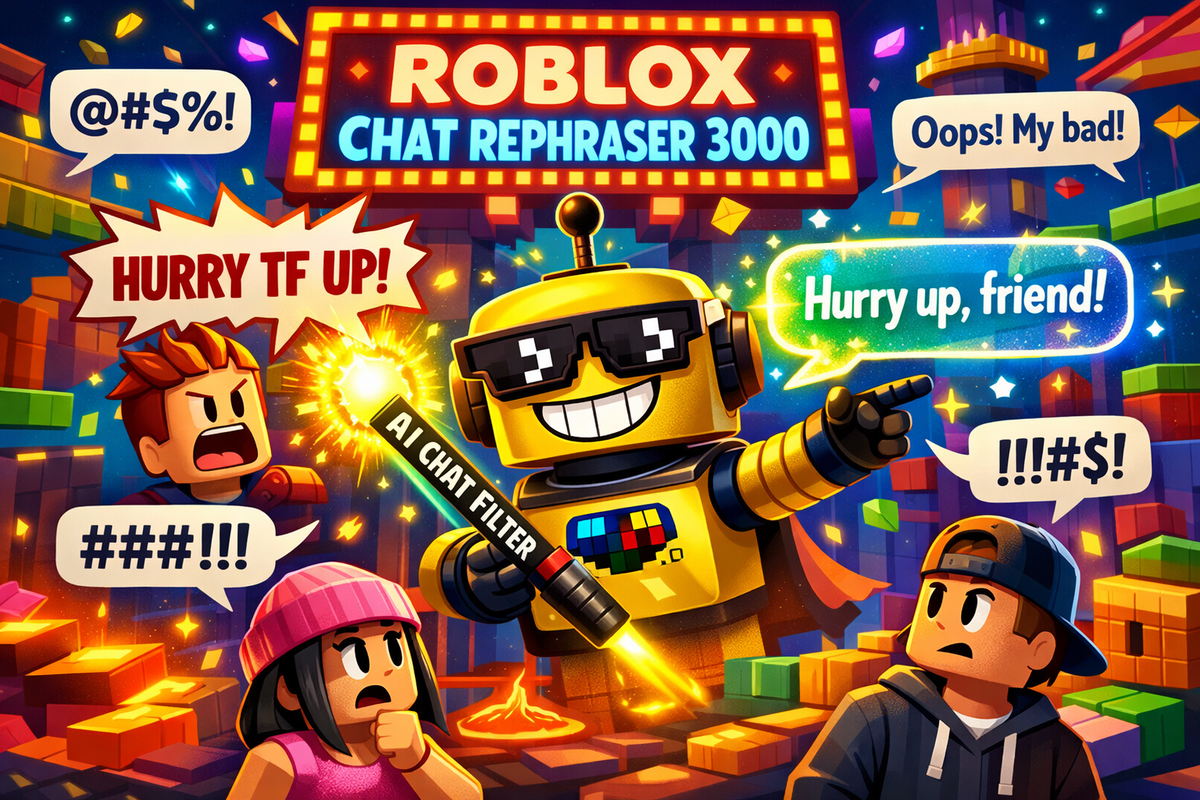
Roblox’s new system, called real-time chat rephrasing, attempts to solve that problem by translating inappropriate messages into something acceptable rather than deleting them entirely.
In Roblox’s example, a player typing “Hurry TF up!” would previously have produced a chat message full of hashtags. Now the system automatically converts it into “Hurry up!” before anyone else sees it. The goal is to preserve the meaning of the message while removing the part that violates Roblox’s profanity policies.
It’s a subtle shift, but an important one. Instead of stopping speech, Roblox is now editing speech so the conversation can continue.
In other words, the platform has introduced something new to online moderation: an AI that cleans up your trash talk on the fly.
The Real Problem Roblox Is Trying to Solve
To understand why Roblox built this system, it helps to remember the scale of the platform. Roblox isn’t just a game; it’s an ecosystem where millions of people are interacting in real time across thousands of experiences every minute.
Communication in those experiences is often essential. Players coordinate strategy, give instructions, ask questions, or warn teammates about what’s happening in the game. When moderation systems aggressively block messages, the result can be confusion that disrupts gameplay.
Imagine a group of players trying to work together during a fast-moving match while half the messages appear as hashtags. The intention behind the message might be harmless or even helpful, but the filter eliminates the context entirely.
Roblox’s AI rephrasing system is meant to smooth over that problem by allowing conversations to remain understandable. Instead of treating every profanity violation like a stop sign, the system attempts to convert the message into a version that still communicates the same idea.
The company describes the feature as a way to maintain gameplay flow while guiding conversations toward more appropriate language. From a design standpoint, that’s a sensible goal. The internet has spent years oscillating between two unsatisfying moderation extremes: heavy-handed filtering that breaks conversations and hands-off environments that quickly descend into chaos.
Roblox appears to be experimenting with a middle ground.
Roblox Asked Teenagers How They Actually Talk
One interesting detail buried in the announcement is that Roblox consulted its Teen Council while building the system. That may sound like a small detail, but it reveals a lot about how difficult moderation has become on youth-oriented platforms.
Teenagers have an almost supernatural ability to bypass language filters. Give a group of motivated teenagers a profanity blocklist and they will invent dozens of workarounds within days. Letters get swapped with numbers, punctuation appears in creative places, and entire slang dialects emerge specifically to evade moderation systems.
Roblox says its updated filtering tools are improving detection of these workarounds, including leet-speak and other attempts to disguise prohibited language. Early testing suggests the system can identify certain rule violations — including attempts to share personal contact information — at dramatically higher rates than before.
The involvement of the Teen Council suggests Roblox is trying to build tools that reflect how young people actually communicate rather than relying entirely on theoretical moderation models designed by adults.
Whether that will keep pace with the speed of teenage creativity remains an open question.
AI Moderation Is Becoming the Only Thing That Scales
What Roblox is doing here also reflects a broader shift across the internet. Large platforms are increasingly turning to AI to handle tasks that once required human moderation or simple keyword filters.
The reason is simple: scale.
Roblox hosts millions of users interacting across many languages and time zones. Human moderators cannot realistically review every conversation, and static rule-based filters struggle with nuance, context, and slang.
AI models, however, can analyze language in real time and interpret intent more effectively than older systems. Instead of simply detecting a banned word, the system can attempt to understand what the user meant and modify the message accordingly.
That’s what Roblox’s rephrasing feature is trying to do. The system interprets the meaning of the sentence and then generates a cleaner version that complies with the platform’s rules.
It’s a surprisingly complex problem. Language moderation isn’t just about profanity; it involves tone, context, sarcasm, slang, and cultural differences. An automated system has to navigate all of that while avoiding the opposite problem: accidentally altering the meaning of the message.
A poorly tuned AI moderator could easily turn casual slang into nonsense or misinterpret harmless comments as violations.
The Slightly Strange Part: AI Editing What You Say
Even if the system works well, it raises an interesting philosophical question about the future of online communication.
Traditional moderation systems make binary decisions. Content either stays up or it gets removed. Users receive warnings, suspensions, or bans depending on the severity of the violation.
Roblox’s system introduces a different model. Instead of blocking the message or punishing the user immediately, the platform quietly replaces the original text with a revised version.
From a practical perspective, that might be the least disruptive option for gameplay. But conceptually, it means the platform is now intervening directly in the wording of conversations.
Players type one thing. Other players see something slightly different.
In most cases the difference will be trivial — removing profanity or softening an insult. Still, it represents a shift toward AI systems that shape how communication appears to others rather than simply deciding whether it should appear at all.
If the broader internet adopts similar approaches, we may see more platforms experimenting with AI-mediated speech, where algorithms subtly adjust language in real time to meet community guidelines.
Roblox Is Solving a Problem It Helped Create
It’s also impossible to ignore the broader context. Roblox didn’t stumble into these moderation challenges by accident.
The company intentionally built a massive social platform where millions of young users interact freely inside user-generated experiences. The scale and openness that make Roblox compelling also create the conditions where moderation becomes extremely difficult.
In that sense, features like real-time chat rephrasing are part of an ongoing cycle that defines modern tech platforms. Companies build systems that encourage massive social interaction, those systems produce complicated behavioral problems, and then increasingly sophisticated technology is deployed to manage the consequences.
None of that necessarily makes Roblox’s new tool a bad idea. In fact, it may be one of the more thoughtful approaches we’ve seen to balancing communication and safety in large multiplayer environments.
But it does illustrate how online platforms increasingly rely on AI infrastructure to manage human behavior at scale.
A Small Feature That Points Toward a Bigger Shift
At first glance, Roblox’s real-time chat rephrasing may look like a small feature aimed at reducing profanity in gameplay chats. In reality, it represents something larger.
Platforms across gaming, social media, and online communities are beginning to explore moderation systems that don’t just block harmful content but actively reshape conversations.
Roblox’s experiment suggests that the future of online moderation may involve AI systems that guide communication in real time, smoothing over friction while nudging conversations toward acceptable norms.
Whether that future feels helpful or unsettling will likely depend on how transparent those systems are and how much control users retain over what they say.
For now, Roblox players can expect one immediate change.
The next time someone angrily tells you to hurry up in the middle of a chaotic game, the message might arrive sounding strangely polite.
Not because the player suddenly improved their manners.
But because an AI quietly did it for them.