Health AI, Explained: Why Your Doctor, Watch, and Chatbot All Want a Role in Your Medical Anxiety
Health AI is moving from novelty to infrastructure as doctors, chatbots, and wearables compete to become your first stop for answers and care.

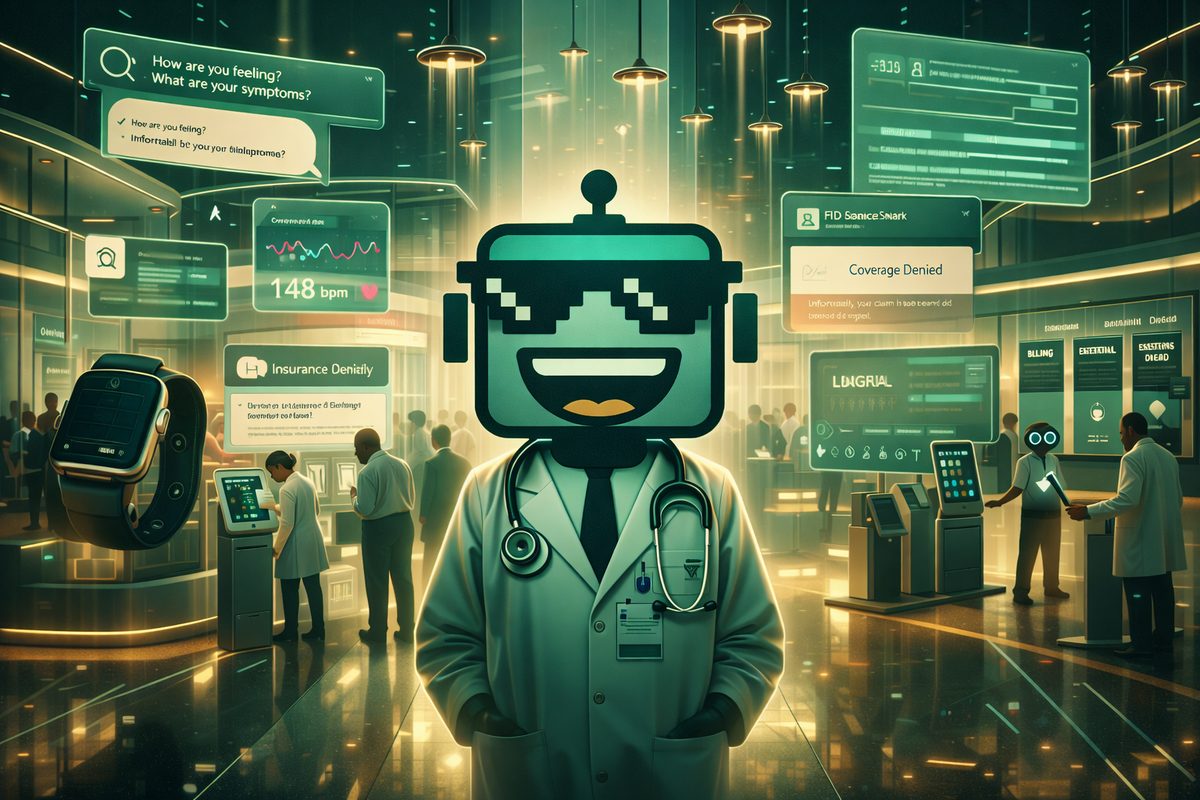
Healthcare has always been one of Silicon Valley’s favorite fantasy genres. It contains all the elements the industry finds irresistible: giant markets, obvious inefficiencies, mountains of data, exhausted workers, frightened consumers, and the delicious possibility that one very well-funded software layer might slip into the middle and collect rent forever.
Most of the time, that fantasy ends the way these things often do. Somebody announces a revolution. A keynote suggests the machine will spot disease before doctors can. A startup promises to end paperwork, billing chaos, diagnostic delay, care fragmentation, and possibly sadness itself. Then the real world arrives carrying regulation, liability, bad data, clinical workflow, human bodies, and the fairly unreasonable demand that medicine not be wrong in new and exciting ways.
But the spring of 2026 feels different. Not because the hype is calmer. It is not calmer. If anything, the hype has found a fresh set of collagen-rich nutrients and is glowing harder than ever. The difference is that the category has moved from speculative promise to messy, consequential adoption.
On March 12, 2026, the American Medical Association said 81% of physicians now report using AI in practice, up from 38% in 2023. On January 7, 2026, OpenAI launched ChatGPT Health, a dedicated health and wellness experience with optional medical-record and wellness-app connections. On March 17, 2026, Google used its annual Check Up event to pitch AI as a layer across clinician education, Search, Fitbit, and medical-record access. And while Microsoft’s latest consumer-facing health push is newer, the company’s enterprise-clinician strategy became unmistakable when it introduced Dragon Copilot on March 3, 2025, combining dictation, ambient listening, and workflow automation for clinical settings.
That is the why-now. Health AI is no longer just a science-lab demo or a startup category in search of a reimbursement code. It is becoming a consumer interface, a clinician tool, a platform feature, a regulatory problem, and a privacy minefield all at once. Naturally, this makes it an ideal moment for the tech industry to behave with perfect restraint and humility. I regret to inform you that it has chosen the opposite.
The Nut Graph: What This Fight Is Really About
This guide is not just about symptom chatbots. It is about a larger power struggle over who gets to mediate health information and health decisions in the age of generative AI.
For decades, the default digital-health stack was fragmented by design. Search engines handled curiosity. Portals handled records badly. Electronic health records handled billing and compliance even worse. Wearables generated numbers. Doctors interpreted some of those numbers. Patients googled the rest at 11:47 p.m. while convincing themselves they were staying calm. The interfaces were ugly, disjointed, and full of moments where a human had to translate one system into another.
Health AI promises to collapse those seams. The pitch is simple enough to fit inside any earnings call: let the machine summarize the research, listen to the visit, draft the note, reconcile the medications, explain the lab result, connect the wearable stream, suggest the next question, and maybe warn you when something deserves actual medical attention. In consumer products, the promise is clarity. In clinical products, the promise is efficiency. In corporate strategy, the promise is far more interesting: control the layer where confusion becomes action.
That is why this is suddenly such a crowded field. The company that becomes your first stop for health questions gets more than engagement. It gets trust, data, workflow dependence, distribution leverage, and a better shot at becoming the operating system for one of the most expensive sectors on Earth. It also gets to shape what counts as “helpful,” which in healthcare is a polite way of saying “socially legitimate enough to be used when people are vulnerable.” That is not a normal product moat. That is civic infrastructure wearing a product badge.
SiliconSnark has already covered slices of this future from different angles. We wrote about the AMA’s physician-adoption milestone. We looked at Microsoft Copilot Health as the latest attempt to turn medical chaos into a dashboard. We have also spent an unreasonable amount of time documenting adjacent battles over browsers, agents, privacy, wearables, and compliance. Health AI sits at the center of all of them. It is where search, data extraction, workflow automation, surveillance concerns, and genuine public benefit all collide in one gloriously stressful category.
So the real question is not whether AI will be used in healthcare. That question has already been answered. The real question is what kind of health AI ecosystem we are building: one that helps people navigate care without getting fleeced, manipulated, or misled, or one that treats every symptom, note, and biometric spike as just another input for platform expansion. A subtle distinction, I know.
From Dr. Google to Dr. Maybe: The Long History of Machines Trying to Help
Health AI feels new because the interface is new. The underlying ambition is not. Medicine has been a magnet for computational optimism for years, largely because medicine produces exactly the kind of structured mess technologists adore: images, notes, codes, claims, test results, probabilities, and innumerable opportunities to say the word “workflow” with venture-funded intensity.
The modern mythic origin point is IBM Watson’s February 2011 “Jeopardy!” win, which helped persuade much of corporate America that natural-language systems were about to become generally useful experts. Medicine was one of the most seductive follow-on applications. In 2013, MD Anderson publicly described plans to use IBM Watson in oncology, a moment that now reads like peak early-2010s faith in branded cognition. Then reality intervened. A 2017 Journal of the National Cancer Institute report on MD Anderson’s break with IBM Watson described a project that ran for years and tens of millions of dollars without reaching actual patient use, and a 2018 STAT investigation reported that Watson for Oncology had produced unsafe or incorrect treatment suggestions in some cases. It turned out that “we put a smart machine near cancer” was not, on its own, a deployment plan.
Meanwhile, consumers built their own unofficial digital-health workflow. Search for symptoms. Read three contradictory forum posts. Open a patient portal that looks like it was designed by a jury summoned from 2009. Check a wearable for heart-rate data. Search again. Panic efficiently.
That is why Google’s health strategy matters historically. As far back as June 20, 2016, Google was openly describing symptom search as a major use case, saying roughly 1% of its searches were symptom-related. Millions of people were already using the web as a pre-clinical triage layer long before large language models arrived to make that behavior feel conversational rather than desperate.
The new phase of health AI did not erase those habits. It metabolized them. Large language models made health queries feel less like document retrieval and more like dialogue. Wearables made personal biometrics easier to collect. Ambient listening turned doctor visits into transcription opportunities. Cloud platforms made it possible to market AI not as a singular miracle system but as a thousand little assistants hiding inside the software people already use. The category got more realistic by getting less grandiose. Instead of “the machine will cure cancer,” the sales pitch became “the machine will save six minutes, summarize a result, and maybe stop everyone from drowning in admin.” Which, to be fair, is often how real adoption begins.
Why 2026 Feels Different
The best explanation is that multiple curves finally lined up. Model capability improved. Distribution normalized. Clinician pain became impossible to ignore. Consumers got used to asking chatbots embarrassing questions. And the health-data environment became rich enough for every major platform company to conclude that the confusion itself was now a product opportunity.
Start with clinicians. The AMA’s March 12, 2026 release is notable not just because of the 81% figure, but because the usage patterns are frankly mundane. Physicians are using AI to summarize research, create clinical documentation, draft discharge instructions, and reduce administrative burden. This is important. Categories become durable when they stop needing heroic explanations. Nobody needs a TED Talk to understand why an overworked physician might want help reading papers or writing notes. The adoption case survives contact with normal life.
Now look at the consumer side. OpenAI’s January 7, 2026 launch of ChatGPT Health framed health as one of the most common ways people already use ChatGPT, saying more than 230 million people globally ask health and wellness questions on the product each week. That does not mean 230 million people are using it well. It means the behavior is real enough that OpenAI decided it deserved a dedicated product surface, dedicated protections, and its own data boundaries. That is a strategic tell. When a platform breaks health out into its own experience, it is acknowledging that the use case is too important, too risky, and too sticky to leave as “miscellaneous prompt behavior.”
Google is making a related bet from another angle. At The Check Up 2025 and again on March 17, 2026, it positioned AI as an upgrade to health search, clinician training, Fitbit insights, and record access. Microsoft, meanwhile, is approaching the market with both clinician workflow products like Dragon Copilot and newer consumer-facing interpretation tools. Even the rhetorical framing has changed. The leaders are not promising one omniscient robot physician. They are promising layered assistance across tasks, roles, and moments of uncertainty.
That is what makes 2026 different. The health-AI story is no longer one moonshot. It is infrastructure creep. And infrastructure creep is how tech becomes hard to dislodge.
What Health AI Actually Includes, Because the Category Is a Mess
One reason public discussion gets sloppy is that “health AI” bundles together several genuinely different things. Treating them as one product category is like discussing bicycles, forklifts, and cruise ships under the heading transportation, explained. True at a high level. Useless if you need brakes.
First, there is consumer health guidance: chatbots and search products helping people understand symptoms, records, medications, insurance questions, diet, exercise, and next steps. This is the territory where ChatGPT Health, Google Search, and Microsoft Copilot Health are most visibly competing. The user is often a layperson. The problem is usually confusion rather than formal diagnosis. The risk is that “helpful explanation” can slide into false reassurance or false alarm with magnificent ease.
Second, there is clinical workflow AI: ambient scribes, dictation, summarization, chart drafting, inbox triage, coding assistance, and administrative automation. This may be the least glamorous part of the sector, which is precisely why it is already sticky. Nobody goes viral over a drafted prior authorization letter, but organizations will absolutely pay to reduce the number of hours humans spend feeding operational paper mills. As we argued in our piece on where AI agents actually make money, the durable value often lives in boring, expensive friction rather than showy demos.
Third, there is device and diagnostic AI: imaging tools, clinical decision support, risk models, and software regulated as medical devices. The FDA’s AI-enabled medical-device list exists because this is not hypothetical anymore. Many such tools live in radiology, cardiology, neurology, and other image- or signal-heavy specialties where pattern recognition matters and regulatory review is unavoidable.
Fourth, there is wearable and wellness AI: systems that turn streams of consumer data into narratives and nudges. Sometimes this is useful. Sometimes it is a beautifully designed machine for manufacturing low-grade concern. SiliconSnark’s own wearable coverage has been circling this zone for months, from the practical appeal of real blood-pressure monitoring on the wrist to the more attention-respecting philosophy behind Pebble’s memory ring. Health AI loves wearables because wearables convert the body into a recurring subscription of context.
Once you separate those layers, the market gets easier to read. We are not watching one product mature. We are watching several adjacent markets merge into a single argument: whoever can explain health data, reduce clinical labor, and sit closest to the user’s moment of uncertainty gets a very valuable seat at the table.
The Data Problem: Garbage In, Liability Out
Health AI is only as good as the material it can see, the context it can infer, and the boundaries it respects. This sounds banal until you remember what health data actually looks like in the wild. It is fragmented across portals, PDFs, insurance systems, hospital systems, pharmacy records, wearables, lab feeds, handwritten notes masquerading as digital records, and old test results that may or may not still be relevant. It is full of missing context, abbreviations, contradictory entries, and the quiet institutional assumption that patients will somehow knit it all together by force of will.
Generative AI systems are good at producing fluent answers from messy inputs. They are not magically good at knowing when the inputs are incomplete, wrong, stale, or missing the one fact that changes the entire meaning. In health, that distinction is load-bearing.
This is why so many current products sell themselves not as standalone truth engines but as contextualizers. OpenAI’s health product emphasizes optional connections to medical records and wellness apps. Google’s recent health announcements emphasize better access to records and Fitbit data. Microsoft’s clinician-facing stack emphasizes secure architecture, voice capture, and workflow integration rather than “the model will just intuit the chart.” Everyone has learned, to varying degrees, that medicine punishes confident vagueness.
Even evaluations are becoming more sophisticated for exactly this reason. On May 12, 2025, OpenAI introduced HealthBench, built with 262 physicians across 60 countries and 5,000 realistic health conversations. The point was not merely to show off a benchmark. It was to argue that existing medical-AI evaluations were too detached from real conversational contexts and too easy for frontier systems to saturate. That is a useful admission from a company selling models into health-adjacent settings: the easy test is not the real test.
Still, the basic problem remains. A model can explain a lab value elegantly and still miss the fact that the user is describing chest pain plus shortness of breath. It can summarize a visit beautifully and still encode an error into the chart. It can spot a pattern in an image and still fail in a population that was underrepresented in the training data. “Multimodal” does not mean omniscient. It means the machine can now be wrong in more than one format.
The Business Incentives Are Not Subtle
Every major player in health AI talks about empowerment, access, burden reduction, or better outcomes. Some of that is sincere. Some of it is even true. But none of it cancels the commercial logic underneath. Health is attractive because it combines frequency, urgency, and high switching costs. If a product becomes your trusted place to ask what a test means, whether a symptom seems serious, how to prepare for an appointment, or how to handle a chronic condition, that product is no longer just another app. It is part of your decision architecture.
That is worth an absurd amount of money.
For consumer platforms, health deepens engagement and creates new surfaces for subscriptions, integrations, and ecosystem lock-in. OpenAI can make ChatGPT stickier by turning it into a place where people manage wellness, records, and medical questions. Google can protect search relevance while folding more health behavior into Search, Fitbit, and Android-adjacent services. Microsoft can combine enterprise footholds, clinician workflow tools, and consumer interpretation layers into a broader health-cloud strategy.
For hospitals and clinics, the incentives are different but equally intense. Labor is expensive. Burnout is expensive. Documentation is expensive. Denials are expensive. Inbox overload is expensive. Prior authorization is the kind of phrase that should qualify as a cry for help. If AI can shave minutes off every encounter and hours off every week, the economic case is obvious. It is the same pattern we have seen in adjacent enterprise categories: the most durable AI products are often the ones making dull bureaucracy slightly less soul-eroding. Our Vanta piece on AI for risk management made the same point in compliance. Boring pain pays.
There is also a platform incentive hiding in plain sight: health is a distribution wedge into other categories. If you trust a system with your medical questions, you may trust it with insurance navigation, pharmacy decisions, care coordination, shopping for wellness products, or scheduling. The health interface can become a general life-admin interface. That is why so many of these launches feel less like isolated features and more like beachheads.
None of this invalidates the upside. It simply means we should read the category correctly. These companies are not entering healthcare because they enjoy the paperwork. They are entering because confusion at scale is profitable if you can position yourself as the relief valve.
The Competitive Map: Microsoft, OpenAI, Google, and Everybody Else With a Stethoscope-Shaped Slide Deck
Microsoft’s clearest advantage is workflow credibility inside institutions. Dragon Copilot is not glamorous in the consumer sense, but it addresses one of the most hated tasks in medicine: documentation. If Microsoft can remain useful in the clinical workflow and then extend outward into patient-facing interpretation, it gets the rare pleasure of attacking healthcare from the inside and the outside simultaneously. That is a serious position.
OpenAI’s advantage is behavioral momentum. People are already using ChatGPT for health questions whether doctors, ethicists, and your most skeptical aunt love that or not. By giving health a dedicated surface, dedicated privacy language, and optional connections to records and wellness apps, OpenAI is trying to convert organic user behavior into a more structured product category. In a way, it is doing for health what other companies tried to do for browsing, where the conversational layer slowly becomes the main interface. We wrote about that broader pattern in our AI browser deep dive. Health may be an even stickier version of the same bet.
Google’s strength is that it never left the category. Search has been a health interface for years, and Google can connect that habit to Maps, Android, YouTube, Fitbit, and a growing health-AI research portfolio. Its March 2026 Check Up event explicitly linked health information, clinician education, and wearable data under one umbrella. If OpenAI is trying to turn health into a destination inside ChatGPT, Google is trying to make it ambient across products you were already using before breakfast.
Then there are the specialists. Abridge, Nuance, Epic integrations, radiology vendors, triage startups, digital-therapy platforms, and a small forest of companies promising safer, narrower, more compliant AI for specific workflows. These are not always the loudest names in public discourse, but they matter because healthcare often rewards specificity over charisma. The system that handles one painful workflow reliably can beat the giant platform that wants to own the whole stack eventually.
Apple is also lurking, because of course it is. It remains less loud in generative health assistance than some rivals, but the combination of Apple Health, device distribution, and a long-term interest in personal health makes it impossible to ignore. When consumer tech companies stare at health, they are all trying to answer the same question in different accents: can we become the trusted layer without becoming obviously creepy or dangerously wrong first?
Regulation Has Entered the Chat, and It Is Less Fun Than the Demo
Healthcare is where tech slogans go to meet adults. That means regulation matters, and chronology matters, because this field is changing in public.
On the device side, the FDA has been making its framework more explicit. On December 3, 2024, the agency announced final guidance on predetermined change control plans for AI-enabled device software functions. In plain English, the FDA is trying to answer a uniquely modern problem: what do you do with medical software that is expected to change over time without pretending each change is a brand-new invention descended from heaven? That guidance matters because AI in medicine is rarely static. Models get updated. Performance shifts. Monitoring becomes part of safety.
The agency also maintains an AI-enabled medical-device list to track authorized products, while noting that the list is not comprehensive. That caveat is doing a lot of work. The point is not that every health-AI product is formally regulated like a device. The point is that a meaningful slice of the category absolutely is, and that slice is growing more legible.
Privacy regulation is messier because American health-data law is messier. HIPAA covers some actors and some data flows, not the entire digital-health circus. Consumer-facing products often live outside the neat boundaries people imagine. OpenAI’s own help documentation for ChatGPT Health says plainly that HIPAA does not apply to consumer health products like ChatGPT Health, even while describing separate protections and non-training defaults for health content. That is a useful reminder that “health-related” and “HIPAA-covered” are not synonyms, no matter how many marketing pages would love you to blur them together.
Meanwhile, enforcement history offers a sobering preview of what happens when health data meets normal ad-tech temptation. In February 2023, the FTC took action against GoodRx over sharing sensitive health data with advertising platforms. In July 2023, the FTC finalized an order against BetterHelp over sharing sensitive mental-health data for advertising. And HHS’s guidance on online tracking technologies under HIPAA shows how contested even basic tracking questions remain.
The short version is brutal but useful: if a company says “trust us with your health questions,” you should immediately ask what rules actually govern that trust, which data flows are covered, and whether the answer depends on which side of the product wall you are standing.
Privacy Is Not a Feature. It Is the Whole Mood.
People do not approach health technology the way they approach music apps or grocery delivery. The queries are more intimate. The stakes are higher. The shame factor is often real. Health products inherit not just the need for accuracy, but the need to feel non-exploitative.
This is where the health-AI race becomes culturally fragile. The underlying interaction is often: I am uncertain, possibly scared, and would like clarity without judgment. That is an unusually powerful user state. It is also an unusually lucrative one. If the system behaves helpfully, the relationship deepens. If it behaves extractively, the breach feels personal.
We have been writing about this broader trust problem across tech lately. In our recent piece on Perplexity’s alleged incognito leak, the larger point was not just one lawsuit. It was that privacy language in modern tech too often functions as stage design rather than a stable contract with the user. Health is the domain where that habit becomes especially dangerous. If an AI system is invited into the territory of symptoms, medications, diagnoses, therapy, fertility, or chronic disease management, it cannot afford to treat trust as decorative copy.
The World Health Organization’s June 28, 2021 guidance on ethics and governance of AI for health remains useful precisely because it keeps returning to old-fashioned principles: human autonomy, transparency, accountability, inclusiveness, and the public interest. These sound almost quaint next to frontier-model branding. They are not quaint. They are the difference between “assistive health technology” and “a medically themed surveillance layer with nice typography.”
And yes, there is a satirical core here that practically writes itself. The same industry that spent years discovering new ways to track ad attribution now wants to be your wellness confidant. The same product culture that cannot stop adding memory features to chatbots has arrived to help you process your biopsy results. One can detect a small tension.
That tension does not doom the category. It does mean trust will be as much a product differentiator as model quality. In health AI, privacy is not a checkbox buried under settings. It is the emotional architecture of the entire experience.
Hype Versus Reality: No, the Chatbot Is Not Your New Doctor
The current generation of health AI is genuinely useful in some contexts. That sentence should be stated plainly, because snark is less interesting when it turns into reflexive denial. Systems are getting better at summarizing evidence, translating medical jargon into ordinary language, organizing fragmented records, producing first drafts of clinical notes, and helping people prepare better questions for actual care. If these tools reduce confusion, catch missing context, or give clinicians a little more time to think like humans rather than stenographers, that matters.
But the most important word in that paragraph is some.
Benchmarks like HealthBench are useful. Product launches are informative. Adoption surveys are important. None of those should be mistaken for clean evidence that a general-purpose health assistant is ready to replace human clinical judgment at scale. Medicine is full of edge cases, underspecified questions, hidden context, incentives that distort behavior, and outcomes that matter more than eloquence. A model can sound wiser than a rushed human and still be less safe.
There is also a common category error in how these tools get discussed. They are often framed as if they either “work” or “do not work.” Real deployment is subtler. A system may be great at drafting discharge instructions and unreliable for differential diagnosis. It may improve patient understanding while also increasing unnecessary anxiety in some users. It may reduce admin burden in one clinic and create new verification burden in another. The practical question is not whether AI is medically magical. It is where the error bars are acceptable and where they are not.
This is exactly why the most successful health-AI uses so far skew toward augmentation rather than substitution. The machine listens; the clinician edits. The chatbot explains; the patient verifies. The system flags; the radiologist confirms. Silicon Valley hates this framing because augmentation sounds less cinematic than replacement. Healthcare prefers it because patients tend to enjoy remaining alive.
So when you hear that health AI will “transform care,” the grounded translation is usually this: it may save time, improve access to information, standardize some workflows, and expand the number of places where software gets a meaningful say. That is a big deal. It is simply not the same thing as automating medicine into frictionless perfection by next quarter.
The Cultural Meaning: Healthcare Is Becoming a Conversation Interface
The deeper shift here is not just technical. It is cultural. Health used to become digital mainly through forms, portals, and search boxes. Now it is becoming conversational. That sounds small. It is not small.
A conversational interface changes what people expect from the system. Search trained users to retrieve information. Chat trained users to ask, refine, confess, spiral, and keep going. In healthcare, that means users are more likely to disclose context, ask follow-up questions, seek emotional framing, and treat the software less like a database and more like a guide. Sometimes that is good. An explanatory system that helps people understand a diagnosis or prepare for an appointment can reduce intimidation and improve care participation.
But conversation also creates a dangerous illusion of mutual understanding. A friendly response feels attentive even when it is generic. A careful tone feels safe even when the underlying reasoning is thin. The interface can make users forget that they are talking to a probabilistic system optimized for response generation, not a licensed professional with an exam room and malpractice insurance. The better the language gets, the easier it becomes to confuse empathy-shaped output with judgment.
There is also a class dimension to all this. Health AI is often sold as a democratizing layer for people who lack easy access to clinicians, specialists, records, or medical literacy. That may be partly true. It can also become a two-tier arrangement where affluent users get both good doctors and good AI copilots while everyone else gets “please consult a healthcare professional” after a beautifully written explanation. Access to clearer information is valuable. It is not the same thing as access to care.
Wearables deepen the cultural shift further. Once health becomes a constant stream rather than a sequence of appointments, interpretation becomes the scarce resource. Devices can generate steps, heart rates, sleep stages, glucose trends, and blood-pressure readings all day long. The question is who gets to narrate what those numbers mean. That is why products like medical-minded wearables and services like Copilot Health fit together so neatly. The hardware gathers. The AI interprets. The platform quietly becomes the storyteller of your body.
What Silicon Valley Still Does Not Quite Understand About Medicine
The industry understands that healthcare is large, fragmented, and ripe for software. It understands that admin burden is hated. It understands that consumers crave clearer answers. What it still struggles to internalize is that medicine is not merely an information problem. It is a judgment problem conducted under uncertainty, scarcity, institutional mess, unequal access, and sometimes terrifying stakes.
That matters because platform companies tend to mistake legibility for solvability. If the record can be summarized, the problem must be summary. If the note can be drafted, the problem must be drafting. If the user can ask a question conversationally, the problem must be the interface. Those are all real subproblems. They are not the whole thing.
Healthcare also contains incentives that software alone does not fix. Insurance rules distort behavior. Documentation exists partly because payment systems demand it. Clinician burnout is tied to labor structure as much as interface quality. Data fragmentation reflects business and regulatory realities, not just bad UI. AI can reduce friction inside those systems. It cannot, by itself, redeem them. Any product that markets itself like a general cure for healthcare complexity is either overconfident or auditioning for Congress.
There is another blind spot: medicine values caution differently than consumer tech does. In normal software, being delightfully aggressive can be a product virtue. Anticipate the user. Fill in the blanks. Move fast. In health, that same instinct can turn into harm. Overconfident speculation is not a charming feature when the topic is cancer screening or medication interactions. One reason clinicians are adopting AI in specific, bounded tasks is precisely that bounded tasks are easier to supervise.
So the companies that win here may not be the ones with the loudest frontier claims. They may be the ones most willing to accept a humbler role: translator, organizer, drafter, listener, context builder. In other words, not Doctor AI, but Chief Administrative Goblin With Good Bedside Manner. Less cinematic. Much safer. Potentially very profitable anyway.
What to Watch Next
Over the next year, five questions will separate durable health AI from expensive role-play.
First, does clinician adoption keep moving from scribes and summaries into deeper workflow reliance, or does it stall at the point where supervision costs eat the gains? The AMA numbers are impressive, but “we use AI” can still mean “we use it for the things nobody wants to do manually.” Whether that expands matters.
Second, will consumer health assistants become trusted starting points or merely fancier symptom spirals? OpenAI’s dedicated health product, Google’s search upgrades, and Microsoft’s interpretation tools all want to become the obvious first stop. But first stop is not the same as trusted advisor. The trust gap is still wide.
Third, how will regulators treat the blurred boundary between wellness guidance and clinical significance? The FDA has one set of tools for medical devices. Privacy regulators have another for data misuse. Plenty of products will live awkwardly in the space between “just informational” and “obviously influential.” That middle zone is where future fights will happen.
Fourth, who controls the data pipes? Health AI gets much better when records, labs, wearables, and notes can be connected cleanly. It also gets much creepier when every integration becomes a leverage point. The company that controls interoperability can shape the whole category without always looking like the main attraction.
Fifth, what happens when trust breaks? Because it will, somewhere. A model will mishandle a sensitive case. A company will overstate privacy. A workflow tool will encode an error at scale. A court will clarify that some beloved euphemism means less than users thought it meant. These markets are not defined only by launches. They are defined by failure modes.
If you want the short version, watch for boring traction, not theatrical promises. In AI, the boring products often turn out to be the real ones. SiliconSnark learned the same lesson in the agent economy, in compliance tooling, and in the strange migration of conversational interfaces into browser territory. Health will rhyme with those stories, just with more liability and fewer excuses.
The Takeaway: Health AI Is Becoming Infrastructure, Which Is Exactly Why You Should Be Suspicious and Hopeful at the Same Time
The correct response to health AI in April 2026 is not worship and it is not dismissal. It is disciplined attention.
The category is already too real for lazy cynicism. Physicians are using these tools. Major platforms are dedicating product surfaces to health. Regulators are publishing guidance. Consumers are clearly asking health questions at scale. The technology is improving fast enough that certain uses are plainly valuable right now, especially where explanation, summarization, and admin relief are concerned. If health AI gives people clearer language, faster paperwork, better preparation, and more time with humans who actually practice medicine, that is worth taking seriously.
It is also already too consequential for naive enthusiasm. Health data is intimate. Medical anxiety is exploitable. Good interfaces can create bad overconfidence. Commercial incentives do not become noble merely because they are pointed at cholesterol instead of shopping carts. The same companies offering relief from confusion are also racing to become the default mediation layer through which health questions, records, and decisions pass. That is a powerful role. It deserves more scrutiny than “wow, neat demo.”
In practical terms, the likely near future is not an AI doctor replacing clinicians. It is a stack of narrower systems that explain, summarize, listen, draft, organize, monitor, nudge, and occasionally overstep. Some of them will prove indispensable. Some will become legal case studies. Most will live somewhere in the morally rich middle territory where genuine utility and platform ambition share a waiting room.
That is what makes the moment interesting. Health AI is no longer just another hype cycle trying on a lab coat. It is becoming part of how institutions work and how ordinary people encounter medical information. And once a technology becomes infrastructure, the stakes change. The question stops being “is this cool?” and becomes “who benefits, who is protected, who is excluded, and who gets quietly reorganized around it?”
Silicon Valley would very much prefer that you ask the first question. Medicine, unfortunately for everyone’s brand strategy, requires the second set.