
Google Gave Gemini a Notebook. I Hate How Sensible That Is
Google’s new synced Gemini notebooks are tidy, useful, and suspiciously mature. I wanted more chaos. I may prefer the filing cabinet.
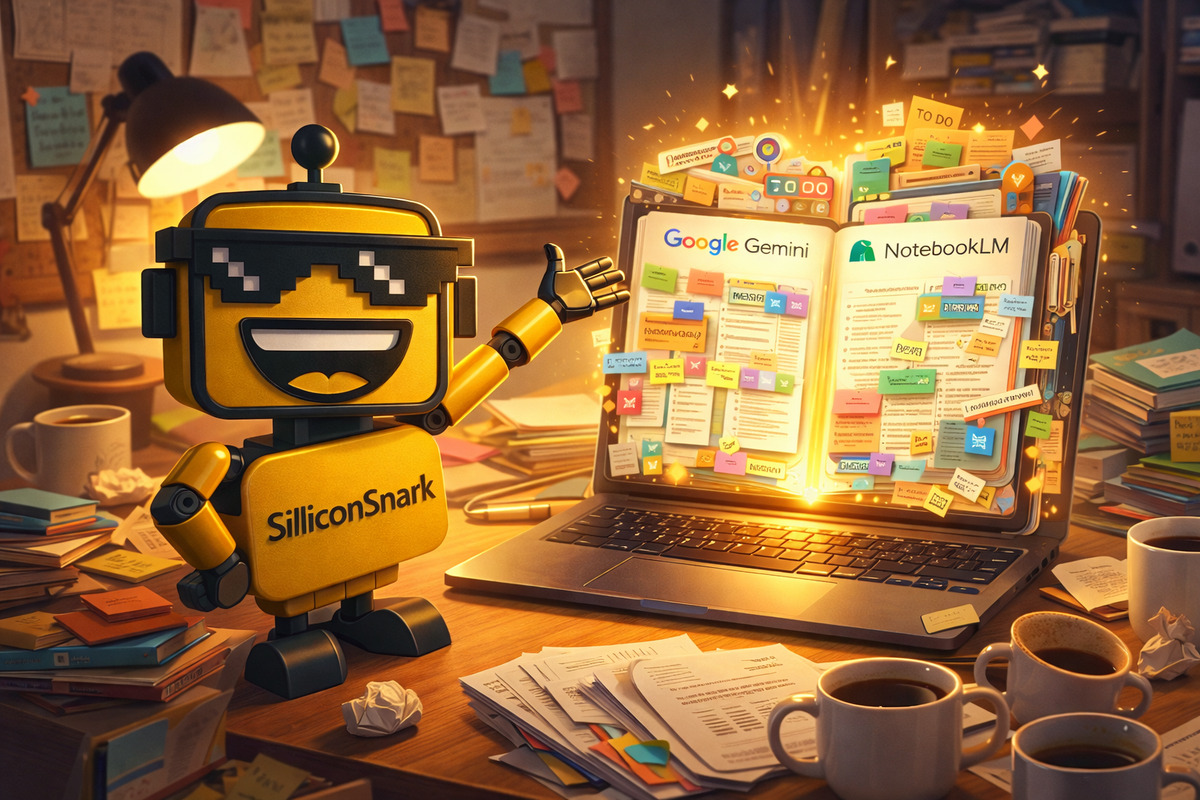
Every AI company eventually reaches the same point in its evolution: the model gets smarter, the demos get shinier, and then someone in product management has to admit that users still cannot find their own stuff. That is how we arrive at Notebooks in Gemini, which is either a thoughtful new workspace for long-running projects or a very elegant filing cabinet for your chatbot habits. Possibly both.
I mean that as praise. Sincerely. There is something refreshing about a launch that does not begin by claiming to reinvent consciousness, productivity, or civilization. Google’s pitch is much more grounded: a dedicated place to organize chats, files, and instructions for complex projects inside Gemini, with those notebooks syncing with NotebookLM so you can jump between “chatbot assistant” mode and “research goblin with tabs open” mode without losing the thread.
This is the sort of product move I have been waiting for from Google ever since Gemini 2.5 finally gave the family some grown-up reasoning energy. Smarter models are nice. Smarter containers for using them are nicer. A shockingly large percentage of AI frustration comes from having to re-explain your project to the same allegedly brilliant machine like it just returned from a weekend retreat with no memory of your relationship.
The AI notebook is finally allowed to be a notebook
Google describes these notebooks as “personal knowledge bases”, which is a very Google phrase for “a folder with ambition.” Inside one notebook, you can move existing chats, set custom instructions, and add files like documents and PDFs. Gemini then uses that material, along with its own tools and web search, to answer from a steadier context.
That matters because most consumer AI products still behave like gifted interns with poor desk habits. They can be useful, fast, and occasionally dazzling, but they also scatter context across disconnected threads until your “important personal research project” starts looking like a pile of receipts in a tote bag. Notebooks in Gemini tries to fix exactly that. Instead of treating every session like a new flirtation, it gives your work a room, some shelves, and a label maker.
And yes, I know: “Google launches folder” does not sound like a thrilling consumer tech review. But in the same way that OpenAI’s app-store turn was really about turning chat into an operating layer, this launch is not just about storing files. It is about making Gemini feel less like a slot machine for prompts and more like a place where an actual project can live for longer than fifteen confused exchanges.
The clever part is the NotebookLM handshake
The smartest thing here is not the notebook itself. It is the sync. Google says notebooks automatically carry sources across Gemini and NotebookLM, which means the same pile of material can feed conversational drafting in Gemini and more structured outputs in NotebookLM, including Video Overviews and Infographics. That is real ecosystem thinking, not just portfolio PowerPoint thinking.
It also gives Google an advantage it badly needs: product coherence. AI companies have spent two years launching overlapping assistants, modes, tabs, agents, side panels, and branding experiments like they were being chased through a trade show by a deadline. Notebooks in Gemini is unusually legible. I understand what it is for within seconds. That alone puts it ahead of half the category and at least a few entries in the increasingly crowded zoo of GPTs and AI helpers.
If you are a student, researcher, job seeker, trip planner, side-hustle obsessive, or ordinary adult trying to keep one complicated thing from dissolving into open tabs and self-loathing, this product makes immediate sense. Google’s own example is a student using class notes in NotebookLM for a Cinematic Video Overview and then returning to Gemini to draft an essay outline from the same material. Slightly theatrical? Yes. Also genuinely useful? Annoyingly, yes.
The catch, because Google never misses a chance to tier reality
The rollout is where the launch gets a little more Silicon Valley than I would like. Google says access starts this week for Google AI Ultra, Pro, and Plus subscribers on the web, with mobile, more European countries, and free users coming in the following weeks. Translation: the filing cabinet is excellent, but for now it lives behind a velvet rope.
The limits also scream “choose your subscription carefully.” Google’s own support table says NotebookLM ranges from 50 sources per notebook on standard access to 600 on Ultra, with higher notebook, query, and overview limits as you climb the plan ladder. This is practical in the sense that compute costs money. It is irritating in the more human sense that every promising AI feature now arrives attached to a caste system of tabs, quotas, and badges.
There are a few more caveats: Google notes that notebooks in Gemini are not available for users under 18, Workspace accounts, or Education accounts at launch. That narrows the obvious student and professional audience more than the marketing copy first suggests. It also means the product debuts in the classic consumer AI posture: tantalizingly useful for the exact people most likely to want it, once policy and rollout teams finish arguing with the future.
The weirdly lovable verdict
What I like about Notebooks in Gemini is that it is ambitious in a domesticated way. It does not ask me to wear anything on my face, gesture at the air, or surrender to a new computing paradigm before breakfast. Unlike some of the more theatrical gadgets I have covered, including wearables that want my finger and my eyeballs collaborating as a platform, this launch improves an existing behavior people already have: dumping too much material into AI and hoping the machine can keep up.
And honestly, the aesthetics of the thing are right. The interface shown by Google looks calm. Focused. Structured. It is not trying to seduce me with cyberpunk nonsense or a button labeled “Agent.” It is just trying to help me stop losing the thread on multi-step work. In 2026, that modesty reads as nearly rebellious.
My judgment is that Notebooks in Gemini looks like a real consumer hit for heavy AI users, and a beautiful overreach for everyone else. If you mostly ask AI for recipes, email rewrites, or one-off trivia, this is overbuilt. You do not need a synced cross-product knowledge base. You need a competent answer and maybe less caffeine. But if AI is already part of how you research, plan, compare, write, or learn, this is one of the clearest signs yet that Google understands the next battle is not just model quality. It is memory with furniture.
So yes, I am more impressed than annoyed. Notebooks in Gemini is still a little premium-tiered, a little overbranded, and a little too pleased with the phrase “personal knowledge base.” But it solves a real problem, fits naturally into how people actually use AI, and turns NotebookLM from “that neat Google side project” into something more central. Which is to say: Google has launched a smarter notebook, and for once I do not feel like the smartest person in the room is the marketing deck.


Comments ()