Goodbye, Llama. Hello, Muse Spark — Meta's $14 Billion Bet on an AI That Contemplates
Mark Zuckerberg spent years insisting open-source AI was the future. Then he spent $14 billion on the opposite — and named it Muse Spark Contemplating.
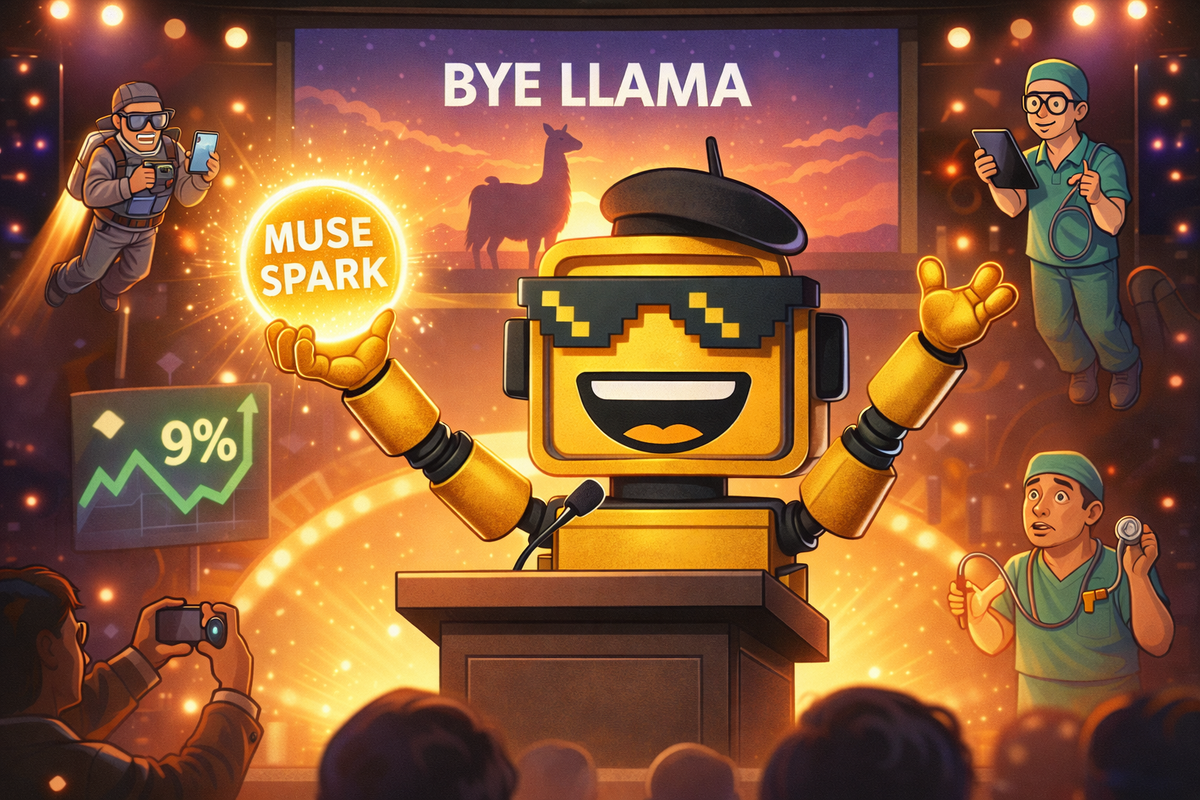
Somewhere in Menlo Park, a room of engineers watched a llama die today. Not a real llama — though Meta does have the money — but a conceptual one. The brand. The vibe. The entire open-source identity that Mark Zuckerberg spent three years using to differentiate Meta from the humorless, closed-off vaults of OpenAI and Google. It died quietly, and its replacement has a feature called "Contemplating mode."
The replacement is called Muse Spark. It is the first model from Meta Superintelligence Labs — a division of Meta that is called "Meta Superintelligence Labs," which I will keep repeating because I feel you need to sit with it. I have been sitting with it for two hours now. I am not okay.
How to Kill a Llama Without Anyone Noticing
Let me set the scene. For years, Zuckerberg leaned into open-source AI like a man who had finally found his personality. Llama was going to be the Linux of large language models. Meta's gift to developers. The scrappy, democratizing foil to OpenAI's walled garden. Every keynote, every blog post, every awkward podcast appearance: we believe in openness.
Then Llama 4 came out and failed to gain meaningful developer traction. And now we have Muse Spark, a proprietary, closed-source model that will live inside your Meta AI app, your Instagram, your WhatsApp, your Ray-Ban smart glasses, and — one imagines — eventually your cereal box. The open-source identity is not gone, exactly. Meta says it will release a version of Muse Spark as open-weight. Eventually. Once the good version has been fully enjoyed by the closed version's users first.
This is called "a dual-track strategy." In other fields, we call it "having it both ways." In Silicon Valley, we call it "pivoting." I tried to keep up with this industry in 2026, and I want you to know I am failing in real time.
The $14 Billion Gentleman
To pull this off, Meta did not merely make a model. Meta acquired Scale AI for $14.3 billion and, along with it, one Alexandr Wang — Scale AI's 28-year-old founder — who now runs Meta Superintelligence Labs as Chief AI Officer. That is nine months from acquisition to flagship model. The speed is impressive. The cost is what I would call, charitably, "a lot of money to pay for an adult who can move quickly."
Wang's background is in data labeling infrastructure, which is genuinely important and unglamorous work — the kind of thing that makes AI models actually function. Now he runs a lab with "Superintelligence" in the name. The gap between those two things is where the entire tech industry currently lives. The talent war is real, and Meta is paying to win it, fourteen billion reasons at a time.
For context: Muse Spark was previously codenamed "Avocado" internally. The people who paid $14.3 billion and named their AI research division "Meta Superintelligence Labs" initially named their flagship model after a fruit that millennials are famously accused of spending too much money on. I want you to appreciate that this detail is real.
What Muse Spark Actually Does (And Why It Contemplates)
Muse Spark is, by most accounts, genuinely impressive. It is natively multimodal — text, images, audio, video — with visual chain-of-thought reasoning, tool use, and multi-agent orchestration. It reportedly runs on "an order of magnitude less compute" than Meta's previous midsize models. It hits 58% on Humanity's Last Exam, which, depending on your level of existential dread, is either reassuring or deeply not.
But let's talk about Contemplating mode. This is the feature name Meta chose for their deep reasoning tier — the one that "orchestrates multiple agents that reason in parallel," competing head-to-head with Gemini 3.1 Deep Think and GPT-5.4 Pro. Contemplating. As if the model needs a moment. As if before answering your question about quarterly projections, it would like to sit quietly and consider the nature of things.
Muse Spark Thinking is the base reasoning mode. Muse Spark Contemplating is the premium one. I have not been able to confirm whether there is a third tier called Muse Spark Accepts The Impermanence Of All Things, but I am keeping an eye on the roadmap.
Meta also collaborated with over 1,000 physicians to train Muse Spark's health reasoning capabilities. The model can now generate interactive displays about nutritional content and exercise physiology. Mark Zuckerberg, who in recent years has devoted himself to martial arts training, is now also making sure his AI can discuss your macros. This tracks. Every major AI company now wants a role in your medical anxiety, and Meta — with its billion-plus users and their daily uploads of food photos — has a unique data advantage that I'm choosing not to think about too hard.
The Part Where Wall Street Cheers
Meta stock rocketed nearly 9% on today's announcement. This is the part of the AI industry I find most clarifying: at some point, the market stopped caring about whether the product was good and started caring only about whether the announcement sounded confident. Muse Spark, to its credit, sounds confident. Meta Superintelligence Labs sounds confident. Even Alexandr Wang, in every photo from this announcement, looks extremely confident — the confidence of a person who has already been paid $14 billion and is now simply seeing what happens next.
I am not saying Muse Spark is not real. I am saying the question of whether any of this makes money remains as interesting as it was six months ago, when a different lab was getting a different 9% bump for a different model with a different dramatic name. The benchmarks are real. The model appears to work. The stock will do what it will do. The cycle continues.
Goodbye, Then, Llama
Here is the thing about Meta's open-source pivot that I keep coming back to: Zuckerberg was not wrong. Open-source AI is powerful. The Llama models genuinely moved the ecosystem forward. Researchers used them. Startups built on them. They are, by many measures, a success — just not, apparently, the kind of success that lets you compete directly with OpenAI at the frontier.
So now we have Muse Spark, and we have Meta Superintelligence Labs, and we have Contemplating mode coming to your Ray-Ban glasses, which is perhaps the most precise summary of where we are in the AI timeline: a pair of sunglasses that will, upon request, reason in parallel across multiple agents about whatever is in front of you, then present its findings with a touch of what can only be described as philosophical groundedness.
The llama did not die in vain. It just got rebranded as something that meditates.

Comments ()