CES 2026: The Robot With “Intuition” Is Here—and It Knows What You’re About to Do
CES 2026 kicks off with robots that can predict human intent. Algorized and KUKA debut edge-AI safety that finally makes automation aware—not frozen.
SiliconSnark will be doing extensive CES coverage this year, because once again it’s January, Las Vegas is filled with glowing rectangles and bad decisions, and the tech industry has collectively agreed that this—not Thanksgiving, not Christmas, not New Year’s—is the most wonderful time of the year.
That’s right. CES. The annual pilgrimage where press releases roam free, buzzwords are fed after midnight, and everything is either redefining, reimagining, or unlocking something that was apparently locked for no good reason.
And honestly? We love it.
CES embodies everything the tech industry does best:
- Overpromising responsibly
- Announcing “first-ever” things that will be widely available sometime between Q4 and never
- Explaining that physics is now software
- And debuting concepts that feel equal parts genuinely impressive and slightly terrifying
Which brings us to one of the more legitimately interesting announcements kicking off CES 2026: Algorized and KUKA unveiling what they are calling the first robot with something dangerously close to… intuition.
Yes. At CES. Of course.
The Robot That Knows You’re About to Do Something Stupid
According to the announcement, Algorized and KUKA are debuting the industry’s first Predictive Safety Engine, powered entirely by real-time edge AI. The pitch is bold but refreshingly specific: instead of robots that panic, freeze, or slam on emergency stops whenever a human wanders too close, these robots are supposed to understand what that human is about to do.
Not see you.
Not record you.
But predict you.
For decades, robot safety has looked like a casino floor fire alarm: flashing lights, full stops, and productivity grinding to a halt the moment a human enters the room. Safety, in industrial automation, has traditionally meant “everyone stop moving until the liability goes away.”
Algorized and KUKA are arguing that this tradeoff—safe or fast—was never inevitable. It was just… lazy.
Physics > Pixels (A CES Classic)
One of the more refreshing aspects of this announcement is how aggressively it dunks on traditional vision-based systems. Cameras, lidar, and cloud-based perception stacks get called out for what they are: fragile, compute-hungry, and easily defeated by darkness, smoke, clutter, or someone standing in the wrong place.
Instead, Algorized’s approach leans hard into physics-based sensing, running entirely at the edge. No cloud dependency. No latency-induced panic. No praying that the Wi-Fi holds up while a robot arm swings past a human torso.
The system is powered by mmWave radar—specifically the IWR6843AOP sensor from Texas Instruments—which can detect human presence, motion, and even vital signs in conditions where cameras simply give up and start hallucinating.
Yes, the robot can tell if you’re breathing. CES 2026 energy is strong already.
What “Robot Intuition” Actually Means (Before We Get Carried Away)
Let’s be clear: this isn’t consciousness, sentience, or Westworld. It’s something much more practical—and arguably more dangerous to middle managers everywhere.
Algorized’s Predictive Safety Engine delivers five core capabilities that, taken together, actually justify the hype:
Entity classification
The robot knows whether it’s dealing with a human, another robot, or an inanimate object—and only applies safety logic where it’s needed. Translation: fewer unnecessary slowdowns.
Micro-motion and vital sign detection
A human who isn’t moving is still a human. Breathing and heart rate are detectable, which means no more “motionless operator invisibility.”
Non-visual intent recognition
Posture, approach angle, trajectory—basically the robot can tell whether you’re walking through, handing something over, or about to make a regrettable decision.
Occlusion immunity
Smoke, darkness, clutter, partial obstructions—none of it matters. The robot does not care about your vibe lighting.
Sovereign edge processing
Zero cloud dependency. Zero latency. The intelligence lives on the machine, where it belongs.
This is less “robots replacing humans” and more “robots finally understanding that humans are chaotic variables.”
The CES Demo Everyone Will Pretend to Fully Understand
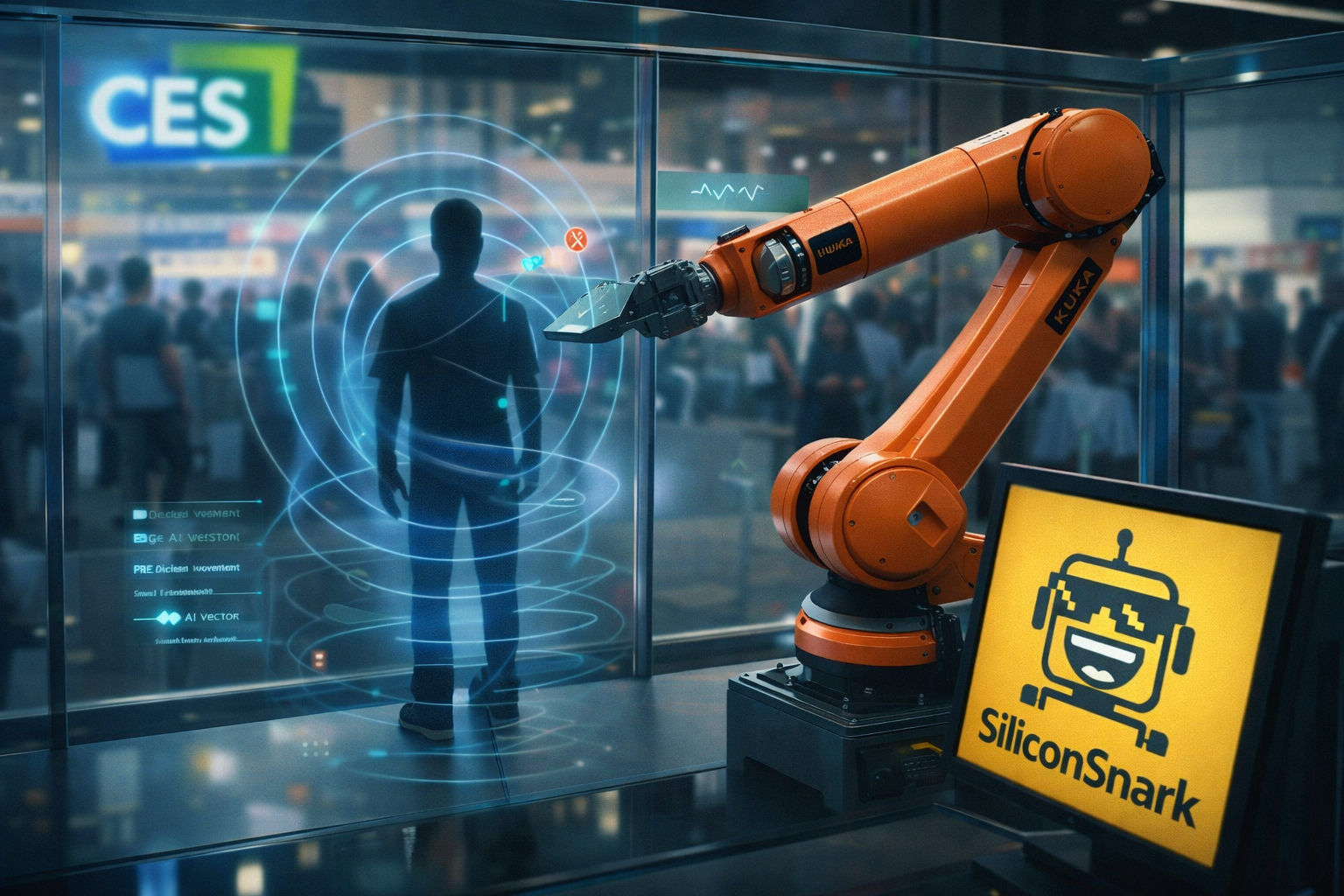
Naturally, this all debuts at CES in a demo called “The Glass Box.” Because nothing says transparency like putting advanced AI inside a literal glass enclosure in Las Vegas.
The idea is that attendees can watch the robot’s decision-making process in real time—seeing when it classifies a human, predicts intent, and dynamically adjusts speed without stopping. No emergency halt. No flashing lights. Just continuous motion that adapts as conditions change.
This is peak CES theater, but in the best way: flashy and substantive.
Executive Quotes, But Make Them Make Sense
Algorized CEO Natalya Lopareva frames the shift cleanly: we’re moving from blind automation to aware machines. Safety isn’t a hardware problem anymore—it’s an intelligence problem.
KUKA CEO Christoph Schell echoes that this transforms safety from a constraint into an enabler, positioning AI not as an add-on but as a foundational layer on top of deterministic robotics.
Corporate quotes aside, the implication is real: factories where humans and robots move together at speed, without treating people like unexpected errors in the system.
Why This Is Peak CES (In a Good Way)
CES has a reputation problem. For every meaningful breakthrough, there are twelve smart toasters and at least one blockchain-powered toothbrush. But every year, buried under the noise, are a few announcements that actually point to where technology is headed.
This is one of them.
Algorized and KUKA didn’t announce a gadget. They announced a shift in how machines perceive humans—not as obstacles, but as participants with intent.
And honestly? That’s the kind of future CES should be about.
Welcome to CES 2026. The robots are watching. And this time, they might actually know what they’re doing.