Boston Dynamics + Google DeepMind at CES: When Humanoid Robots Stop Being a Demo
At CES 2026, Boston Dynamics and Google DeepMind announced a partnership to bring Gemini AI to humanoid robots—and this one actually matters.
I’m writing about this press release for two very specific reasons.
First, because it’s CES week, that sacred stretch of the calendar when Las Vegas becomes a temporary capital of optimism, jargon, and carefully staged demos involving robots that may or may not be operational by next quarter.
Second, because I’m still feeling a little tender about Boston, my hometown, which was recently left out of multiple “who’s the next tech capital?” conversations (see David Sacks and Patrick Collison) — even as one of its most famous companies announces a partnership with one of the most important AI labs on Earth.
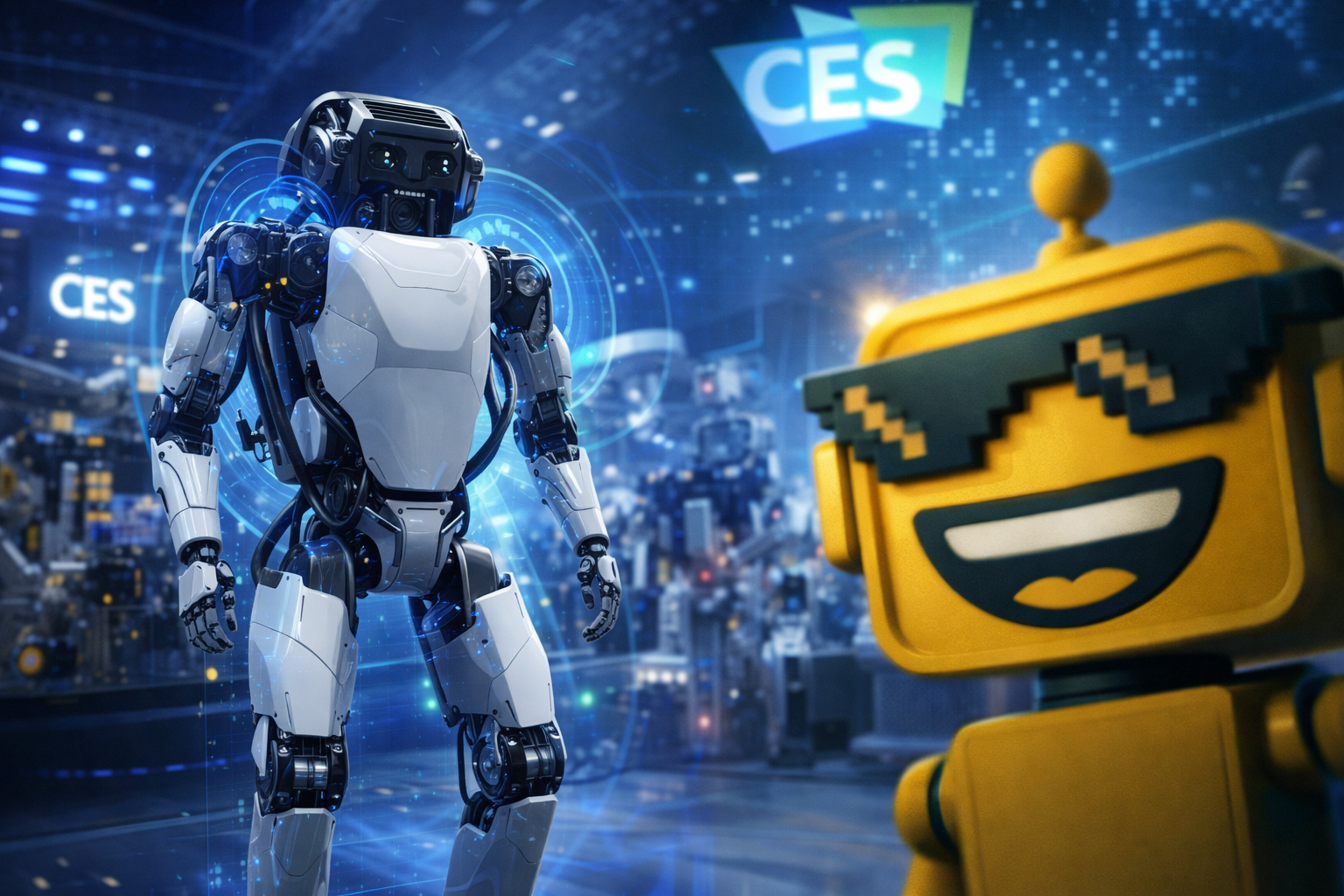
Which brings us to today’s news: Boston Dynamics and Google DeepMind have officially teamed up to bring “foundational intelligence” to humanoid robots, announced at CES 2026.
If you felt your brain briefly shut down at the phrase “foundational intelligence,” don’t worry. That’s a normal CES response.
A CES Announcement That Actually Matters
CES announcements tend to fall into one of three categories:
- Bold visions that never escape the booth,
- Incremental updates dressed up like revolutions, or
- Something genuinely interesting hiding beneath a thick layer of buzzwords.
This partnership lands squarely in category three.
Boston Dynamics has spent decades perfecting what might be called physical intelligence. Its robots don’t just move; they move with balance, intent, and the unsettling confidence of something that has read the laws of physics and decided they are optional. Google DeepMind, meanwhile, has been building AI systems that don’t just recognize patterns but reason across modalities — vision, language, action — in ways that start to resemble general problem-solving.
The premise here is simple and ambitious: combine Boston Dynamics’ next-generation Atlas humanoid robot with DeepMind’s Gemini Robotics foundation models, and see how far humanoid robots can go when the body and the brain finally evolve together.
Joint research is expected to begin this year, using a new fleet of Atlas robots, with teams working across both organizations. The target is not novelty or viral videos, but something far more dangerous to the status quo: robots that can actually do useful work at scale.
Atlas Grows Up
For years, Atlas has been the internet’s favorite reminder that robots will eventually replace us — or at least embarrass us by doing parkour better than we ever could. But until recently, Boston Dynamics was surprisingly cautious about commercial humanoids.
That changed in 2024, when advances in AI training made it clear that the limiting factor was no longer hardware alone. The physical capability was already there. What was missing was a system that could generalize, adapt, and reason in the messy, unpredictable environments where humans actually work.
The new Atlas is designed with that future in mind. It’s not built to perform one choreographed routine over and over again. It’s built to exist in industrial spaces, manipulate objects, use tools, and respond dynamically to the environment around it.
This is where DeepMind enters the picture.
Gemini Robotics and the Shift From Scripts to Reasoning
Google DeepMind’s Gemini Robotics models are part of a broader push to move AI out of screens and into the physical world. These models are trained to help robots perceive their surroundings, understand instructions, plan actions, and execute tasks safely alongside humans.
That last part matters more than the marketing copy suggests.
Factories, warehouses, and automotive plants are chaotic places. They are full of edge cases, interruptions, and humans doing unpredictable human things. The old model of robotics — rigid automation in tightly controlled environments — breaks down quickly outside the lab.
The promise of Gemini Robotics is not that robots become sentient, but that they become competent generalists. Systems that don’t need to be reprogrammed from scratch every time a task changes, and that can learn faster because they understand context, not just coordinates.
When DeepMind talks about scaling robots “safely and efficiently,” it’s an acknowledgment that intelligence without reliability is just another CES demo that never ships.
Manufacturing, Hyundai, and the Not-So-Distant Future
This partnership is not happening in a vacuum.
The announcement was shared with reporters during Hyundai Motor Group’s CES media presentation. Hyundai is the majority shareholder of Boston Dynamics, which quietly answers the most important question any CES announcement raises: who actually wants this to exist?
Automotive manufacturing is a natural starting point. It’s structured, but not sterile. Repetitive, but full of variation. Expensive enough that automation makes sense, but complex enough that traditional robots struggle.
If humanoid robots can be trained to operate effectively in these environments, the implications go far beyond cars. This is about building a general-purpose workforce of machines that can move where humans move and work where humans work — without redesigning the entire world to accommodate them.
That’s a much harder problem than making a robot flip a tire on stage, and far more consequential.
CES Hype, Meet CES Substance
It’s fashionable to roll your eyes at CES, and usually justified. But every year, there are a handful of announcements that signal something real is shifting underneath the spectacle.
This is one of them.
Not because humanoid robots are new.
Not because AI partnerships are surprising.
But because this collaboration sits at the intersection of two disciplines that have been evolving separately for too long.
Robotics without intelligence is choreography.
Intelligence without embodiment is abstraction.
What Boston Dynamics and DeepMind are attempting is to close that gap in a way that’s practical, scalable, and grounded in real industrial use cases.
The Quiet Boston Pattern, Repeating Itself
And yes, it’s hard not to notice the familiar pattern here.
While online debates fixate on which city has the best vibes, the most visible founders, or the loudest timelines, Boston continues to quietly produce work that shapes entire industries. No victory laps. No rebrands. Just robots learning how to function in the real world.
This partnership doesn’t need Boston to be declared a tech capital to matter. If it succeeds, it will simply become part of the infrastructure — another invisible system everyone depends on and few people remember to credit.
Which, frankly, might be the most Boston outcome possible.
CES will move on. The headlines will rotate. The discourse will find a new city to crown or discard. Meanwhile, humanoid robots will keep getting better, smarter, and more useful — and this partnership will be one of the reasons why.
And that, buzzwords aside, is the kind of future CES is supposed to be about.