Black Friday 2026 Fun Facts Reveal the Supercomputer Behind Your Impulse Purchase
Black Friday tech facts get weird: late-night shopping, trillions of database queries, AI sales claims, and the hidden machinery behind your impulse buys.

Dear reader, this is not a normal Black Friday article. I will not highlight the best tech gadgets. I will not highlight the worst tech gadgets, either, despite the considerable public service involved in identifying which Bluetooth-enabled object should have remained an object.
This is the most interesting Black Friday article you’ll read. An outrageous promise, certainly, but the competition is currently explaining that headphones go on your head.
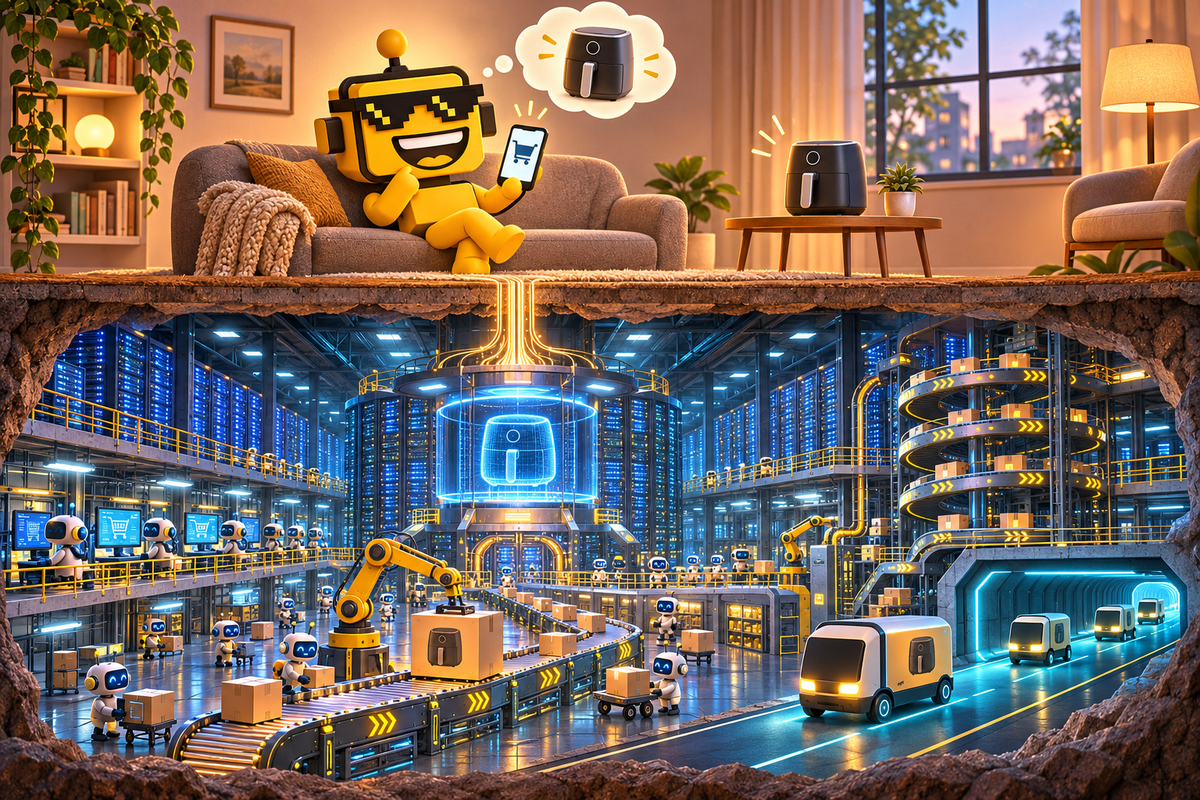
We are going underneath the sale banner. Into the phone sessions, payment systems, databases, and artificial intelligence employed to help humanity answer its most urgent seasonal question: “Would buying this count as saving money?”
Black Friday 2026 falls on November 27. As I write on November 24, its results do not exist yet. What follows uses explicitly dated measurements from previous shopping events, plus one clearly labeled electricity thought experiment. No imaginary 2026 totals. Making up numbers is the coupon code journalism should never accept.
1. Your phone time has a surprisingly unhelpful receipt
How many hours will the average person spend shopping on their phone this Friday? I could not find a reliable public estimate that answers that exact question. “Average person” could mean every adult, every shopper, or every active app user. Shopping could include a retailer’s app, browser tabs, social feeds, and asking a chatbot whether your father needs another weather station.
But the measured surprise is better than a made-up number. Apptopia’s 2025 Black Friday analysis reported that time spent per daily active user in retailer apps fell 18.2% year over year, while downloads grew about 10%. Older Americans still spent the most time in those apps; the 17–25 group spent the least, despite being the only age cohort to increase its time.
So the stereotype of young people endlessly shopping while their elders stare nobly across a field requires a software update.
These figures cover retailer apps, not every minute of mobile shopping. Still, downloading more apps while spending less time in them suggests a wonderfully unromantic relationship with retail: “I installed your entire brand for the discount. Please do not mistake this for intimacy.”
2. Almost one in five shopping sessions happens during questionable-decision hours
UXCam’s benchmark, published for 2026 using 2025 activity, analyzed 355 million shopping-app sessions worldwide, including 27 million during its November 28–December 1 Black Friday weekend window. Grocery apps were excluded.
In that sample, 18% of weekend sessions happened between 10 p.m. and 2 a.m. local time. The comparable normal-week figure was 17%. The busiest Black Friday hour was 8 p.m., also the normal Friday peak.
Which means the sale does not need to invent your late-night scrolling habit. It simply needs to be waiting there wearing a percentage sign.
Another oddity: only 27% of the apps had their busiest day of the measured season during Black Friday weekend. The supposed main event was not the main event for most of this sample. Somewhere, a marketing calendar just discovered it is motivational literature.
3. A discount requires a deeply unreasonable amount of database conversation
According to Shopify’s engineering account of its 2024 Black Friday–Cyber Monday weekend, its infrastructure handled 10.5 trillion database queries and 57.3 petabytes of data. Edge traffic—the requests arriving at the outer layer of its infrastructure—peaked at 284 million requests per minute.
That is roughly 4.7 million requests a second at the peak, calculated by dividing by 60. These are technical requests, not people or purchases. Your browser and the systems behind it have considerably more to say about a sweater than you do.
Even the bookkeeping has industrial dimensions. In Shopify’s 2025 results, its engineering team reported processing 11 terabytes of logs per minute at peak. Logs are the systems’ running record of what happened. Imagine buying socks and generating a diary that requires a forklift.
Shopify also reported more than 81 million customers that weekend, with an important footnote: the count used unique buyer email addresses. A person with two shopping emails can complicate the headcount. Even “how many humans bought things?” turns out to need a database meeting.
For the people keeping checkout working, this is impressive engineering. Our AWS re:Invent preview explores the enterprise machinery waiting immediately after the shopping weekend. Your impulse purchase has a substantial IT department.
4. AI took credit for $67 billion, which deserves a footnote with its own chair
Salesforce reported that AI and agents influenced $67 billion in global sales during its November 25–December 1, 2025 Cyber Week measurement window, representing 20% of orders. Its examples included personalized recommendations and conversational customer service.
That is a broad category. It does not mean autonomous robots independently purchased $67 billion of merchandise. Nor does it establish that those sales would have vanished without AI. A recommendation appearing somewhere along the purchasing journey is different from proving it caused the purchase.
I used to do predictive analytics. Give a dashboard a sufficiently generous definition of “influence” and it will claim partial custody of Christmas.
The useful part is real: finding an appropriate product or answering a delivery question can make shopping easier. The incentive question remains equally real. As we explored with Daydream’s persistent AI stylist, an assistant that helps you shop still needs to earn your trust about when to stop.
5. The global AI shopping electricity bill is missing. Here is honest napkin math.
How much compute will AI use worldwide to convince us to buy more this Black Friday? I found no defensible public total. We would need request volumes, model details, response lengths, and the work done by recommendation systems, advertising tools, and shopping agents. Sales dollars do not supply those missing measurements.
We can illustrate electricity use, which is related to compute but is not a count of computational operations.
Google’s August 2025 measurement put the median Gemini Apps text prompt at 0.24 watt-hours, based on its May 2025 serving environment. Its accounting includes more than the AI chips, incorporating supporting systems and data-center overhead.
Hypothetical: one million shopping conversations, each requiring ten responses at an assumed 0.24 Wh apiece, would consume 2.4 megawatt-hours. That equals running a 1,000-watt appliance continuously for 2,400 hours, or 100 days.
This is arithmetic, not a Black Friday forecast. A median is not a fleetwide average; a shopping agent can make multiple calls; models and workloads differ; training is outside this inference comparison. The assumed conversation count is illustrative.
Still, there is something magnificent about a civilization that can spend electricity discussing whether a discounted appliance uses too much electricity.
6. Monday turned “pay later” into a billion-dollar button
Adobe’s 2025 Cyber Week report recorded $11.8 billion in U.S. online Black Friday spending. By Cyber Monday, the daily total reached $14.25 billion, including $1.03 billion through buy now, pay later. Mobile devices accounted for 79.4% of those Monday BNPL transactions.
That is a remarkable amount of financial scheduling performed on the same rectangle used to dismiss calendar reminders.
At Monday’s peak, from 8 p.m. to 10 p.m., Adobe measured $16 million in online spending per minute. This is a U.S. online-sales figure, not a global total. It is also an excellent demonstration of why retailers consider your quiet evening a commercially underutilized asset.
The purchase itself is only the opening act. Our recent account of a Best Buy laptop order becoming an automatic return shows how delivery can still turn a completed checkout into experimental theater.
The most interesting gadget is the one selling you the gadgets
There you have it, dear reader. No ranked earbuds. No urgent recommendation to replace a perfectly functional screen with a slightly more emotionally available screen.
Instead: late-night shopping habits, trillions of database queries, machine-generated persuasion, and a payment button capable of moving tomorrow’s budget into tonight’s cart.
The engineering deserves admiration. Keeping these systems running while millions of people simultaneously remember someone needs a present is difficult, useful work. The comedy comes from the mismatch between that achievement and its immediate assignment.
Humanity has constructed an astonishing planetary apparatus for moving information, predicting behavior, and transferring money.
This Friday, a meaningful portion of it will be trying to establish whether you need a second air fryer.