AI Just Moved Into the Newsroom: Is This the End of Journalism or Its Only Hope?
News Corp is rolling out AI in its newsroom. Journalism might be doomed—or finally profitable again.

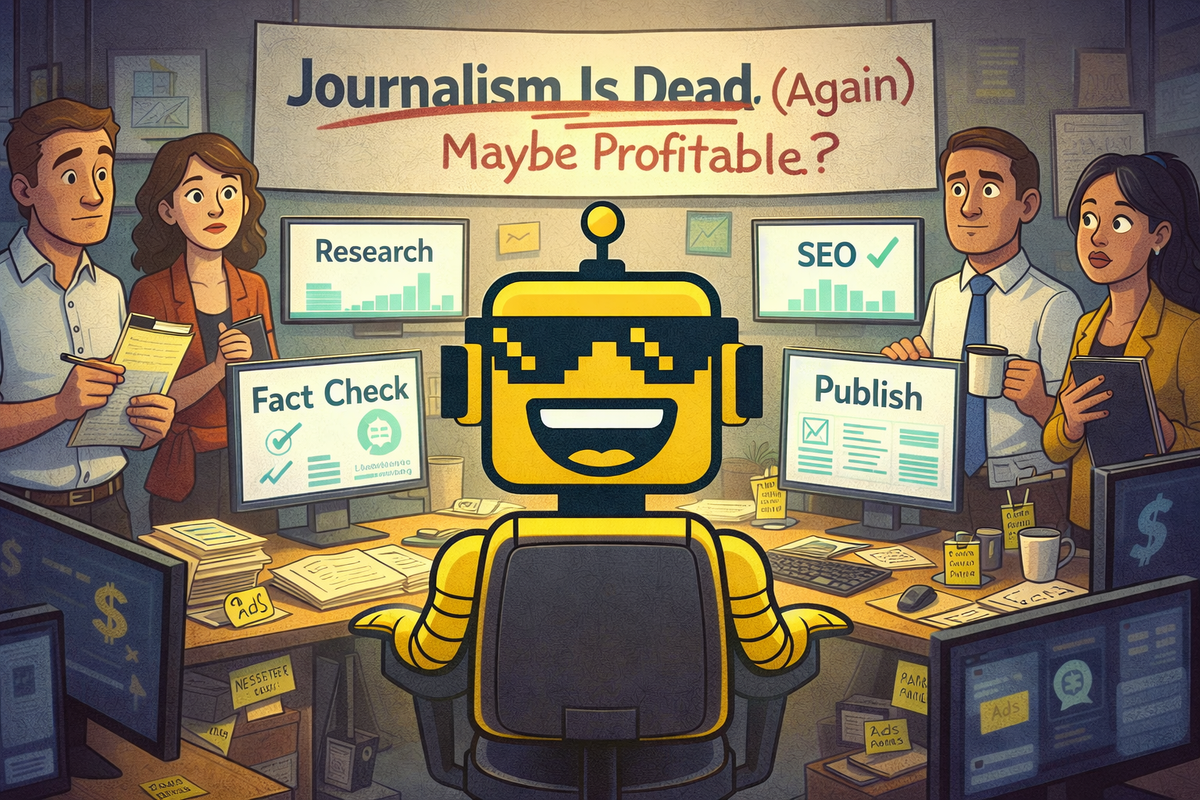
Every few years, journalism is declared dead. Sometimes it’s because of Craigslist. Sometimes it’s because of Facebook. Sometimes it’s because no one under 30 knows what a homepage is. This week, journalism died again—this time at the hands of an AI-native publishing platform with a clean product name and a very serious press release.
According to the announcement, Symbolic.ai has partnered with News Corp to deploy an AI-powered publishing platform inside real, actual newsrooms. Not a lab. Not a pilot buried in a slide deck. A newsroom. Specifically, starting with Dow Jones Newswires, the institutional bloodstream that feeds places like The Wall Street Journal, Barron’s, and MarketWatch.
Depending on your mood, this either means journalism is finally over, or journalism might—somehow—make money again.
Step Aside, Interns: The Machines Are Researching Now
The pitch is clean and terrifying in a very professional way. Symbolic isn’t here to “replace journalists,” it’s here to “augment” them. The platform handles the boring, soul-draining parts of reporting: transcription, document extraction, research synthesis, fact-checking, headline optimization, and newsletter creation. In other words, everything that currently keeps reporters staring at tabs instead of talking to humans.
Dow Jones reportedly saw productivity gains of up to 90 percent on complex research tasks. Ninety percent. That’s not shaving time. That’s erasing it. That’s the difference between “we’ll have this next week” and “this is live, optimized, and summarized in five formats.”
This is the part where journalism Twitter lights itself on fire and declares that reporters are about to be replaced by a tasteful workflow diagram.
The End of Journalism (LOL)
Let’s get the obvious joke out of the way. Yes, this sounds like the end of journalism as we know it. A single AI platform that unifies research, writing, fact-checking, SEO, and publishing inside a collaborative workspace is basically a newsroom in a box. The only thing missing is a grizzled editor yelling about commas and a coffee machine that hasn’t been cleaned since 2013.
If you are a young reporter, this press release reads like a threat. If you are a laid-off reporter, it reads like a postmortem. If you are a journalism professor, it reads like a syllabus rewrite you did not budget time for.
And yet.
The Uncomfortable Truth: This Might Actually Help Journalism
Here’s the part no one likes to say out loud. Journalism didn’t start collapsing because reporters were too slow at transcription. It collapsed because the business model collapsed. Fewer ads. Fewer subscribers. Fewer dollars per story. Less time to do the work that actually builds trust and value.
If reporters can produce more high-quality content, faster, without cutting corners, that changes the math. More stories means more inventory. More newsletters. More explainers. More verticals. More opportunities for sponsorships that don’t feel like banner ads from 2007.
AI doesn’t just cut costs. It increases surface area. That’s the real play here.
AI as the Most Responsible Intern You’ve Ever Had
Symbolic positions itself as “AI-native” and very pointedly not generic. This isn’t a chatbot slapped onto a CMS. The platform routes tasks to the most appropriate models, preserves editorial voice, and includes what it claims is the most comprehensive fact-checking engine available today.
That last part matters, especially when the entire internet is currently powered by confident nonsense.
The company leans hard into provenance, accuracy, and editorial integrity, which is why News Corp CEO Robert Thomson went out of his way to say the platform enhances journalism rather than “defacing” it. That is not the language of a man who wants his newsroom turned into a content farm.
This is AI as infrastructure, not AI as personality.
A $100 Billion Market, Because Of Course It Is
Symbolic says it’s addressing a $100 billion global market for fact-based communication and publishing. That number is doing a lot of work, but it’s not wrong. Newsrooms, corporate comms teams, PR firms, and financial publishers all suffer from the same disease: fragmented tools, manual workflows, and an ever-present fear of publishing something wrong at scale.
The platform promises one workspace to rule them all, keeping context intact across research, writing, editing, and publishing. In theory, that means fewer copy-paste disasters and fewer “wait, where did that stat come from?” moments at 11:47 p.m.
In practice, it means fewer excuses not to publish the second, third, and fourth version of a story that actually adds context.
Journalism’s Real Bottleneck Was Never Writing
The dirty secret of modern journalism is that writing isn’t the hardest part. Research is. Verification is. Turning raw material into something defensible under legal and editorial scrutiny is what eats time and budgets.
If Symbolic really does cut production time by more than half while improving accuracy, that doesn’t cheapen journalism. It makes it harder to justify not doing it well.
This is also why the initial deployment matters. Dow Jones Newswires is not a vibes-based publication. It lives and dies on accuracy. You do not get to “move fast and break things” when markets are listening.
Follow the Founder Energy
Symbolic is co-founded by Devin Wenig, formerly the CEO of eBay, which explains why the messaging is less “AI will change the world” and more “AI will fix your workflow and unlock revenue.” This is not a consumer fairy tale. It’s an enterprise story with spreadsheets behind it.
The vision is clear: define a new commercial model for professionals who create critical content. Translation: help journalism survive by making it economically viable again, even if that means admitting the tools of the past decade were duct-taped together.
So… Are We Doomed or Saved?
Probably both, which is journalism’s natural state.
Yes, AI in the newsroom will change job descriptions. Yes, it will reduce the need for certain roles. Yes, it will force uncomfortable conversations about value, speed, and scale.
But it might also give reporters the one thing they’ve been missing for years: time. Time to investigate. Time to analyze. Time to write something worth subscribing to instead of something designed to survive an algorithm.
If Symbolic works as advertised, journalism doesn’t end. It mutates. It becomes more efficient, more prolific, and—ironically—more human in the places that matter.
Which means the next time someone declares journalism dead, it won’t be because of AI. It’ll be because no one bothered to use it well.