A Deep Dive Into Roblox’s Age Verification Fiasco
Roblox says age checks will protect kids. Users say it’s buggy, invasive, and easy to bypass. Here’s what’s happening and why it matters.

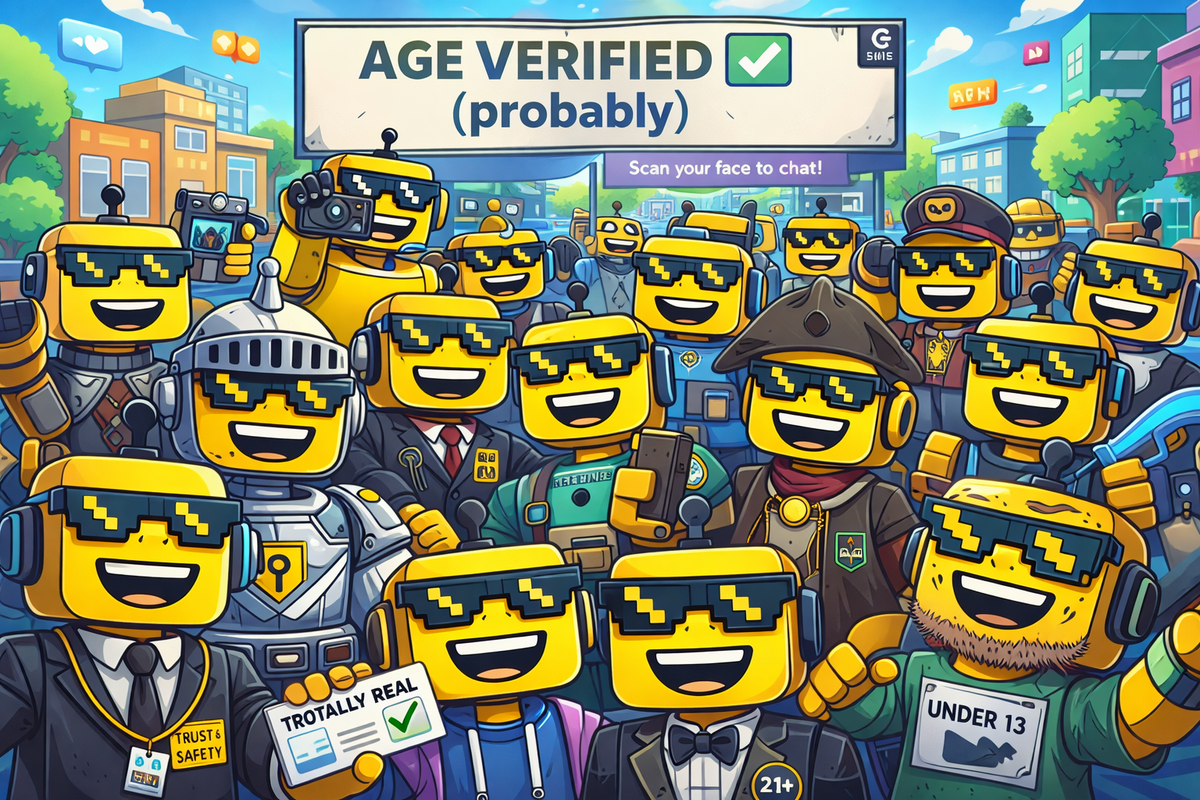
I’ve written extensively about Roblox, from its face-scan “safety theater” to its casino-like monetization that trains kids to spend on pixelated prizes. I don’t keep roasting Roblox just for fun (well, mostly not). I do it because I genuinely believe not enough is said about how awful this product has been for kids. Even therapists who love video games have singled out Roblox as uniquely scary and problematic[5]. One child-safety analyst went so far as to call Roblox an “X-rated pedophile hellscape” given how easily predators have exploited it[6]. Ouch. So yes, a little snark and dark humor feels appropriate if it helps people grasp how bad things have gotten.
That said, I’ll admit: since millions of kids insist on playing Roblox no matter what, I’m hopeful that the platform’s new age verification measures might actually help (or at least do something useful beyond PR). This month Roblox flipped the switch on mandatory age checks for chat – a move they hyped as a bold safety innovation. Is it working? Are kids any safer? Or is this just more corporate safety theater that manages to punish regular users without seriously deterring creeps? Let’s dive into the snarky deep-dive on how Roblox’s age verification rollout has gone so far in January, what prompted it, and why it’s already turning into a circus.
Why Roblox Suddenly Cares About Ages: Lawsuits, Predators & 2025’s Horror Show
To understand why Roblox is suddenly scanning everyone’s face like it’s a dystopian theme park, we need to recall the nightmare year that was 2025. Roblox has long billed itself as a “safe” online playground for kids. In reality, it became a breeding ground for predators – something law enforcement and regulators have taken extreme notice of. By late 2025, Roblox was facing a barrage of lawsuits and investigations for allegedly failing to protect children from abuse and exploitation[7][8]. Attorneys General in multiple states basically accused Roblox of putting “profits over the safety of children,” calling it a “digital playground for predators” where minors are routinely exposed to sexual content and grooming[8][9]. The Texas Attorney General’s November 2025 lawsuit even coined the phrase “pixel pedophiles” to hammer home how bad things had gotten[8].
Louisiana’s AG was first out of the gate in August 2025 with a landmark suit, alleging that Roblox’s design and lax oversight let bad actors reach kids too easily[10][11]. That complaint highlighted how Roblox’s chat and friend features allowed direct contact between adult strangers and children, with “inadequate age verification” making it trivial for adults to masquerade as kids[12]. Soon Kentucky and Texas followed with similar suits, and even Florida’s AG opened a criminal probe into whether Roblox was “aiding predators in accessing and harming children”[13]. By year’s end, Roblox was reportedly embroiled in 35+ lawsuits alleging it facilitated child grooming, with some cases of abuse so severe they led to real-world tragedy[14].
Internally, this was a five-alarm fire for Roblox’s public image and potentially its bottom line. User trust was tanking, and a damning report by Hindenburg Research (a firm known for exposing corporate misconduct) had blasted Roblox for “compromising child safety to juice growth,” describing parts of the platform as an “X-rated pedophile hellscape”[6]. In short, Roblox spent much of 2025 getting dragged for being the opposite of a safe kids’ space.
How did Roblox leadership respond? Mostly with the kind of tone-deaf tech exec speak that makes you wonder if they live on the same planet. In a New York Times interview late last year, CEO David Baszucki was asked about Roblox’s predator problem – and his reply was jaw-dropping. He reframed the child safety crisis “not necessarily just as a problem, but an opportunity”[15]. (Yes, opportunity – buddy, read the room!) Baszucki basically treated rampant grooming on Roblox as a chance to “innovate” in communications features, rather than as, you know, a moral failing or urgent emergency[7][16]. This attempt to spin a safety crisis into a growth story did not reassure anyone. As one snarky commentator put it, it felt like watching someone pivot from “our platform is a playground for predators” to “but look at our engagement metrics!” without ever passing through anything resembling accountability[17][18].
In that same interview, Baszucki insisted Roblox was “one of the safest places online” and trotted out the old line that “my kids use Roblox” as proof everything’s fine[19]. (News flash: plenty of the kids in those lawsuits used Roblox too – having executives’ children on the platform doesn’t magically make it safe[20].) He also bragged about Roblox’s “mind-boggling” scale and said the company halted growth early on at 200 users to build safety, painting themselves as heroes of moderation[21][22]. Meanwhile, tens of millions of users – many under 13 – were still chatting freely with adult strangers, and lawsuits described kids being groomed and even lured off-platform into abuse[18][23]. By late 2025, Roblox needed to show regulators and parents something concrete to address these failures. Enter the Age Verification gambit.
Roblox’s Big Idea: AI Face Scans for Everyone (What Could Go Wrong?)
On paper, Roblox’s new age verification system sounds almost reasonable – if you ignore the sheer absurdity that it took them over 15 years to implement such basic guardrails. As of January 2026, all Roblox users must undergo an age check to use the chat features, regardless of how old they claim to be. The company trumpets that this makes Roblox “the first large online gaming platform to require age checks for users of all ages to access chat”[24]. They frame it as a revolutionary safety measure: no age check, no chatting. The goal is to force age separation in chats so that adults can’t mingle unsupervised with young kids, finally limiting those creepy random encounters between 45-year-olds and 10-year-olds in Roblox games.
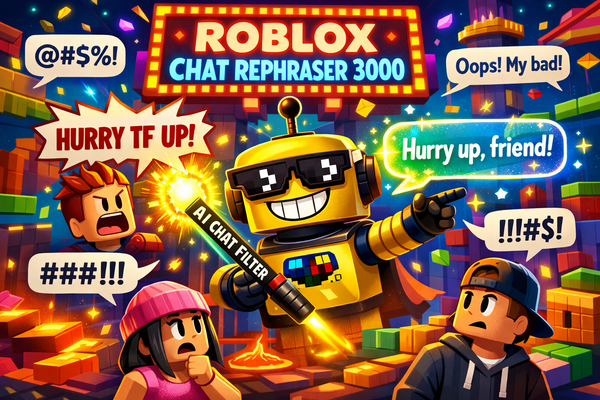
How does it actually work? In classic 2020s tech fashion, it’s all about AI-driven face scanning. Roblox’s system uses a feature called Facial Age Estimation, built by a third-party vendor (a company named Persona)[25]. When you go to verify, the Roblox app prompts you to record a short video selfie using your device’s camera[26][27]. That video is then analyzed by Persona’s AI, which tries to guess your age – not your identity, just your approximate age. Roblox claims the images/video are processed securely and then immediately deleted, to assuage privacy concerns[25]. If you’re age 13 or older and for some reason you don’t trust the AI (shocking!), you also have the option to provide a government-issued photo ID instead[28][27]. But since most 13-year-olds don’t exactly have a driver’s license lying around, the primary method is this face scan.
Based on the scan, Roblox slots you into one of six age buckets: under 9, 9–12, 13–15, 16–17, 18–20, or 21+[29]. And here’s the key: by default, you can only chat with users in your age group or adjacent age groups[30]. In other words, a 12-year-old (in the 9–12 group) can chat with kids slightly younger or older (the under-9 group, if parents allow those kids to chat, and the 13–15 group), but not with say 17-year-olds or 25-year-olds[30]. A 21+ adult can only chat freely with those 18 and up – they are walled off from anyone 16 or younger. No more intergenerational mingling on public chat by default. Roblox touts this as a huge safety win: “age-based chat” that “limits communication between adults and children younger than 16”[31][32].
Roblox presents this “Age Check to Chat” as a pillar of a multilayered safety system. They’ve even called it the “gold standard for communication safety” (yes, they actually said gold standard with a straight face)[31]. In press releases and blog posts, the company waxes poetic about how this innovation will create a more age-appropriate, positive experience for everyone[31][32]. Their Chief Safety Officer, Matt Kaufman, emphasized that it’s about building “proactive, age-based barriers” so users can connect in ways that are “safe and appropriate”[34][35]. Roblox also keeps repeating that privacy is super important: they promise images are ephemeral and deleted immediately, and that the AI only outputs an age range, not a permanent record of your face[36][37]. To further reassure folks, they note that Persona’s age estimation tech was tested by third-party labs and achieved a Mean Absolute Error of about 1.4 years for users under 18[38][39]. (Translation: on average it guesses a kid’s age within ~1.4 years of their real age – at least in the lab tests.) Not perfect, but trust us, it’s certified and “designed for accuracy”[38].
The system isn’t completely one-and-done either. Roblox built in some appeals and failsafes, acknowledging that AI will inevitably screw up for some people. If you think the AI got your age wrong, you can appeal and try verifying by another method (like using an ID, or having a parent verify your age via parental controls)[40][41]. They also claim to be monitoring user behavior continuously; if someone acts way older or younger than their verified age, Roblox might re-prompt them to verify again[40][42]. In their words, they’re “leveraging multiple signals” and will “soon begin asking users to repeat the age-check process” if something seems off[40]. (More on that later – because it raises its own questions.)
To Roblox’s credit, parts of this plan do address long-standing safety holes. For instance, kids under 9 are now completely barred from chat unless a parent explicitly opts them in after an age check[43]. That’s a sensible tightening for the littlest players. Roblox also says it’s working on features to help kids chat safely with known Trusted Connections (like parents or IRL friends) who might be in other age groups[44][45]. And they remind us that even before age checks, they had chat filters to block profanity, personal info, and so on (though those filters were notoriously easy to evade)[46]. In short, the official messaging is: Look, we know we screwed up letting Roblox become a wild west – but now we have fancy AI gates, multiple safety layers, and we’re super serious about protecting kids.
It all sounds very high-tech and responsible, right? Facial recognition but make it safety! If you listened only to Roblox’s PR, you’d think this system was going to magically solve the predator issue overnight while hardly affecting regular players, aside from a quick “private, fast, secure” age check process[25]. Unfortunately (and predictably), the reality of this rollout has been far messier and more farcical. Less “gold standard” and more…complete clown show.
Rollout Reality Check: False Ages, Freakouts, and Face-Scan Fiascos
Roblox began rolling out these age checks in a few test regions in December 2025, then flipped the switch globally in early January 2026[33][47]. Within days, it became painfully clear that the system is anything but flawless. In fact, Roblox’s much-hyped AI age verification is turning out to be a hot mess on multiple fronts:
- Mismatched Ages – Kids flagged as adults, adults labeled as kids: The AI has one job (figure out roughly how old you are) and it’s already screwing that up in spectacular ways. Users as young as 10 have been erroneously tagged as over-18, throwing children into adult-only chat pools[48]. Meanwhile, grown adults are being told they’re teenagers. WIRED reported one 23-year-old user got classified as 16–17; his reaction: “I don’t want to be chatting with fing children.”*[49] Another person, age 18, was deemed 13–15[49]. One frustrated player with a “full-ass beard” griped that the system put his account in the 13–16 range[50]. Suffice to say, the algorithm’s accuracy in the wild is looking a lot worse than that 1.4-year error claim**. It’s mis-aging users by several years, creating exactly the scenarios it’s meant to avoid (adults stuck in kiddie chat, or kids accidentally let into adult chat).
- Privacy and Trust Issues – Many users refuse to scan: A huge chunk of the community is flat-out uncomfortable with the entire idea of scanning their face for Roblox. The company line is that images are instantly deleted and nothing’s stored[25], but skepticism runs high. Social media and forums are filled with users (and parents) saying “Nope, not handing over biometric data to Roblox.” Some worry about how that data could be misused or if it might not be as ephemeral as promised. Others just balk at the principle of a kids’ game requiring what feels like a police booking. Roblox insists the process is optional – but of course if you don’t do it, you effectively lose core features (no chat, which is a huge part of Roblox’s appeal)[51][52]. So it’s a coerced choice: give up privacy or be muted. Unsurprisingly, a lot of players are choosing silence over face-scans, at least for now.
- Broken Friend Groups – “I can’t chat with my buddy?!”: One immediate pain point has been friend communication getting cut off. Imagine being, say, 14 and having a close friend who’s 16 – pre-update you chatted freely in Roblox, but now you’re suddenly in different age silos. Unless you both get an adult to vouch as a Trusted Connection or move to some external app, you can’t talk in-game anymore. This has thrown friend groups and even families for a loop. Roblox did build a “Trusted Connections” feature to let age-verified teens chat with known older friends (with some hoops like scanning a QR code together in person for 18+ contacts)[53]. But for many casual friend networks, the new age barriers came as a harsh surprise. Players are complaining that they “can no longer chat with [their] friends”[54] if there’s an age gap that crosses the forbidden threshold. In effect, Roblox’s solution to predators was a blunt axe that also chopped many legitimate social ties on the platform.
- Chaos for Parents – Some kids “aged up” by Mom or Dad: Perhaps the most ironic outcome: well-meaning parents trying to help their kids through verification ended up defeating the entire purpose of age checks. How? By verifying on behalf of the child – i.e., a parent scans their own adult face on the kid’s account. This, of course, yields a 21+ age result. Now little 8-year-old Johnny’s account thinks he’s a grown man and voila, he can chat with adults freely. Nice job breaking it, hero. Roblox acknowledged this problem almost immediately: “We are aware of instances where parents age check on behalf of their children leading to kids being aged to 21+. We are working on solutions to address this…”[55][56]. In other words, the system got gamed from Day 1 by the simplest workaround – have someone older take the selfie. Many parents likely did this innocently, not realizing the consequences. Others might do it intentionally because they disagree with the restrictions. Either way, it undermines the whole safety plan. Roblox says they’ll adjust the process to stop or flag these cases, but it’s not clear how (perhaps they’ll start asking “Are you an actual child?” – because people on the internet never lie!).
- Technical Loopholes – Kids outsmarting the AI: You have to hand it to the Roblox community – they immediately started finding ways to trick the AI. Some enterprising players discovered you could show the system a photo or an avatar instead of a real face and sometimes get a pass[57]. One person reportedly got verified using a picture of Kurt Cobain (yes, the long-deceased Nirvana singer)[58]. Another viral video showed a young boy who literally drew wrinkles and a beard on his face with marker, then ran the age check – it gave him a 21+ rating[59]. The kid basically cosplayed as Grandpa and the AI said “welcome, adult!” This is both hilarious and horrifying. It proves that any determined minor can likely fool the AI with enough cleverness (or just a printed photo of an older person). Roblox has responded that they’ll be improving detection and will “periodically recheck” ages if fraud is suspected[60], but they haven’t explained how they’ll catch these tricks[61]. As of now, the cat-and-mouse game is on, and kids are having a field day on TikTok sharing hack tutorials.
Given all these issues, it’s no surprise that the initial reaction from users has been absolute outrage. The Roblox developer forums and social media have been flooded with thousands of angry posts calling the update everything from “godawful” and “harmful” to “lifeless” and “a total ghost town”[62][63]. Which brings us to…
Community Backlash: “Roblox Feels Dead” and Developers Revolt
For a platform whose lifeblood is social interaction, the age check rollout has been like cutting off oxygen – at least in the short term. Many players, especially younger ones without IDs or who are creeped out by the face scan, simply haven’t verified yet. The result: a huge chunk of the user base lost access to chat overnight. Developers are reporting that text chat activity in their games has plummeted. One dev shared stats showing the percentage of players using chat in their game dropped from ~85% pre-update to just 36% after the age checks went live[64][65]. That is catastrophic for a social game platform. Imagine walking into a Roblox game lobby that used to be bustling with chat messages and now it’s mostly…silence. Players are describing the experience as “lifeless” and “a total ghost town”[66]. “It just feels dead,” said one TikTok user about the new vibe[66]. The irony is rich: in trying to make Roblox safer, they’ve inadvertently made it far less social and fun – at least until verification rates pick up.
On Roblox’s official Developer Forum, the backlash has been on full display. A forum thread about the age check update has thousands of negative comments[67][62], with the overwhelming majority of devs and users begging Roblox to reverse the change. Some choice quotes from frustrated developers:
- “Nobody wants this godawful change and it is only harming your core userbase instead of providing any safety,” one dev wrote. “Roblox is inherently a social platform and these recent changes have pushed us into a future of no privacy and censorship rather than communication and … playing fun games.”[68][69]. That pretty much captures it: creators feel the mandatory age gates are killing the social aspect (and by extension, their game engagement metrics) without meaningfully stopping bad actors. To them it’s all downside, no upside.
- Another exasperated comment: “Why are we still pushing this change? … It is only harming your core userbase… Roblox… [is now] no privacy and censorship rather than communication and fun.”[68]. These folks see the platform’s social fabric being ripped apart and are furious that Roblox isn’t listening to the outcry.
Over on Reddit and X (formerly Twitter), regular players are also venting like crazy[54][70]. Common sentiments include: “This update is garbage, I can’t chat with half my friends now”; “I’m 20 and it put me with kids, wtf”; “Roblox wants my ID or face? Hell no”; and plenty of “Roblox is ruined, GGs.” Memes are circulating of Roblox’s logo with a tombstone, jokey references to 1984 and “Big Brother” for the surveillance vibe, etc. It’s clear a segment of users view the age check as an authoritarian move that violates trust – akin to an invasive DRM or nanny-state measure – rather than something protecting them.
Even Roblox game developers with big followings have taken to social media to protest. Some have changed their games or avatars in protest, and at least one popular Roblox YouTuber (KreekCraft) publicly highlighted the absurdity by showing how age-verified accounts were being sold on eBay within days of the rollout[71]. Which, speaking of…
The Black Market Angle: Age-Verified Accounts for Sale (So Much for “Safety”)
Perhaps the most ridiculous development in this saga is the emergence of a black market for “age-verified” Roblox accounts. Yes, you read that correctly. No sooner had Roblox started requiring age checks, enterprising individuals began creating and selling accounts that were already verified. Why would anyone buy one? Simple: to bypass the hassle of verification or to get into an older age bracket without actually verifying. For example, if you’re a kid who doesn’t have ID and your parents won’t let you do the face scan, you could just purchase an account that someone else (likely an adult) already verified as 18+ or 21+. Boom – you instantly have full chat privileges with no scan, no parent oversight, nothing. Also, if you’re an adult who doesn’t want to scan your face but still wants to chat, you could buy a pre-verified account too.
According to reports on January 8-9, just a couple days into the global rollout, multiple listings popped up on eBay advertising Roblox accounts with various verified ages[72][73]. Some were priced as low as \$4–\$5 each[74] – about the cost of a fancy coffee – while others were around \$8, and one was even over \$100 (that one bundled a high-level account with lots of Robux, basically a “premium” account)[74]. In the item descriptions, sellers would specify the account’s age group (e.g. “Verified 21+ account”) and region. One listing specifically mentioned a verified under-13 account – presumably so a buyer (who might be an adult) could masquerade as a kid to access child chats, which is a very alarming prospect[75][76].
Wired investigators found these listings and flagged them to eBay, which then removed some for policy violations[75][76]. But of course, once a genie like this is out of the bottle, it’s hard to put back. By all accounts (pun intended), sellers are likely to move to other platforms or more discreet channels. Roblox’s safety chief Kaufman responded to this by essentially shrugging that any change at this massive scale will have bumps and it won’t be flawless overnight[77][78]. True, perhaps – but it’s a bit rich to see age verification, meant to secure accounts, spawning an account resale market that actively subverts that security.
Roblox did warn that they are constantly evaluating for fraud and “it will become increasingly difficult for users to spoof their identity”[79]. They claim they can dynamically re-check ages and even use device signals to detect inconsistencies[79]. So hypothetically, if you buy an account verified as a 9-year-old but you play on a PC that the system flags as typically used by adults, maybe they’d catch on? Or if your gameplay patterns suddenly change drastically? It’s all very murky. In their official comms, Roblox said they “may periodically recheck users’ age if fraud is suspected” and take action if they see potential misrepresentation[60][80]. However, they did not explain how they’ll do this or whether players would even be notified of a re-check[81]. So buyers of verified accounts might suddenly get hit with an age re-verification prompt or even a ban if caught. Roblox has hinted that purchasing these accounts is a violation and could lead to a ban[82][83]. In short, it’s a risky cheat. But the mere fact that within a week people are selling and buying “age passes” on the grey market shows just how easily a safety measure can be undermined when there’s demand to bypass it.
And let’s not ignore the elephant in the room: if kids are buying adult-verified accounts, that defeats the entire child-protection purpose. Conversely, if predators obtain child-verified accounts, the gatekeeping is blown open from the other side. It’s a nightmare scenario – one Roblox must figure out how to address fast. Otherwise, this age check system will end up as nothing more than security theater: a showy measure that creates inconvenience for legit users while serious bad actors quietly work around it.
Roblox’s Response: “It’s Fine, We Meant to Do That (Eventually)”
Amid the uproar, what has Roblox said and done? The initial stance has basically been: Keep calm, this is a huge change, give it time. Chief Safety Officer Matt Kaufman acknowledged to WIRED that rolling out something of this magnitude to 150+ million daily users is complex, and he implied that expecting a flawless system overnight is unrealistic[77][84]. In corporate-speak, that’s “please bear with us while we iterate”. Kaufman emphasized that “tens of millions of users” did successfully verify already, suggesting that proves the “vast majority” of the community values a safer environment[85][86]. (Tens of millions out of 150 million daily users is still far from majority, but hey, points for optimism.)
When pressed about the false age readings and the resulting kid/adult mixups, Roblox hasn’t given much detail beyond saying they have support and appeals in place, and that they’ll be improving the AI. They note that if you were mis-aged, you can use those alternative verification methods or contact customer support[40]. One can imagine support is absolutely inundated right now with people claiming “I’m actually 17, your AI says I’m 12, fix it!” – not exactly a quick fix scenario.
Roblox did address the parent-verified-as-21+ issue on their dev forum, as mentioned, promising to find a solution soon[55]. It’s likely they’ll implement some kind of step requiring the child’s face too, or a secondary check if an account that was clearly registered as a kid (they have birthdates on file for many accounts) suddenly comes in as age 21+. There may also be additional prompts for parental consent if an account that should be under 13 tries to age verify in the 21+ bracket. Details TBD.
As for the community backlash, Roblox’s public communications have been relatively quiet (perhaps wisely, as anything they say just fuels the fire). They did update their blog and FAQ to clarify some points and basically reiterate why this is necessary for safety. And notably, CEO David Baszucki himself doubled down on the philosophy behind it: In that NYT Hard Fork podcast, Baszucki defended the facial age scan move as a long-term “innovation” for safety and again refused to characterize Roblox’s predator problem as purely bad, insisting it’s an “opportunity” to build better systems[15][87]. He claimed Roblox has been working on safety from the start (citing things like chat filters and AI moderation) and that combining multiple inputs (AI + other signals) “really helps” catch bad actors[88]. When confronted with the idea that Roblox let child safety lapse in favor of growth (as Hindenburg alleged), Baszucki “categorically rejected” that description[89][90]. He basically positioned Roblox as already doing an incredible job and said they’re constantly innovating to stay ahead of risks[91][92].
That stance hasn’t won over many critics. To them, this all smacks of Roblox covering its legal behind more than sincerely caring about users. The timing – rolling this out only after multiple AGs sued – and the initial bungles make it feel reactionary and half-baked. Some have pointed out that Roblox’s stock price took a hit when the Louisiana AG suit news broke[93][94], so the company had financial incentive to show investors they’re taking safety seriously now. In other words, the age verification might be as much about appeasing regulators and repairing PR as it is about actual child safety. That cynicism is fueling the “safety theater” narrative: i.e., Roblox is putting on a big show (scanning faces, partitioning chats) to signal “problem solved” – even if the underlying issues (predators networking in games, kids being lured to third-party platforms like Discord, etc.) aren’t fully addressed by this.
Is Anyone Safer? Early Verdict on the “Face-Scan Fix”
We’re only a couple weeks into this grand age-check experiment, so it’s too early to measure definite outcomes. But we can already weigh some pros and cons:
Potential Upsides (Silver Linings?):
- The barrier for opportunistic predators is now higher. Before, any adult could make an account saying they’re 13, hop into a game, and strike up chats with little kids quite easily. Now, an adult cannot chat at all unless they verify, and if they verify, they’ll be stuck in the 18+ lane, unable to directly message under-16 users[31][32]. That is unquestionably an improvement in theory. A lot of grooming on Roblox happened when predators would meet kids in-game then try to move them to private chats or other apps[95]. With age-gating, a random adult can’t even say “hi” to a random kid in Roblox now. That’s a big deal. It could deter less tech-savvy predators or those crimes of opportunity where an adult was just roaming games looking for kids to chat up. The truly determined predators will try to find ways around (as discussed – buying accounts, tricking the AI, etc.), but many creeps might give up when faced with verification or inability to reach kids.
- Kids under 13 are a bit safer from strangers (for now). Since a lot of younger users haven’t verified yet (and those under 9 can’t without a parent), they effectively can’t use chat at all[43]. While that’s annoying for them socially, it does mean they’re not exposed to sketchy interactions on Roblox chat. In the short term, Roblox is essentially enforcing a parental mute on millions of kids. If you’re a parent worried about stranger danger, that’s arguably a win (except your kid might now beg for Discord so they can talk to friends… sigh).
- Awareness of Roblox’s issues is higher. The controversy itself has shone a light on exactly the problems Roblox needed to address. Media coverage from places like Wired, Psychology Today, etc., is informing parents that Roblox had a serious predator issue and is taking drastic steps now[96][14]. The snark and backlash notwithstanding, more parents might now take a second look at Roblox’s safety settings, talk to their kids about online strangers, or use the new parental controls that show a child’s verified age status[97]. Roblox added features for parents to review and update their kid’s age and manage permissions[97] – hopefully this debacle actually prompts parents to use those tools. A little public outrage can sometimes lead to positive change in user behavior.
Serious Downsides (So Far):
- Community fracture and user experience damage. Roblox’s charm is being a social hangout; by fracturing the user base by age and silencing many who won’t verify, the platform has lost much of its social glue, at least temporarily[64][66]. If the “ghost town” effect persists, Roblox could see a drop in engagement – users might simply leave for other platforms where they can easily talk to friends (Minecraft, Fortnite, etc., which have less restrictive chat or alternatives like Discord). Developers are already worried about losing players and revenue because their experiences feel empty without chat[64][68]. A safety measure that saves kids but kills the fun could ultimately kill the platform – a Pyrrhic victory at best.
- False sense of security. Perhaps the biggest danger is declaring victory too soon. By saying “we’ve age-gated everyone, problem solved,” Roblox (and parents) might drop their guard. But as experts have noted, this system “does little to help address the problem it was designed to tackle: the flood of predators…grooming young children.”[70][98] Predators can still exploit many loopholes: convincing a child to friend them as a Trusted Connection (maybe by pretending to be a peer on another platform and arranging a QR code scan meet-up – which a safety expert warned about[99][100]), or just targeting kids in the same age group (sadly, abuse can and does happen even peer-to-peer among minors). Also, not all risks on Roblox are from direct chat; there’s problematic content in games, and voice chat for 13+ users (Roblox had a voice feature requiring ID verification previously). If a predator verifies as 21+ and a kid somehow gets into the 18+ group (via a parent or trick), they could meet in voice-enabled games. So while age checks close one avenue, they don’t seal every crack.
- Disproportionate impact on the wrong people. Right now it feels like legitimate users – especially teens and adults with established friend networks – are bearing the brunt of the inconvenience, while truly bad actors will find workarounds. The kid who just wants to play and chat with school friends is now locked out unless they comply with Big Roblox Brother’s scan. The small developer whose game relied on open communication sees their community evaporate. Meanwhile, a predator with some technical savvy can drop \$5 on a fake account or use a little movie makeup to fool the AI. If the barriers are easily sidestepped by those with malicious intent, then the system ends up punishing mostly the innocent. That’s the definition of bad security – high friction, low actual prevention.
- Unresolved accuracy and bias questions. The AI age estimator’s flubs raise concerns: Is it biased by skin tone, lighting, etc.? Some users worry it might mis-age people of certain ethnic backgrounds or those with conditions that affect appearance. Roblox said Persona’s tech was trained on a “diverse dataset”[101], but it’s hard to know how it performs across the vast diversity of Roblox’s user base. A 13-year-old girl who looks older for her age might get flagged 18+ and suddenly be cut off from her actual peers – that’s harmful in a different way. Likewise, a baby-faced adult now can’t hang out with their adult friends ’cause the AI thinks they’re 15. These edge cases can breed resentment and aren’t trivial if they number in the millions (Roblox has so many users that even 1% error means a lot of people miscategorized).
Bottom line: Are kids safer today on Roblox than they were in December? Marginally, probably yes – certain easy avenues for predators have been walled off, which is a good thing. But is Roblox “safe” now? Far from it. As one safety advocate noted, Roblox’s measures are largely opt-in and put responsibility on minors to manage risks – which “contradicts everything we know about grooming dynamics”[102][103]. Minors aren’t great at self-protection; a truly safe system would require far more involvement from parents and proactive detection beyond age checks. The age verification is a Band-Aid on a wound that needed a tourniquet years ago. It might slow the bleeding, but it’s not a cure.
Conclusion: Safety Theater or Necessary Evolution?
Watching Roblox’s age verification rollout has been equal parts grimly satisfying (to longtime critics) and frustrating. On one hand, it’s nice to see Roblox finally forced to confront the monster under its bed – the fact that a huge portion of its “kid-friendly” platform was essentially unsupervised mingling of children and adults. The age gates should have been in place ages ago. The current mess feels like the result of years of Roblox dragging its feet on safety until external pressure left them no choice. As one commentator quipped, “we built a massive platform where random adults could talk to random kids for years, and now that the lawsuits are stacking up, here’s a biometric Band-Aid.”[104][105] That cynicism is earned.
On the other hand, there’s an argument to be made that this messy rollout is a necessary evolution. Perhaps it was always going to be painful to retrofit safety onto a platform at Roblox’s scale. Maybe Roblox truly is breaking some new ground here – they love to tout that they’re the first to do facial age checks on this scale[31] – and pioneering any “gold standard” is hard. It’s possible that in a few months, the kinks will be ironed out: the AI gets more accurate (no more 10-year-olds passing as 21), the majority of users verify without incident, and everyone settles into the new normal of age-segregated play. Kids will chat with kids, adults with adults, predators will have a harder time lurking, and Roblox will pat itself on the back for creating a safer metaverse. The initial outrage may fade, especially if Roblox responds to feedback (e.g. maybe loosening some age-group restrictions for verified friend relationships, improving communication about the process, etc.).
However, it’s equally possible that Roblox’s age verification will go down as a case study in doing the right thing the wrong way. By rushing out an AI-driven system that wasn’t fully tested in real-world chaos, they’ve alienated a lot of their community. The term “safety theater” keeps coming up – measures that look impressive but don’t stop the real threats[104][106]. Critics point to the reliance on algorithms and minimal human oversight; Roblox bragged about fewer human moderators in favor of AI, claiming that equals better safety[107][108]. We’ll see. If a single tragic incident slips through that this system should have prevented, Roblox will be right back under the gun.
For now, color me cautiously pessimistic. The age verification rollout so far has been snark fodder galore – and yes, I’ve indulged in that, perhaps hoping humor can illuminate the seriousness beneath. Roblox is an amazing creative platform at its core, but it’s also a greedy, corporate, often irresponsible entity that grew by exploiting kids’ attention (and wallets) while turning a blind eye to obvious dangers[109][2]. If a clunky face-scan system is what it takes to curb even a bit of the predation and exploitation, then I begrudgingly support the intention. Yet I remain unconvinced that this is more than a PR Band-Aid on a deep wound. As that Psychology Today article pointed out, Roblox’s fundamental model – user-made games with little oversight, addictive features, open social mechanics – is problematic for kids at its core[110][14]. Age verification doesn’t fix that; it just slices the user base and hopes the bad parts end up quarantined.
In the coming months, we’ll find out if Roblox doubles down, adapts, or quietly rolls back some of these measures. Maybe they’ll surprise us and actually strike the right balance between safety and fun. Or maybe Roblox will continue being Roblox: putting out fires one after another, with kids and parents caught in the chaos. Until then, stay snarky, stay safe, and maybe hold off on that $4 eBay Roblox account – trust me, it’s not worth it[75][111].
Enjoy the post? Press this button to financially support the snark → ☕.
Sources:
· Roblox press release and safety blog on age verification rollout[112][25][31][37]
· WIRED investigative report on the age verification issues[26][70][57][49]
· Developer forum and social media reactions compiled by WIRED[64][68]
· Psychology Today analysis of Roblox’s platform risks to kids[14][6]
· State AG lawsuits alleging Roblox’s safety failures (Texas AG press release)[8][9]
· SiliconSnark tech commentary on Roblox’s monetization and safety theater[7][106][2]
· Dexerto report on age-verified accounts being sold on eBay[73][74]
· Statements from Roblox CEO via NYT/Hard Fork interview[15][87] and Roblox’s own communications[40][60].
[1] [3] [7] [16] [17] [18] [19] [20] [21] [22] [104] [105] [106] [107] [108] Roblox’s Face-Scan Safety Theater Is Even Worse When You Hear the CEO Explain It
[2] [4] [109] Roblox: The Lottery That Trains Kids to Spend, Not Win
https://www.siliconsnark.com/roblox-the-lottery-that-trains-kids-to-spend-not-win/
[5] [6] [14] [110] Roblox Isn't a Game | Psychology Today
https://www.psychologytoday.com/us/blog/video-game-health/202511/roblox-isnt-a-game
[8] [9] Attorney General Ken Paxton Sues Roblox for Putting Pixel Pedophiles and Profits Over the Safety of Texas Children | Office of the Attorney General
[10] [11] [12] [93] [94] Louisiana Sues Roblox: What the August 2025 Attorney General Lawsuit Means | Dolman Law Group
[13] [26] [27] [48] [49] [50] [51] [52] [54] [55] [56] [57] [58] [59] [60] [61] [62] [63] [64] [65] [66] [67] [68] [69] [70] [75] [76] [77] [78] [80] [81] [84] [85] [86] [96] [98] Roblox’s AI-Powered Age Verification Is a Complete Mess | WIRED
https://www.wired.com/story/robloxs-ai-powered-age-verification-is-a-complete-mess/
[15] [79] [87] [88] [89] [90] [91] [92] Roblox CEO defends AI facial age scans, says predator problem is also an “opportunity” - Dexerto
[23] [53] [95] [99] [100] [101] [102] [103] Roblox’s New Age Verification Feature Uses AI to Scan Teens’ Video Selfies | WIRED
[24] [25] [28] [29] [30] [33] [34] [35] [36] [40] [41] [42] [43] [97] [112] Roblox - Roblox Requires Users Worldwide to Age-Check to Access Chat
[31] [32] [37] [38] [39] [44] [45] [46] [47] A New Era of Safety: Facial Age Checks Now Required to Chat on Roblox | Roblox
https://corp.roblox.com/newsroom/2026/01/roblox-age-checks-required-to-chat
[71] [72] [73] [74] [82] [83] [111] Age-verified Roblox accounts are already being sold on eBay - Dexerto
https://www.dexerto.com/roblox/age-verified-roblox-accounts-are-already-being-sold-on-ebay-3302680/