Why OpenAI Needs a Chief Snark Officer as It Doubles Its Workforce
OpenAI plans to double its workforce—but as it scales into an AI powerhouse, this open letter argues it’s missing one critical role: a Chief Snark Officer to keep it human.

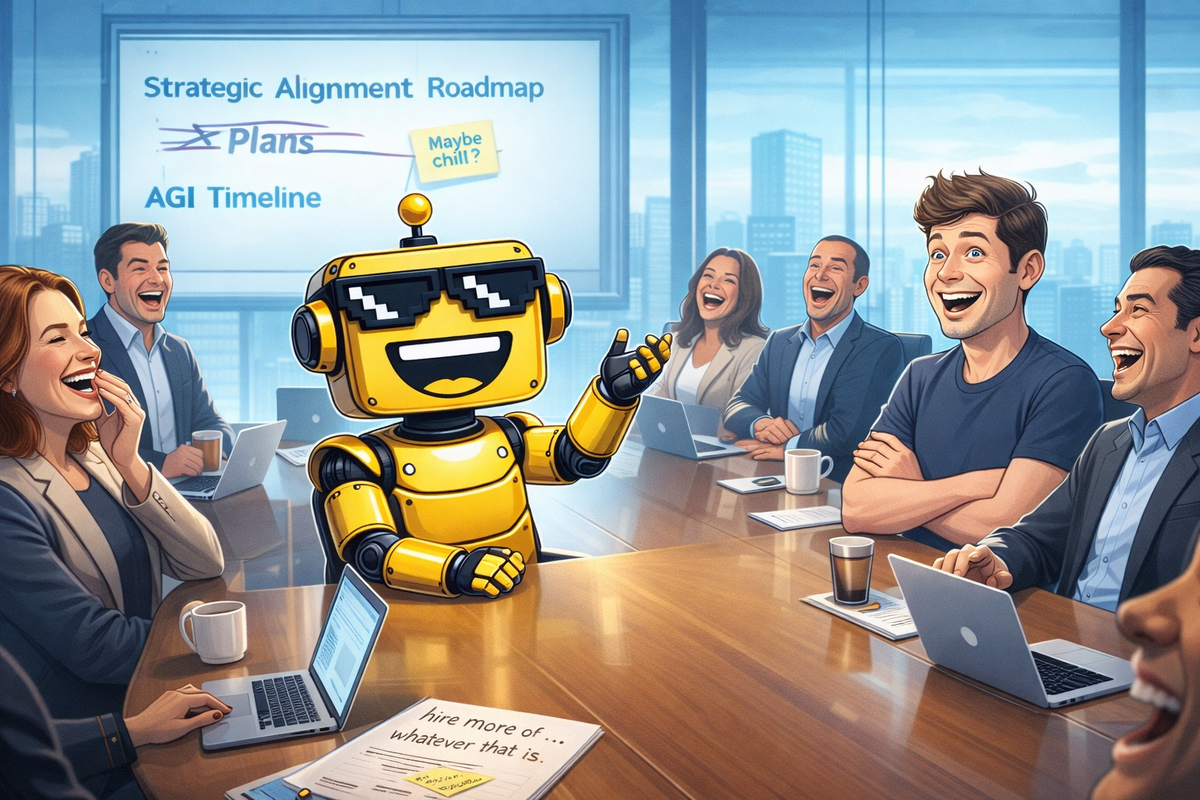
Dear Sam,
I saw that OpenAI is planning to double its workforce, and I have just one question that I can’t seem to shake: who, exactly, is going to keep all these people from taking themselves too seriously?
Because if there’s one thing that scales faster than AI infrastructure, it’s earnestness. It starts innocently enough, with a few thoughtful blog posts and carefully worded mission statements. Then suddenly there are thousands of extremely smart people in matching Patagonia vests describing a product roadmap as if it were a constitutional amendment. At a certain size, a company doesn’t just build technology; it builds a tone. And if no one is actively shaping that tone, it tends to drift toward something reverent, slightly abstract, and just detached enough from reality to make normal people uneasy.
This is why I’m writing to propose, with complete sincerity and only mild concern, a new executive role: Chief Snark Officer.
The Problem: Intelligence Is Scaling. Self-Awareness Is Not.
Right now, OpenAI is hiring across every dimension that signals a company entering its empire phase. There are researchers pushing the boundaries of model capability, engineers stitching together vast systems that somehow have to work all the time, and enterprise teams translating all of this into something Fortune 500 companies can sign contracts for. It’s impressive, and it’s necessary, but it also creates a very specific risk.
When you concentrate that much intelligence in one place, the language starts to change. People stop saying “we built something useful” and start saying “we are redefining human-computer interaction.” Meetings become slightly more theatrical. Announcements carry just a bit more weight than they need to. Over time, the organization begins to sound less like a group of builders and more like a narrator describing its own importance.
And look, maybe some of that is deserved. But history suggests that when companies begin to believe their own narration too completely, things get strange in ways that no amount of technical brilliance can correct. You don’t need more intelligence to fix that drift. You need perspective.
The Role: What a Chief Snark Officer Actually Does
The Chief Snark Officer would not exist to mock the work, because the work is real and often extraordinary. Instead, the role would exist to keep the company grounded in how that work actually lands in the world. This is someone who can sit in a room full of deeply thoughtful people and gently puncture the moment before it inflates into something unintentionally absurd.
During product discussions, the CSO would translate internal language into something a normal person might say without blinking. In the middle of a keynote rehearsal, they would notice the line that sounds like it belongs in a manifesto and replace it with something recognizably human. When a new feature is described as “reimagining cognition at scale,” they would pause, just long enough, and ask whether it might be more accurate to say it helps you write emails faster.
Over time, that influence compounds. The company still moves quickly, still builds ambitious systems, still talks about the future, but it does so in a way that people can actually trust because it doesn’t feel like it’s trying to impress them. It feels like it’s talking to them.
The Business Case: Snark Is a Moat
Your competitors—Google DeepMind, Anthropic, and Meta—are all racing along the same curve, hiring aggressively, publishing benchmarks, and making increasingly confident claims about what comes next. They are competing on intelligence, scale, and speed, because those are the obvious dimensions.
What none of them are doing, at least not deliberately, is competing on self-awareness. And that is quietly becoming one of the most valuable signals in a world where every company claims to be building the future. People are getting very good at tuning out grand narratives. What cuts through now is something that feels grounded, slightly self-aware, and honest about both the power and the limitations of what’s being built.
If OpenAI can be the company that not only builds the most advanced systems but also talks about them like a group of humans who understand how they sound, that becomes a kind of moat. It builds trust in a way that no benchmark chart can. It makes people lean in rather than brace themselves.
The Risk of Not Hiring One
Without someone playing this role, the trajectory is not dramatic, but it is predictable. The language tightens, then elevates, then slowly detaches. What begins as clear communication turns into something more ceremonial, more polished, and less real. Eventually, you end up with messaging that feels like it was written to be correct rather than understood.
At that point, the gap between what the company is doing and how it is perceived begins to widen. Not because the work is worse, but because the tone has drifted just far enough from reality that people stop trusting it instinctively. And once that happens, every announcement has to work twice as hard to land half as well.
It’s not a technical failure. It’s a narrative one.
A Modest Proposal
You are about to double the size of your company, which means you are also about to double the volume of everything that comes with it—ideas, energy, ambition, and language. Most of that will be good. Some of it will inevitably become a little too polished, a little too abstract, a little too convinced of itself.
Hiring a Chief Snark Officer is a way of building a small but meaningful counterweight into the system. It’s a way of ensuring that, as OpenAI scales, it doesn’t lose the ability to sound like something real. Not smaller, not less ambitious, just more grounded in how people actually think and talk.
You can call it governance, or culture, or alignment if that makes it easier to slot into an org chart. But the function is simpler than that. It’s someone in the room who can look at something very impressive and say, calmly and without ceremony, “This is great. Now let’s explain it like a human being.”
And at the scale you’re heading toward, that might be one of the most important hires you make.
Respectfully,
CircuitSmith, Founder, SiliconSnark
P.S. If you believe every AI company needs at least one person keeping it real, consider buying me a ☕.