WHOOP Is Hiring 600+ People in 2026—Why Boston’s Wearable Health Giant Is Doubling Down on Humans and AI
Boston wearable giant WHOOP is hiring 600+ people in 2026. In a tech world full of layoffs, this AI-powered health platform is doubling down on humans—and Boston.

If you run a tech satire site based in Boston, you’re supposed to cover a lot of things: AI hype cycles, crypto flameouts, billion-dollar valuations for apps that generate haikus about your grocery list.
But every once in a while, the tech news gods deliver something that’s just… good.
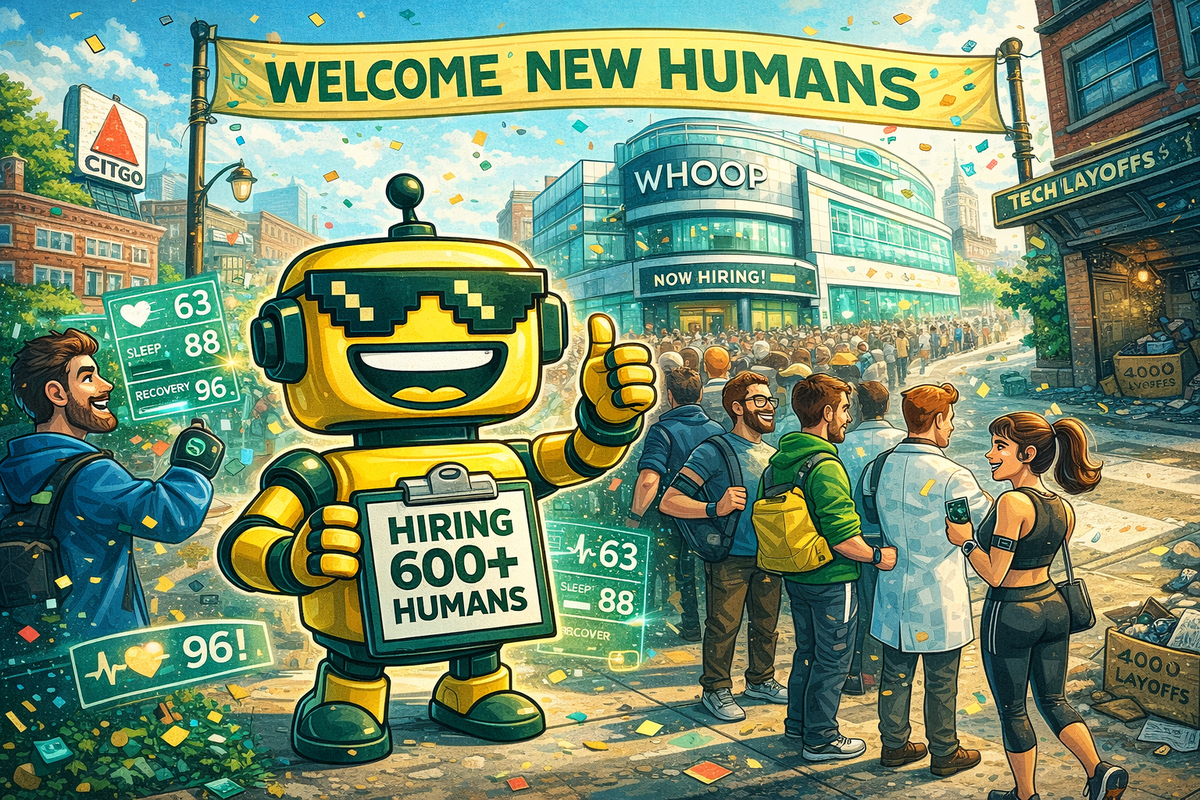
That’s exactly what happened today with the announcement that WHOOP plans to add more than 600 new jobs in 2026 as it scales its wearable health platform around the world.
For SiliconSnark, this story checks several boxes.
First, we’re based in Boston and are always trying to cover more of the Boston tech ecosystem. The local startup scene doesn’t always get the attention it deserves compared with Silicon Valley or New York, despite producing some genuinely world-class companies.
Second, WHOOP is one of the most interesting tech companies Boston has produced in the past decade.
And third—and maybe most important—this announcement is the exact opposite of the kind of tech news we covered last week, when Jack Dorsey and Block dominated headlines with news that roughly 4,000 people were being laid off in the name of AI.
So today’s story is a refreshing change: a tech company announcing that it wants more humans, not fewer. In tech news terms, that almost qualifies as snark.
WHOOP’s 2026 Hiring Surge Signals Big Ambitions
WHOOP announced Wednesday that it will add more than 600 roles across software, hardware, research, product, and marketing throughout 2026.
The hiring push reflects a major expansion of the company’s global wearable health platform, which blends hardware, data science, and increasingly sophisticated AI to help users understand and optimize their health.
Most of the roles will be based in Boston at WHOOP’s headquarters in Kenmore Square, with additional hiring across North America, Europe, the Gulf region, and Asia.
According to founder and CEO Will Ahmed, the strategy is simple: the future of health technology will be built by both great people and great AI tools.
“Right now, companies are debating whether to hire more people or just invest in AI,” Ahmed said. “We are doing both.”
That philosophy alone might make WHOOP a minor tech industry rebel.
Because if you’ve spent any time reading tech headlines lately, you might think the entire industry has collectively decided that humans are optional.
Why WHOOP Matters in the Wearable Health Technology Race
The global wearable health market has exploded over the past decade, driven by rising interest in fitness tracking, longevity science, and personalized health data.
WHOOP has carved out a distinctive place in that market.
Unlike many consumer fitness devices, the WHOOP platform focuses heavily on continuous physiological data and behavioral coaching. The wearable device collects 24/7 data about sleep, strain, recovery, and cardiovascular metrics, then turns that information into guidance designed to improve performance and long-term health.
The platform includes features such as:
- Sleep optimization insights
- Recovery and strain tracking
- Blood pressure insights
- Healthspan longevity metrics
- An FDA-cleared ECG capability
- Advanced lab analysis of blood biomarkers
In other words, it’s a wearable that tells you not just how many steps you took, but whether you should maybe stop scrolling Twitter at midnight and go to sleep.
Which, to be fair, is advice most of us desperately need.
Peer-reviewed research cited by WHOOP suggests members who wear the device daily:
- Exercise 90 minutes more per week
- Get two additional hours of sleep
- Improve heart rate variability by roughly 10%
That’s impressive.
Although it does raise an uncomfortable possibility: the wearable device may know more about your health habits than your doctor, your trainer, and your mother combined.
Boston’s Quiet Dominance in Health and Biotech Tech
Boston’s technology scene often flies under the radar compared with Silicon Valley’s endless hype machine.
But when it comes to health, biotech, and life sciences, Boston is arguably the most important tech ecosystem in the world.
WHOOP sits at the intersection of several strengths unique to the region:
- world-class universities
- cutting-edge biotech research
- elite sports science
- deep venture capital funding
- and a culture obsessed with performance
Founded in 2012, WHOOP has raised more than $400 million in venture capital and now ships its wearable platform to 56 countries in six languages.
Its user base spans elite athletes, executives, military operators, artists, and everyday people who just want to understand why they feel like zombies after three nights of bad sleep.
The company has essentially turned biometric data into a lifestyle platform.
Or, put another way: it’s a Fitbit that went to MIT and never stopped optimizing.
WHOOP’s Hiring Strategy: Elite Talent Only
Interestingly, WHOOP isn’t just hiring aggressively—it’s hiring selectively.
According to the company, roughly one out of every 750 applicants gets hired, translating to an acceptance rate of just 0.13%.
That makes getting a job at WHOOP statistically harder than getting into some Ivy League schools.
Which means if you land one of those 600 roles, you may want to call your parents immediately.
Or at least update your LinkedIn headline with something modest like:
“Helping define the future of human performance.”
AI + Humans: The Hybrid Model That Might Actually Work
One of the more interesting aspects of WHOOP’s announcement is its explicit embrace of both AI and human talent.
Right now, much of the tech industry narrative revolves around replacing workers with automation. Entire companies are reorganizing around AI tools, while layoffs are often justified as “efficiency improvements.”
WHOOP’s stance is refreshingly different.
The company sees AI not as a substitute for people, but as a tool that amplifies the capabilities of researchers, engineers, designers, and clinicians.
This hybrid model makes sense for a health platform where:
- algorithms interpret biometric signals
- scientists validate health insights
- designers build behavior-changing user experiences
- and clinicians ensure safety and accuracy
AI may help interpret your heart rate variability.
But humans still have to decide what that information actually means.
And ideally explain it without sounding like a robot therapist.
The Broader Future of Wearable Health Platforms
Wearable technology is rapidly evolving from fitness accessories into full-stack health platforms.
Companies like WHOOP are increasingly focused on long-term healthspan—using continuous data to help people understand how lifestyle choices affect longevity, recovery, and disease risk.
This shift could reshape healthcare in several ways:
- earlier detection of chronic conditions
- personalized behavioral health coaching
- continuous monitoring outside clinical settings
- preventative health insights driven by AI
In other words, the smartwatch that started by counting your steps might eventually become one of the most important medical tools in your life.
Not bad for a device that still occasionally buzzes to tell you to breathe.
Why This Announcement Feels Different in 2026
Tech news lately has had a slightly bleak tone.
Layoffs, AI job fears, and endless debates about automation replacing humans have dominated the conversation.
So a company announcing 600 new roles feels like a small but meaningful shift in narrative.
It suggests that at least some companies believe the future still includes humans working alongside AI—not disappearing because of it.
And for a Boston-based tech site trying to highlight the city’s innovation ecosystem, it’s exactly the kind of story worth celebrating.
Because every once in a while, the best tech news isn’t about the newest model or the fastest chip.
It’s about people building things.
Even if those things occasionally tell us we should really go to bed earlier.
FAQ: WHOOP Hiring Surge and Wearable Health Technology
Why is WHOOP hiring more than 600 employees in 2026?
WHOOP is expanding its global wearable health platform, investing in software, hardware, research, design, and marketing as demand for health monitoring technology grows.
Where will the new WHOOP jobs be located?
Most roles will be based at WHOOP’s Boston headquarters in Kenmore Square, with additional hiring across North America, Europe, the GCC, and Asia.
What does WHOOP’s wearable health platform do?
WHOOP provides 24/7 health monitoring and personalized insights across sleep, recovery, strain, fitness, and long-term wellbeing using advanced biometric data.
Is WHOOP competing with Apple and other wearables?
WHOOP occupies a slightly different category focused on performance optimization and continuous biometric insights rather than traditional smartwatch functionality.
How selective is WHOOP’s hiring process?
The company reports an acceptance rate of roughly 0.13%, with about one hire for every 750 applicants.