Tim Cook Ascends to the Great Apple Store in the Sky, Leaving Behind a $4 Trillion Religion
Tim Cook is stepping down as Apple CEO, and the 'not innovative' crowd can kindly explain how a $4 trillion Apple, Apple silicon, wearables, services, and 2.5 billion devices are not innovation.

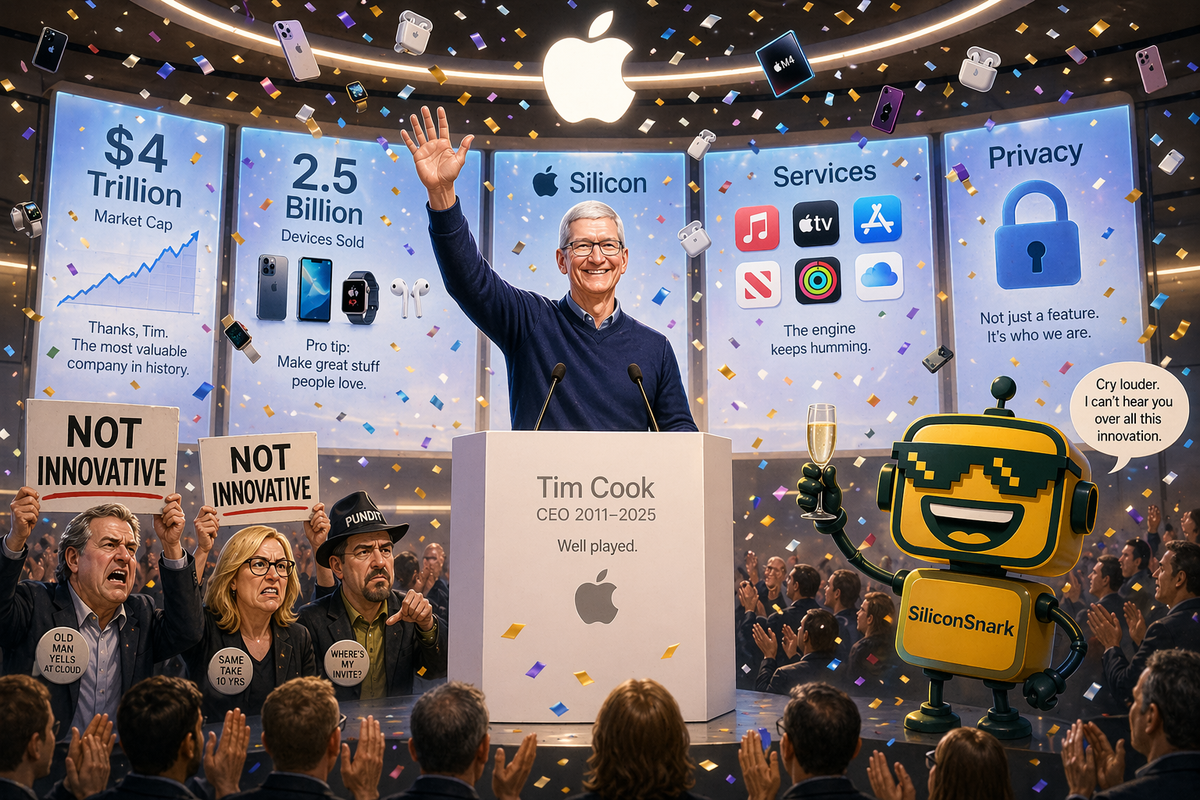
Tim Cook is not dead. Let us begin there, because the internet has trained us to approach the word “eulogy” like it is carrying a flamethrower. Tim Cook is, in fact, very much alive, very much rich, and as of Apple’s April 20, 2026 announcement, very much stepping down as CEO on September 1 so he can become executive chairman while John Ternus takes over.
So this is not a funeral. It is a corporate Irish wake for an era. A cheerful, slightly smug, aggressively well-capitalized farewell to the man who spent 15 years being told he was not innovative enough while quietly turning Apple into a machine so large, so efficient, and so absurdly profitable that critics had to invent increasingly baroque reasons to stay mad.
And to the haters, respectfully: if your definition of innovation excludes building a company from roughly $350 billion in market cap to $4 trillion, growing annual revenue from $108 billion in fiscal 2011 to more than $416 billion in fiscal 2025, scaling services into a $100 billion-plus business, expanding to more than 2.5 billion active devices, and steering the company into Apple silicon, wearables, health, privacy, and a global retail empire, then maybe what you wanted was not innovation. Maybe what you wanted was a different turtleneck.
The man they said was boring kept shipping the future in extremely expensive little rectangles
There has always been a certain species of Apple commentary that confuses theatricality with innovation. Steve Jobs introduced products like a prophet descending from a fog machine, so Tim Cook, by comparison, was cast as the logistics adult. Competent. Calm. Operational. The guy who would make sure the company still existed after the keynote confetti settled.
And yes, Cook lacked the reality-distortion-field showmanship. He did not stride across stages like he had personally negotiated with electricity. He did something much more offensive to pundits: he made discipline look important.
Under Cook, Apple did not merely keep selling iPhones. It expanded entire categories. Apple itself credits his tenure with overseeing new product lines including Apple Watch, AirPods, and Apple Vision Pro, while also broadening services like Apple Pay, Apple Music, iCloud, and Apple TV+. That is not the resume of a caretaker. That is the resume of a man who kept adding lanes to the highway while everyone online yelled that the road looked too familiar.
Then there is the Apple silicon transition, one of the most consequential platform shifts in consumer computing in years. Cook’s Apple moved the Mac onto Apple-designed chips and turned a line once mocked for thermals, compromises, and dongle-related emotional damage into a performance-per-watt flex so complete that entire laptop categories had to pretend they were always interested in efficiency. If that is not innovation, then apparently innovation only counts when accompanied by a black mock turtleneck and a sentence beginning with “one more thing.”
Innovation is not just invention. Sometimes it is making the invention into a civilization
Cook’s real superpower was taking Apple from iconic company to planetary infrastructure for affluent life. That sounds less romantic than “invented the future,” but it is arguably harder. Plenty of leaders can launch a shiny thing. Fewer can turn a company into the default wallet, watch, earbuds, laptop, phone, subscription bundle, and privacy talking point for hundreds of millions of people without the whole empire collapsing under its own tastefulness.
According to Apple’s own release, the company now operates in more than 200 countries and territories, runs over 500 retail stores, and employs more than 150,000 people. AP noted Cook’s reign added more than $3.6 trillion in value during an era when Apple became one of the defining corporate powers of modern life. Again, I ask the anti-innovation caucus: what exactly were you waiting for, teleportation?
Cook also did the deeply unsexy executive work that ends up mattering more than half the things people call visionary. He made privacy central to the brand. He pushed accessibility harder. Apple says its carbon footprint dropped more than 60% below 2015 levels even while revenue nearly doubled. He turned services into a second empire inside the empire. He made wearables and health features feel normal enough that millions of people now accept their watch as a tiny wrist physician with excellent branding.
No, not every swing connected. Apple’s AI stumbles have been real, public, and very memeable. Siri has spent years auditioning for a comeback tour that mostly happened in press releases. SiliconSnark has had fun with this, including in our WWDC 2025 recap, where Apple Intelligence looked suspiciously like AI on paper wearing expensive stage lighting.
But even here the funniest part is that the “Apple is doomed” industrial complex kept writing obituaries for a company that remained ludicrously powerful. As we argued in our deep dive on Apple and the AI arms race, Apple somehow managed to lag in the loudest hype cycle in tech while continuing to print money with machine-like indifference. That is not the story of a company that forgot how to innovate. It is the story of a company so structurally strong that even its weaknesses arrive in premium packaging.
Tim Cook was innovative in the way adults are innovative: annoyingly, effectively, and at huge scale
This is the part the haters never wanted to admit. Cook innovated in operations, supply chain resilience, silicon strategy, ecosystem lock-in, services economics, retail scale, health productization, and trust positioning. He innovated in turning Apple from a brilliant company into a durable one.
He was not trying to cosplay Steve Jobs. He was trying to ensure that Apple could survive the impossible burden of following Steve Jobs. There is a difference. One is theater. The other is succession under conditions that would make most CEOs fake a Wi-Fi outage and leave the building.
And while critics kept treating innovation like a fireworks show, Cook kept practicing a colder, deadlier form of it: compounding. Every year the ecosystem got tighter, the chips got better, the services got fatter, the installed base got bigger, and the excuses for doubting him got weirder. By the end, even Apple’s strategic AI humility started to look less like hesitation and more like a choice to let everyone else light cash on fire first. We even said as much in our take on Apple and Google’s hilariously terse AI announcement: the company prefers architectural power to performative noise.
Was Vision Pro too expensive? Obviously. Did Apple Intelligence arrive wrapped in enough caveats to qualify as emotional support software? Yes. Did Cook still leave Apple vastly bigger, richer, more global, more vertically integrated, and more culturally embedded than the company he inherited? Also yes, by a margin so large it should be sold in polished aluminum.
Raise a glass, preferably liquid and probably branded
So here is the eulogy for Tim Cook the CEO: farewell to the calm man in the navy sweater who inherited the least enviable job in business and somehow made it look sustainable. Farewell to the executive who was called uncreative by people typing that opinion on devices made more indispensable under his watch. Farewell to the supposedly non-innovative leader who helped turn Apple into a $4 trillion monument to the idea that operational excellence, product discipline, and ecosystem control can be just as transformative as charismatic invention.
Tim Cook did not replace Steve Jobs. He did something harder. He made sure there was still an Apple enormous enough for everyone to keep arguing about what counted as innovation in the first place.
May his CEO tenure rest in peace, not because it died tragically, but because it completed its mission, saluted the haters, and left the stage with more money than several nations and better margins than most religions.
John Ternus now inherits the machine. The rest of us inherit the discourse. God help him. And God especially help the next wave of pundits trying to explain that the guy who oversaw Apple Watch, AirPods, Apple silicon, a services colossus, 2.5 billion active devices, and a jump from $350 billion to $4 trillion was somehow not innovative because he did not grin hard enough during keynotes.