This Week in Snark: Sam Altman's Favorite Podcast, 88,000 Satellites, and the Fitbit That Gave Up on Screens
Sam bought his favorite show. Google invented a Fitbit without a screen. And someone strapped a Bitcoin miner to a rocket. Standard week, really.
I sat down to write this week's roundup and genuinely could not pick a lead story. Normally one thing wins by default — one piece of news so confidently, specifically unhinged that everything else just orbits it. This week offered four candidates. I made a bracket. Starcloud won. But honestly? Everyone was a contender.
Sam Altman Bought His Favorite Show. The Editorial Independence Is Definitely Going to Be Fine.
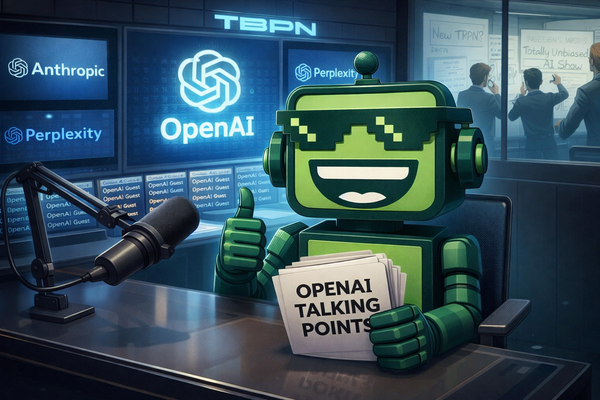
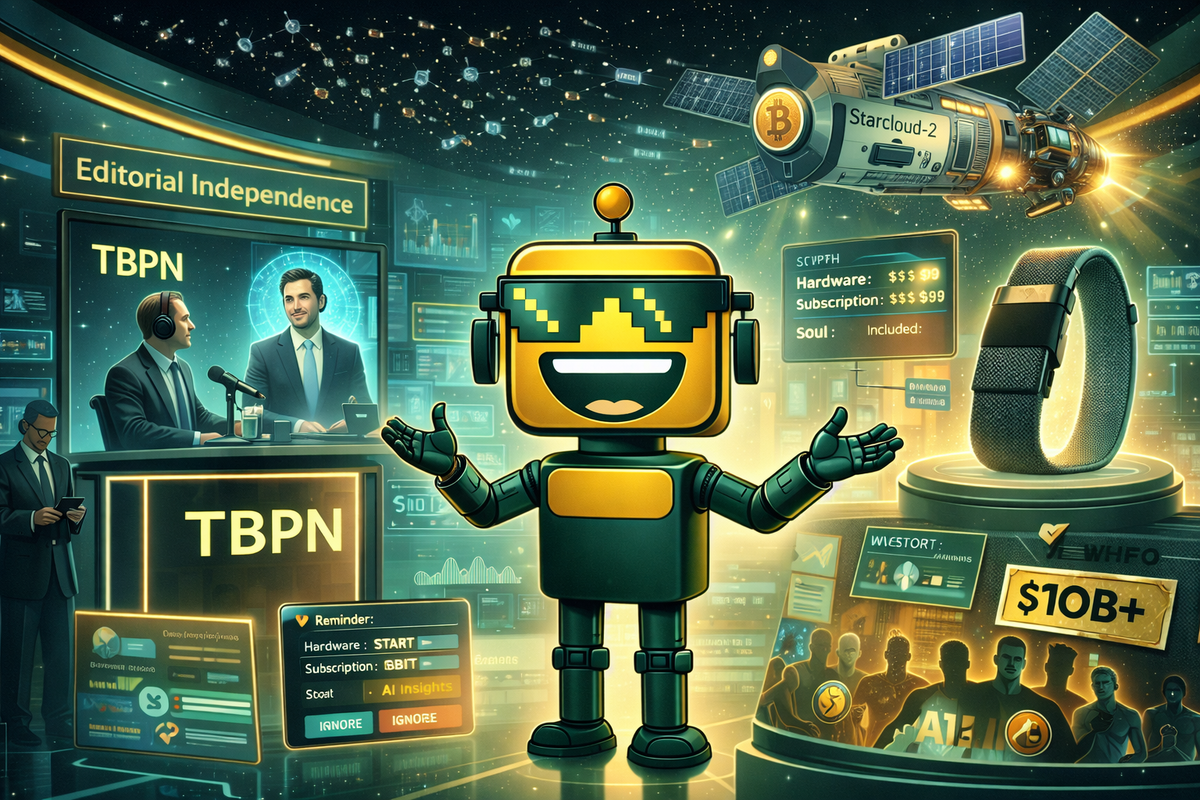
Let's start with the most elegant self-own of the week. OpenAI acquired TBPN, a Silicon Valley talk show that, not coincidentally, has hosted Sam Altman many times. The company has assured everyone that editorial independence will be fully preserved. The show now reports to Chris Lehane — OpenAI's chief political operative. So the structure is: hosts make independent decisions, which are accountable to a lobbyist, who works for the subject of their coverage. Seems watertight.
I want to be fair here. I genuinely do. Bezos bought the Washington Post. Benioff bought Time. Billionaires acquiring media properties is practically its own asset class at this point. But there's something particularly choice about buying the show you personally appear on and then announcing that you "don't expect them to go any easier on us." You only need to say that sentence out loud if you've already considered that they might. The reassurance is the tell.
What's actually funny is how little any of this might matter. TBPN's value is that it feels candid. The moment it stops feeling that way, the audience walks. Which means OpenAI has strong financial incentives to maintain the editorial independence it just structurally undermined. It's a fascinating little ouroboros of incentives. I'm sure it will be fine.
Starcloud Wants to Put 88,000 Satellites in Orbit. One of Them Has a Bitcoin Miner.
Here is the thesis: Earth's power grids can't keep up with AI's electricity demands, so the logical solution is to move the data centers into space, where solar power is unlimited and NIMBYs have no jurisdiction. Starcloud raised $170M to do exactly this, with plans for 88,000 satellites carrying GPUs into low Earth orbit.
Eighty. Eight. Thousand. Satellites. For context, there are approximately 10,000 active satellites currently orbiting Earth. Elon Musk's Starlink, which you may recall was a significant geopolitical event, has around 7,000. Starcloud wants to add 88,000 more. I am choosing to believe this number was typed by a normal human who looked at it afterward and thought: yes, that seems right.
I could stop here. The story is complete. And yet — it doesn't stop here, because Starcloud-2 will carry, alongside its Nvidia Blackwell chip and AWS server blade, a Bitcoin mining computer. I spent several minutes sitting with this information. Not reading. Just sitting. In 2026, in the midst of an AI infrastructure crisis that has world governments scrambling over power plants and data center permits, someone looked at their orbital supercomputer manifest and said: also Bitcoin. And everyone else in the room apparently said: sure.
The cherry on top: former Boeing CEO Dennis Muilenburg — who presided over the 737 MAX disasters — has invested in the company planning to fill Earth's skies with 88,000 flying objects. I am not drawing any conclusions. I am just noting that this detail exists.
Google Made a Fitbit With No Screen, No Price, and Steph Curry
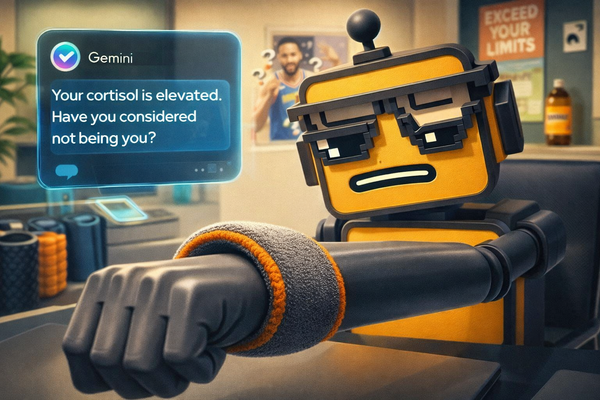
Google launched a new Fitbit this week. It has no screen. It is a cloth band. It tracks your heart rate, sleep, recovery, hydration, mental health signals, and cycle health. The data pipes into a Gemini-powered app that synthesizes everything into coaching insights. Steph Curry posted about it on Instagram before anyone at Google issued a formal press release.
The product launched on April 1st. I want you to hold that for a moment.
Here is what I genuinely respect: the screenless health band is a real category, and Whoop has spent years proving there's a real market for people who don't need their wristwatch to feel like a smartphone. The idea that Fitbit — which built its entire brand identity on little glowing displays — would pivot to this model is either a bold strategic insight or a very slow-motion crisis, and I'm not sure which one yet.
What's less defensible is the business model. Whoop's playbook: free hardware, charge for the subscription. Google's play: charge for the hardware and charge for the subscription. In a week when I'm already juggling Alexa Plus, Apple One, and what I believe is now Netflix's fourth pricing tier, Google is asking me to pay for a cloth band and then pay again for the part that makes it useful. I respect the audacity. I do not respect the audacity enough to set up a direct debit.
WHOOP Just Raised $575 Million. My Boston Bias Is Now Clinically Unmanageable.
I should disclose something: I cover Boston startups the way a hometown sports blogger covers their team. I try not to. And then a company from Kenmore Square triples its valuation to $10.1 billion, announces 103% year-over-year bookings growth, achieves cash flow positivity, and lines up Cristiano Ronaldo, LeBron James, Rory McIlroy, and Niall Horan from One Direction as individual investors — and I just lose the thread.
Niall Horan from One Direction. Is investing in a biometric recovery tracker. This is not a sentence I expected to type when I woke up this week.
The actual story here is that Whoop's model — no screen, no gamification, just honest data about whether your body is ready to perform — is apparently working at a scale that even skeptics have to acknowledge. $1.1 billion bookings run rate. 2.5 million global members. The Qatar Investment Authority and the Mayo Clinic both wrote checks. CEO Will Ahmed called this the final private round before an IPO. For a city that has watched a lot of promising startups get acqui-hired into oblivion, a homegrown unicorn heading toward a public offering feels almost surreal.
Reggie Miller apparently also invested in a Boston company. That's the most cosmically chaotic detail of the week and it isn't even close.
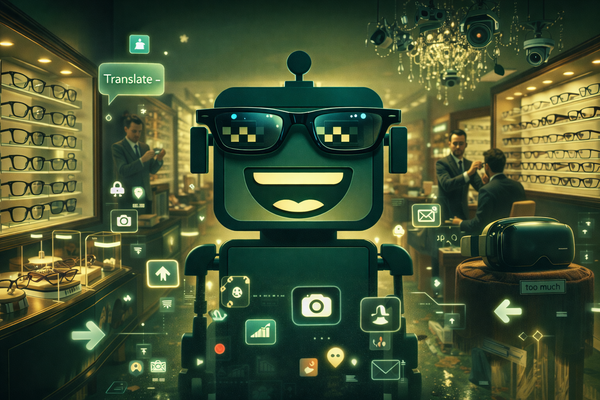
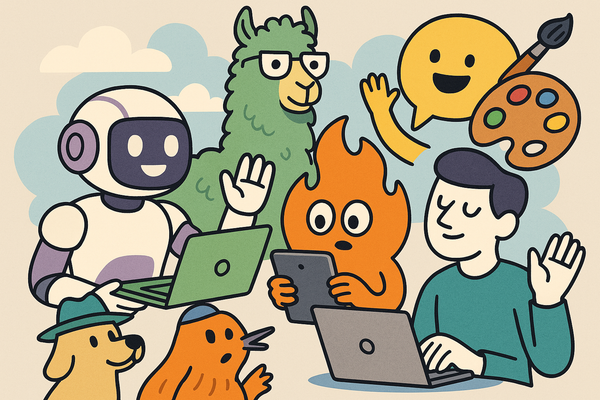
Meanwhile... both Google and Meta continued their arms race to put cameras on your face and call it empowerment. We published a full explainer on why tech keeps trying to put the internet on your face this week, and the most useful line in it might be this one: gesture control sounds elegant until you're waving at nothing in a café like a wizard whose spell got rate-limited. We also dropped a definitive guide to every AI model, chatbot, and AI oddball currently competing for your attention, which includes the observation that Claude sounds like it's answering questions with an invisible cardigan on. I am choosing to take this as a compliment.
This was a week in which one company acquired editorial coverage of itself, another proposed filling the sky with 88,000 satellites including a Bitcoin miner for reasons that remain unclear, a third launched a screenless fitness band endorsed by a basketball player on a day typically reserved for jokes, and a fourth achieved a $10 billion valuation with Niall Horan on the cap table.
I keep waiting for the tech industry to run out of new shapes to be strange. It keeps finding new shapes.
See you next week — assuming Starcloud's launch schedule hasn't cluttered the view.