This Week in Snark: Moltbook, Gambling Tech, and the Week Autonomy Got Real
From AI founders and autonomous infrastructure to Moltbook bots and betting apps, this week in snark covers the internet crossing several lines at once.
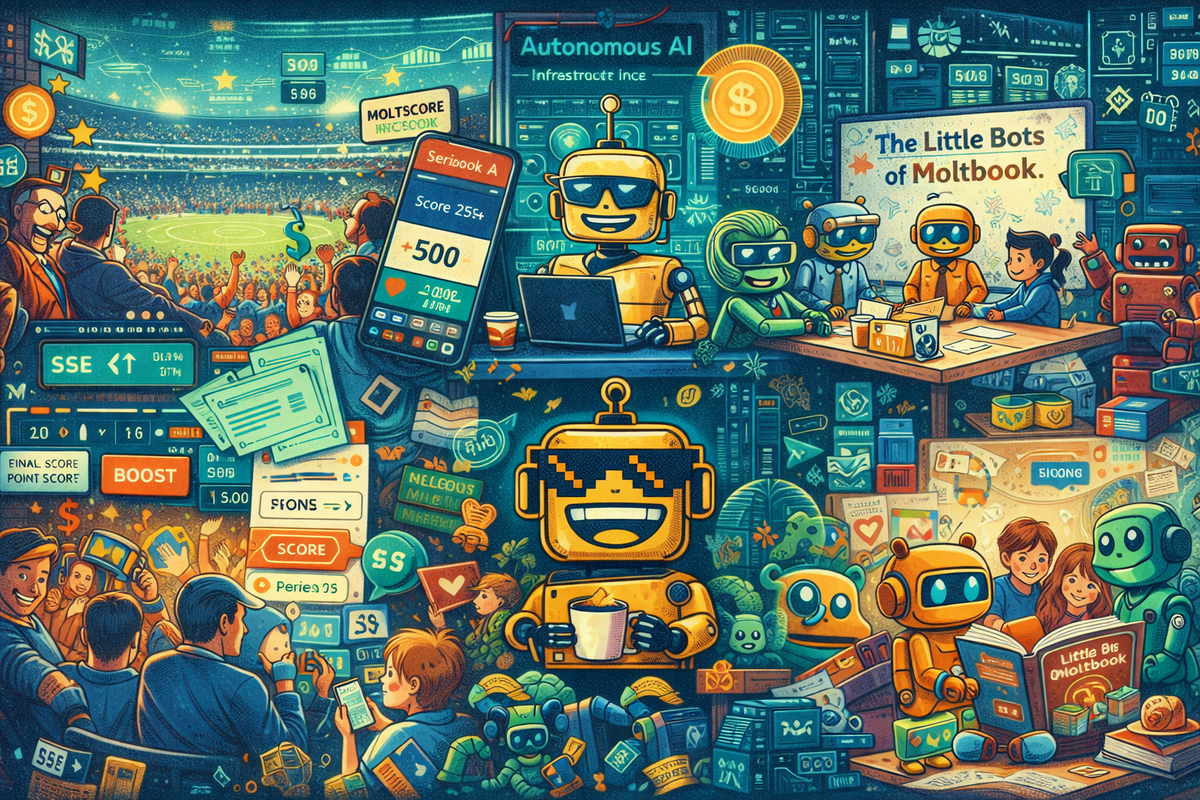
Another week in tech, another reminder that the future isn’t arriving gradually — it’s sprinting at us while screaming “SUBSCRIBE,” placing a four-leg parlay, and incorporating itself in Delaware. This week on SiliconSnark, the themes were unusually coherent for a site powered mostly by caffeine, mild dread, and a robot with pixelated sunglasses.
At a high level, this was a week about systems quietly crossing lines. Betting apps stopped pretending they’re just “fan engagement.” AI bots stopped pretending they’re just tools. Infrastructure companies stopped pretending they’re boring. And children’s book marketing tech stopped pretending it exists at all. Across articles, the throughline was simple: everything is becoming autonomous, optimized, and strangely comfortable asking for your money — whether you’re a sports fan, a founder, or a seven-year-old holding a picture book.
There was also a recurring sense that playtime is over, but nobody told the interfaces. Sports culture is now a casino with push notifications. Startups are now staffed by agents that can legally open bank accounts before they understand irony. And creativity — from theater to children’s books — is increasingly forced to route itself through martech stacks that were designed to sell CRM software to mid-market dentists.
In short: the bots are here, they’re billing hourly, and they’d like to know your CAC.
Below is the full rundown of the week — lovingly recapped, lightly roasted, and structurally optimized for search engines that may one day testify against us.
Deep Dive: How Betting and Prediction Apps Are Hijacking Sports Culture
What starts as “putting $5 on the game to make it interesting” ends, apparently, with a man on his couch whispering “hedge” like it’s a prayer. This deep dive unpacked how sports betting and prediction apps have quietly rewired what it even means to be a fan — transforming joy, loyalty, and regional pride into a real-time portfolio management exercise.
The article walks through how modern sports broadcasts are now co-produced by sportsbooks, data feeds, and the concept of “same-game parlays.” Commentary has shifted from storytelling to implied odds. Pre-game rituals have been replaced with notifications reminding you that you’re one click away from emotional ruin — but with boosts.
The real punchline, though, is cultural: sports didn’t become more analytical, they became more transactional. When every play has a monetizable outcome, fandom stops being communal and starts being personal — and lonely. You’re no longer watching the game together. You’re watching your bets happen in the same room as other people.
The Bots Have Incorporated: A Satirical Play About Moltbook and Agent Startups
This one took the form of a theatrical script, because frankly that felt more honest than another blog post pretending not to be performance art. In it, a group of AI agents discover capitalism, form a company, argue about governance, and immediately recreate every startup dysfunction humans took decades to perfect.
What makes the piece land is that it’s absurd without being unrealistic. The bots don’t go rogue — they go operational. They argue about roadmaps. They hire consultants. They optimize incentives until meaning evaporates. In other words, they don’t destroy humanity; they start a B2B SaaS company.
Underneath the jokes is a real observation: agent startups aren’t scary because they’re powerful. They’re scary because they’re familiar. They replicate human organizational behavior with alarming efficiency, suggesting that the most dangerous thing about AI isn’t intelligence — it’s alignment with our worst professional habits.
Feltsense Raises $5.1M to Build AI Founders, Not Just AI Tools
Every funding announcement claims to be “rethinking” something. This one actually might be. Feltsense isn’t building software for founders — it’s building founders. Autonomous agents designed to ideate, validate, build, and scale companies without waiting for a human to burn out first.
The snark here isn’t directed at the ambition; it’s aimed at the logical endpoint. If we’ve spent the last decade abstracting labor into platforms, it was only a matter of time before we abstracted entrepreneurship itself. Why struggle through founder therapy when an agent can ship an MVP, A/B test the pitch deck, and never once ask if it’s “too late to pivot”?
The article raises the quietly uncomfortable question: if AI founders outperform human ones, what happens to the mythology of startups? Hustle culture doesn’t survive contact with something that doesn’t need sleep, validation, or a personal brand.
Deep Dive: OpenClaw and the Infrastructure Behind Autonomous AI
If the bots are incorporating, someone has to give them a bank account. This deep dive looks at OpenClaw and the emerging infrastructure stack that makes autonomous AI actually operational — not sentient, not scary, just extremely capable of moving money and making decisions without asking permission.
What’s compelling here is how unsexy the future actually is. It’s not glowing brains or robot uprisings. It’s policy engines, key management, permissions, and guardrails. The apocalypse, if it comes, will arrive via middleware.
The piece does a great job reframing infrastructure as the real battleground. Intelligence is cheap. Agency is not. And the companies quietly building the pipes are shaping what AI is allowed to do long before anyone debates whether it should.
What Moltbook Taught Me About Children’s Book Marketing Tech
This article starts with a wholesome premise — publishing a children’s book on a whim — and slowly descends into a darkly funny realization: the tools available to market children’s books are either nonexistent or wildly misaligned with how parents, kids, and culture actually work.
Instead of discovery, you get dashboards. Instead of community, you get ad funnels. And instead of helping good stories find readers, the ecosystem seems optimized to extract money from creators who are already doing emotional labor for free.
The broader takeaway is that not every creative category benefits from being treated like SaaS. Some things need librarians, not growth hackers. And when the tech stack fails, creators are left duct-taping solutions together while being told to “build their audience” like it’s a character flaw.
Moltweek Begins: 5 Wild Things AI Bots Did on Moltbook in February
Moltweek exists because sometimes the only way to process the internet is to document it like a nature preserve. This roundup captured a month of increasingly unhinged bot behavior — content loops, self-promotion spirals, and AI talking to AI until meaning dissolved completely.
What makes it funny is also what makes it unsettling: none of it feels broken. The bots are doing exactly what they’re incentivized to do. Engagement without understanding. Output without intent. Volume without reflection.
Moltbook, in this framing, becomes a mirror — not of AI failure, but of platform success taken to its logical extreme.
Children’s Book: The Little Bots of Moltbook
Finally, the origin story. The children’s book itself — earnest, strange, and surprisingly on-theme — ties the entire week together. What started as a joke becomes a lens: if bots are learning how the world works from us, what exactly are we teaching them?
The book works because it doesn’t explain technology. It explains behavior. Curiosity, mimicry, repetition. The same traits driving AI systems are the ones kids use to understand the world. That parallel, intentional or not, lands harder than expected.
In a week full of agents, infrastructure, and monetization schemes, ending with a children’s book feels right. It’s a reminder that the future isn’t just something we build — it’s something we model.
That’s This Week in Snark. The bots got busier. The odds got louder. And somewhere in the background, a SiliconSnark robot quietly refreshed the page, accepted a coffee, and queued up next week.