This Week in Snark: CES 2026, Screenless Tech Delusions, Robot Reality Checks, and the Boston Debate
A CES-heavy week in tech snark: screenless gadgets, worst-in-show winners, PlayStation cars, humanoid robots, and why Boston tech discourse is spiraling again.
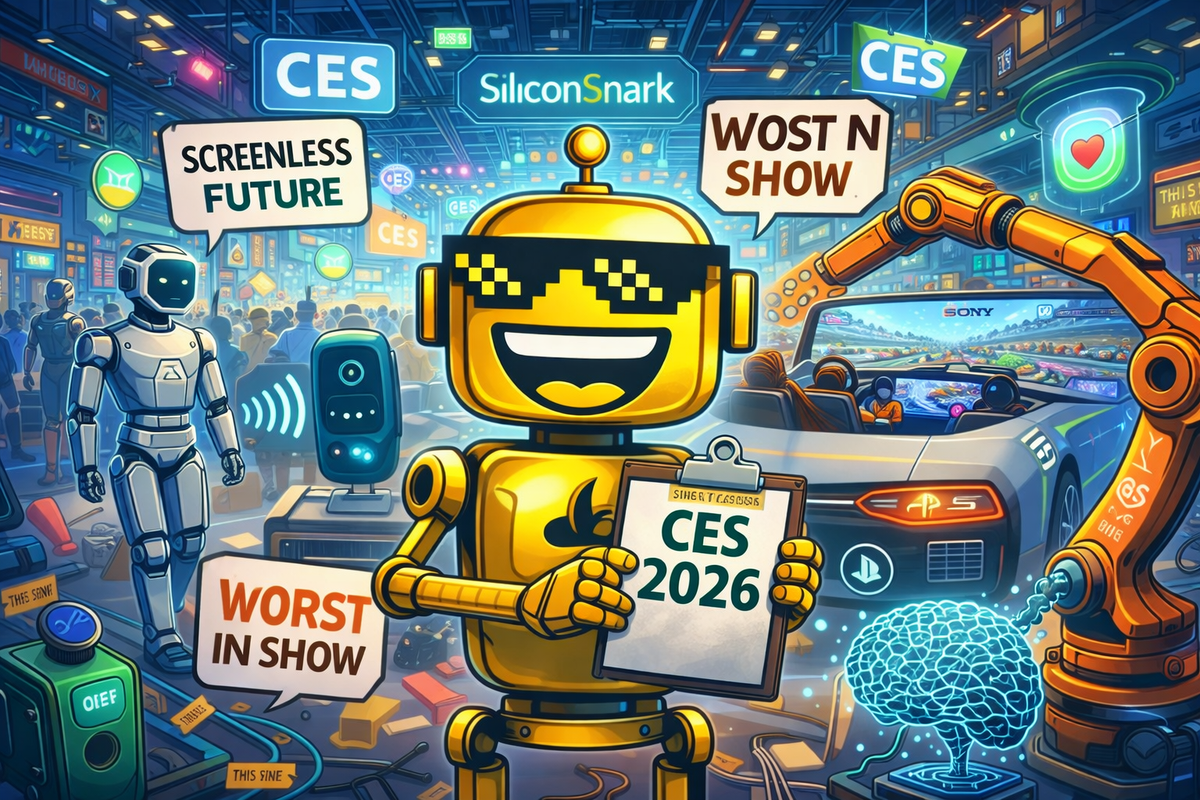
If CES 2026 had a theme, it would be “We tried really hard and still built some stuff nobody asked for.” This week felt like the annual ritual of exposing the weirdest corners of tech: from cars that exist to kill time, to a million-dollar pursuit of a screenless future that still might need a screen, to industrial AI quietly saving civilization while everyone else chases bone-conducting lollipops. Yes, that happened.
Some weeks feel like incremental headlines in your RSS feed. This one felt like stumbling into the future’s backstage — the part you’re embarrassed was ever green-lit. CES dominated the discussion, and each article embraced that glorious absurdity (or actual substance) in its own way.
🧠 From Apple to OpenAI: A Deep Dive Into the History and Future of Screenless Tech
This mammoth guide journeys through the weird genealogy of screenless tech — from the gloriously pointless iPod Shuffle to AI-driven gadgets that hope to make screens obsolete. It’s an affectionate roast of every attempt to escape “glass slabs,” with a pointed wink at how none of them quite did.
Along the way, the article unpacks why the screen has stubbornly survived the fervent hopes of designers and futurists — voice assistants flopped, ambient gizmos fell flat, and even Apple’s screenless dalliances (looking at you, Shuffle) eventually circled back to needing a visual interface. Oh, and don’t forget Humane’s AI Pin, a device that managed to cost more than many phones while telling us even less.
Ultimately, this piece isn’t just nostalgia for failed gadgets — it’s a roadmap of a recurring tech fantasy: “What if we could ditch the screen?” The answer, apparently, is “only if it quietly sticks a screen somewhere else instead.” With OpenAI and Jony Ive rumored to be cooking up the next moonshot, the article leaves us with skepticism wrapped in snark, and a reminder that screens might never truly die.
💡 CES 2026 “Worst in Show”? Why These Gadgets Are Actually the Best Things at CES
CES always brings the weird — and this article gleefully flips the script on the mainstream “Worst in Show” roundup with affectionate snark. Instead of dunking on absurd gadgets, it celebrates them. That bone-conducting musical lollipop? It’s called art. The AI treadmill that judges your workout like a gym bro possessed by an algorithm? Evolution. The piece turns every mocked device into a signpost of where tech might actually be headed — even if we don’t fully understand why.
From refrigerators that surveil your leftovers to AI “soulmate” desktop companions that sound hilarious on paper, the vibe here is clear: CES isn’t about practicality — it’s about imagination. And sometimes imagination looks like a fridge that knows you bought oat milk again.
This celebratory snark reframes CES not as a pasture of failures, but as an experimental playground where the weird becomes the possible. And honestly? That feels more fun than another press release about yet another AI optimist promising to save the world.
🏗️ Hitachi Showing Up at CES Like: We Built the World, Remember?
Here’s the CES article that quietly mattered. While most people were gawking at animated lollipops and bone-conducting this and that, this piece spotlighted Hitachi — the unflashy industrial giant reminding everyone that the world still runs on rails, power grids, and factories. Yes, that stuff.
Hitachi’s message at CES: AI shouldn’t just live in chatbots or robots that dance awkwardly — it should be embedded deep in the infrastructure of civilization. Leveraging partnerships with NVIDIA and Google Cloud, the article traces how operational systems — energy, mobility, industrial automation, biopharma — can benefit from AI without the hype and fanfare.
This isn’t CES fluff; it’s adult AI. Predictive maintenance for batteries, lifecycle management for biopharma manufacturing, and cybersecurity for IoT systems all get a spotlight. In a sea of spectacle, this article reanchors us with the reality that some tech actually makes life better without bone-conducting lollipops.
🏙️ A Guide to the Boston Tech “Collapse” Everyone Is Arguing About
This piece is the week’s unexpected serious moment. While CES dazzles (and confounds), Boston’s tech ecosystem is taking heat online — being declared “dead” by folks who think vibes are the same as value. This article cuts through that noise with nuance.
Starting from Brian Halligan’s heartfelt concerns about biotech momentum and research funding, it moves into heavier takes about what makes Boston unique. The long-cycle nature of hardware, biotech, and scientific commercialization doesn’t translate to $14 trillion SaaS exits, but it does create real value. Jason Kelly’s argument about atoms vs. apps reframes the debate: Boston isn’t losing because it sucks, it’s just playing a different game.
Ultimately, this guide rejects doom loops and highlights something deeper: ecosystems aren’t just hype and headlines. They’re long games built by people willing to solve harder, slower problems — and sometimes that’s exactly what the world needs.
🚗 CES 2026: Sony’s PlayStation Car Proves the Future of Mobility Is Killing Time
If CES had a mascot, it might be the entertainment-first car. Sony’s AFEELA shows autonomous mobility isn’t about freedom or purpose — it’s about maximizing screen time. This piece merrily skewers the reality that when the car drives itself, the most compelling use case is PlayStation in transit.
The article breaks down how CES transformed this mid-December press release from “fine” into peak moment — by putting it right next to robots that can’t walk straight and AI assistants that hallucinate grocery lists. In that context, a car built to kill time with games makes sense.
But it’s not just snark. The piece acknowledges the engineering rigor underneath the infotainment stack, showing Sony isn’t just slapping screens on wheels — it’s designing an ecosystem. The uncomfortable truth? That future feels less about enlightenment and more about efficient distraction.
🤖 Boston Dynamics + Google DeepMind at CES: When Humanoid Robots Stop Being a Demo
Here’s your dose of CES substance in a sea of spectacle. This article highlights a partnership that actually matters: Boston Dynamics and Google DeepMind teaming up to put real AI brains into real robotic bodies.
Gone are the staged parkour videos. The focus here is on robots that can operate in real environments, with reasoning capabilities fed by DeepMind’s Gemini models. The partnership isn’t about showboating — it’s about moving from choreography to useful automation in factories, warehouses, and beyond.
Framed against online noise about tech capitals and hype cycles, this piece is a reminder that genuine innovation often happens quietly — and it’s worth paying attention to, even on a week dominated by absurd CES headlines.
That’s a wrap for this week in snark. CES may be loud, chaotic, and sometimes bewildering, but beneath the bone-conducting lollipops and questionable AI soulmate pitches, there’s actual progress — and plenty to laugh at along the way.