The Rise and Fall of Reality Labs: How Meta Spent Billions to Invent a Metaverse Nobody Wanted
Meta bet tens of billions on the metaverse through Reality Labs. This is the snarky deep dive into how it rose, stalled, and quietly pivoted to AI.

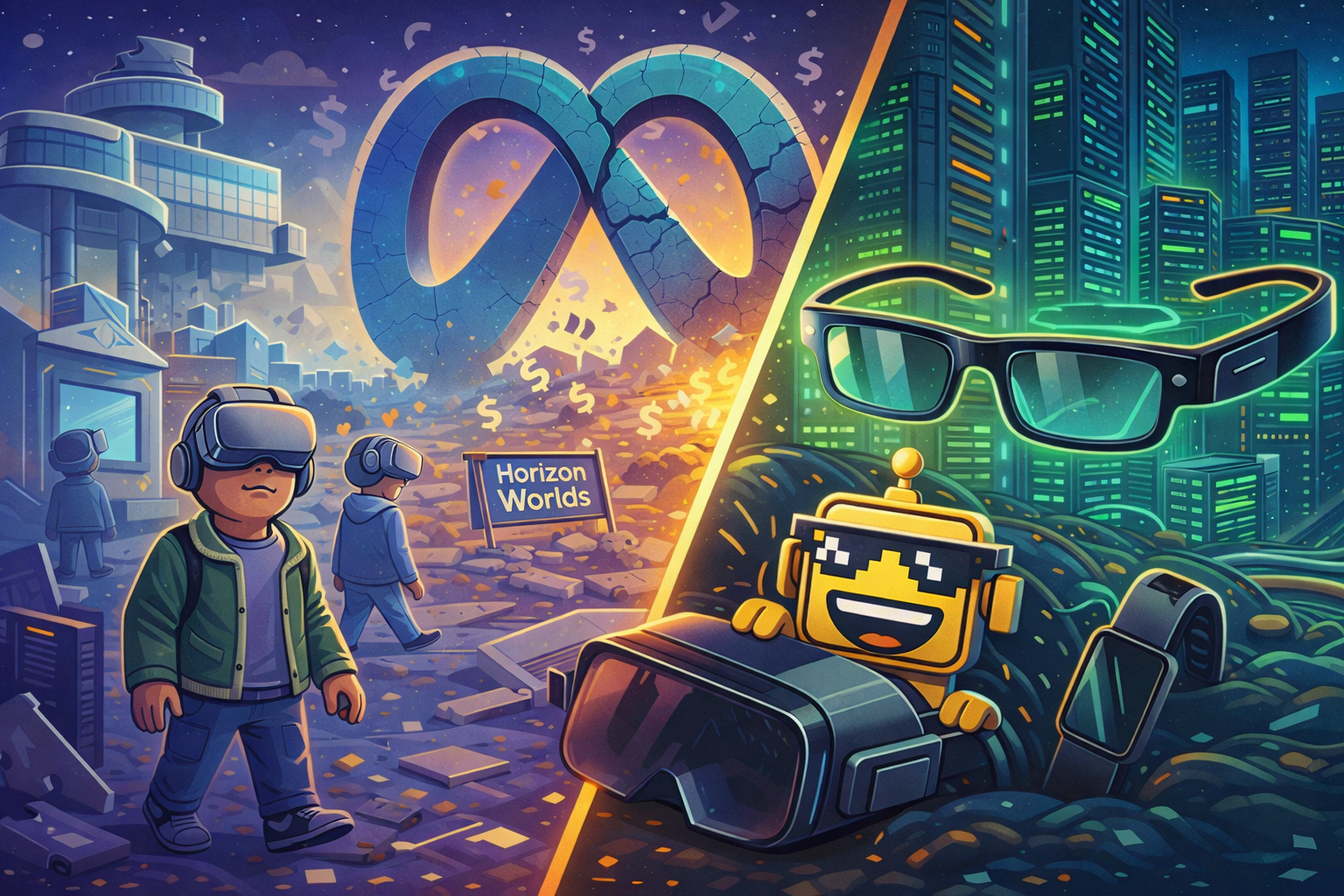
Today, The New York Times reported that Meta plans to cut roughly 10% of its Reality Labs workforce, a move that—while framed as a routine budget adjustment—lands more like a long-overdue admission. After years of insisting the metaverse was the future of everything, Meta is quietly doing what Silicon Valley does best: reallocating headcount, changing the narrative, and hoping no one replays the old keynotes.
On its own, the news isn’t shocking. Big tech lays people off all the time now. But this one hits differently. Reality Labs wasn’t just another product group—it was the philosophical center of Meta’s identity. This was the division that justified renaming Facebook, burning tens of billions of dollars, and telling the world that our social, professional, and economic lives would soon take place inside glowing headsets. Cutting it back isn’t just a cost-saving measure. It’s a punctuation mark.
The layoffs arrive at the end of a very long experiment that began with genuine optimism. When Meta acquired Oculus in 2014, virtual reality still felt like a plausible next interface—clunky, yes, but promising. Over time, that cautious bet metastasized into something far grander: Reality Labs became a moonshot factory tasked with building not just new hardware, but a replacement for the internet itself. The metaverse wasn’t supposed to be a product. It was supposed to be destiny.
Reality, unfortunately, had other plans.
Consumers didn’t flock to VR. Work meetings did not improve when everyone lost their legs. Horizon Worlds remained eerily empty. Investors grew tired of waiting. And then, almost overnight, artificial intelligence showed up and reminded everyone what technological momentum actually looks like when it works.
So this isn’t a victory lap, and it’s not a eulogy either. VR isn’t dead. AR isn’t a gimmick. And Reality Labs didn’t fail because its engineers weren’t smart enough. It failed in the far more interesting Silicon Valley way—by trying to arrive all at once, by confusing ambition with inevitability, and by assuming that if you built the future loudly enough, people would eventually move in.
What follows is a snarky look at the rise and fall of Reality Labs: how Meta went from Oculus curiosity to metaverse obsession, why that vision stalled, what survived the wreckage, and what the future of AR and VR actually looks like now that the hype has burned off.
Part I: Oculus, or How This All Started Sensibly
Before Reality Labs was Reality Labs, it was Oculus. And Oculus, in its early days, made sense.
Virtual reality had been circling the tech industry like a half-remembered dream since the 1990s. The hardware was finally getting good enough. Screens were smaller, cheaper, sharper. Sensors were improving. GPUs were monsters. Gaming PCs could push immersive environments without setting your apartment on fire.
Oculus wasn’t pitching a parallel universe. It was pitching immersion. Better games. Better simulations. Better presence. It spoke the language of developers, gamers, and early adopters—not philosophers.
When Facebook acquired Oculus in 2014, the move was weird but intriguing. Facebook, the social network, buying a VR startup? Sure, why not. At the time, Facebook was still in its confident, pre-midlife-crisis phase. Mobile ads were printing money. Growth was relentless. Buying Oculus looked like a long-term hedge—a future platform play that might not pay off immediately but didn’t need to.
Back then, Oculus felt like a bet on interfaces. A recognition that phones wouldn’t be the last computing paradigm. That someday, something would replace the rectangle.
So far, so reasonable.
Part II: When a Hardware Bet Became a Worldview
Things started getting… philosophical around 2019–2020.
This was the moment when VR stopped being “a new way to experience games” and started becoming “the next version of the internet.” Internal rhetoric shifted. External messaging followed. VR wasn’t just hardware anymore; it was infrastructure. It wasn’t just immersive; it was inevitable.
Reality Labs was born as a kind of umbrella term—part hardware division, part research lab, part speculative fiction studio. Inside it lived VR headsets, AR experiments, social platforms, avatar systems, haptic research, optics research, neural interfaces, and an increasingly bold belief that Meta wasn’t just building products—it was building reality.
Then came the rebrand.
Facebook renamed itself Meta in 2021, a move so audacious it briefly stunned even Silicon Valley’s most jaded observers. Rebranding your entire trillion-dollar company around a product category that barely existed was either visionary or unhinged. Possibly both.
Internally, this was framed as clarity. Externally, it landed like a hostage note written by a futurist. The metaverse, we were told, would be:
- The next computing platform
- The next social platform
- The next economy
- The next workplace
- The next everything
Reality Labs wasn’t just a division anymore. It was the justification for Meta’s future. And it was about to get very, very expensive.
Part III: Spending Like the Future Was Guaranteed
Once Meta committed, it committed.
Reality Labs burned cash at a scale that made even seasoned tech investors squint. Tens of billions per year flowed into headsets, custom silicon, optics, research staff, content subsidies, developer incentives, and internal tooling. Entire teams worked on problems that might not matter for a decade—or ever.
This wasn’t incremental R&D. This was industrial-scale belief.
And belief is expensive.
The theory was straightforward: if Meta built the platform early enough, funded it aggressively enough, and waited long enough, the world would eventually follow. Developers would come. Consumers would adapt. Enterprises would migrate. Entire industries would reorganize around virtual spaces.
This wasn’t entirely irrational. Platforms do create gravity. Apple proved it. Google proved it. Meta itself proved it with mobile social.
But there was a critical difference: none of those platforms required people to strap a heavy device to their face and relearn how to exist.
Part IV: The Consumer Problem Nobody Solved
Here’s the part Reality Labs never fully cracked: normal people.
VR, for all its technical progress, remained a high-friction experience. Headsets were bulky. Setup was annoying. Motion sickness was real. Sweat was unavoidable. Wearing one isolated you physically and socially in ways phones never did.
Phones fit into existing behavior. VR demanded new behavior.
And while gamers tolerated that friction, mainstream consumers mostly did not. They didn’t want to enter the internet. They wanted the internet to come to them—lightly, passively, conveniently.
Horizon Worlds, Meta’s flagship social VR platform, became the symbol of this mismatch. It was endlessly demoed, endlessly hyped, and quietly underused. Avatars floated legless through empty digital plazas, hosting meetings no one wanted to attend.
The metaverse had a loneliness problem.
Even enterprise use cases—training, collaboration, design—proved narrower than promised. Some companies found value. Many tried pilots. Few went all-in. Zoom fatigue was bad enough without adding helmets.
Reality Labs had built a cathedral before it had a congregation.
Part V: The Investor Mood Turns
As Reality Labs spending climbed, patience declined.
Wall Street doesn’t mind long-term bets—but it does like milestones. Adoption curves. Revenue signals. Clear paths to profitability. Reality Labs had none of those in convincing form.
Losses were reported openly, almost defiantly. Billions per quarter vanished into a future that always seemed one product cycle away. Meta executives insisted this was normal. Necessary. Strategic.
Investors increasingly disagreed.
The metaverse began to feel less like a platform shift and more like an indefinitely deferred payoff. At the same time, something else was happening in tech—something Reality Labs didn’t anticipate stealing its thunder.
AI arrived. Loudly.
Part VI: AI Changes the Conversation Overnight
If VR was a slow burn, AI was a detonation.
Generative models rewired expectations almost instantly. They didn’t require new hardware. They didn’t demand new behavior. They slotted neatly into existing workflows, apps, and interfaces.
AI felt magical and practical. It wrote emails. Generated images. Summarized documents. Answered questions. Improved search. Powered assistants. It showed value in minutes, not years.
Suddenly, the future wasn’t embodied—it was ambient. Meta noticed. Quickly.
Budgets shifted. Talent moved. Messaging softened. Reality Labs was still “important,” but AI became urgent. Data centers replaced digital plazas as the new symbols of ambition.
The future was no longer about escaping reality. It was about augmenting it.
Part VII: The Quiet Retreat
By 2025–2026, the pivot was undeniable.
Reality Labs wasn’t killed—but it was redefined. VR efforts were slowed. Teams were cut. Projects were paused or merged. Social VR receded from center stage. At the same time, other parts of the division were protected—especially augmented reality.
This wasn’t an accident.
AR didn’t ask people to leave the world. It asked the world to become slightly smarter. Smart glasses. Subtle overlays. Voice assistants. Gesture controls. Lightweight wearables that added information instead of replacing surroundings. These products sold. Not explosively—but steadily. Millions, not hundreds of millions. Enough to matter. Enough to suggest a different path forward.
Reality Labs wasn’t dying. It was shedding a skin.
Part VIII: Why AR Survived and VR Didn’t (Yet)
The difference between AR and VR isn’t just technical. It’s philosophical.
VR replaces reality. AR respects it.
VR demands immersion. AR offers assistance.
VR is episodic—you put it on, you take it off. AR is continuous—it’s there when you need it and invisible when you don’t.
This distinction matters more than specs ever did. Consumers don’t want to live somewhere else. They want help here. That’s why AR has quietly outperformed expectations while VR struggled under them. It fit into life instead of competing with it. Reality Labs learned this lesson the hard way.
Part IX: The Metaverse Wasn’t Wrong—Just Early and Overbuilt
It’s tempting to declare the metaverse “dead,” but that’s not quite accurate.
What died was a specific vision of it: a fully virtual, socially central, headset-first replacement for the internet. That version required too many leaps at once—technological, behavioral, cultural.
The idea of shared digital spaces didn’t fail. It just turned out to be narrower, slower, and more contextual than predicted.
Gaming will keep using VR. Training will keep using VR. Design and simulation will keep using VR. But they won’t define daily life for billions of people.
Reality Labs bet on universality before earning utility.
Part X: What Reality Labs Leaves Behind
Despite its stumbles, Reality Labs wasn’t a waste.
It advanced optics. It pushed displays. It improved tracking. It trained a generation of engineers to think spatially. It normalized the idea that computing doesn’t have to live on rectangles.
Those lessons are now flowing directly into AI-powered wearables, AR systems, and ambient interfaces.
The future Meta is building now looks very different—but it’s standing on the bones of Reality Labs.
Part XI: The Future of AR/VR (Without the Hype)
Here’s the likely shape of things to come:
- AR becomes boring—and that’s good. It integrates quietly into glasses, cars, workplaces, and homes.
- VR becomes specialized. Powerful where it’s useful, invisible where it’s not.
- AI becomes the interface layer. Not worlds, not avatars—assistants that understand context.
- Hardware gets lighter. Comfort beats spectacle.
- Presence matters more than immersion. Feeling helped beats feeling transported.
The metaverse won’t arrive with fireworks. It will leak into reality gradually, one useful feature at a time.
Part XII: Reality Labs’ Real Legacy
Reality Labs will be remembered less for what it built than for what it taught the industry:
You can’t brute-force adoption. You can’t will behavior change with capital alone. You can’t skip the boring part where products earn their place.
Meta didn’t fail because it aimed too high. It failed because it tried to arrive all at once. Now, chastened and refocused, it’s doing what Silicon Valley always does after a grand overreach—shrinking the vision just enough to ship something people actually want.
And somewhere, buried under abandoned virtual conference rooms and legless avatars, the future quietly adjusts its glasses and gets back to work.
Welcome back to reality.