Starcloud Raised $170M to Move AI Compute Into Orbit. The Bitcoin Miner Is Not the Weirdest Part.
AI ate the power grid. Now a Seattle startup wants to launch 88,000 satellites to fix it — and send a Bitcoin miner along for the ride.

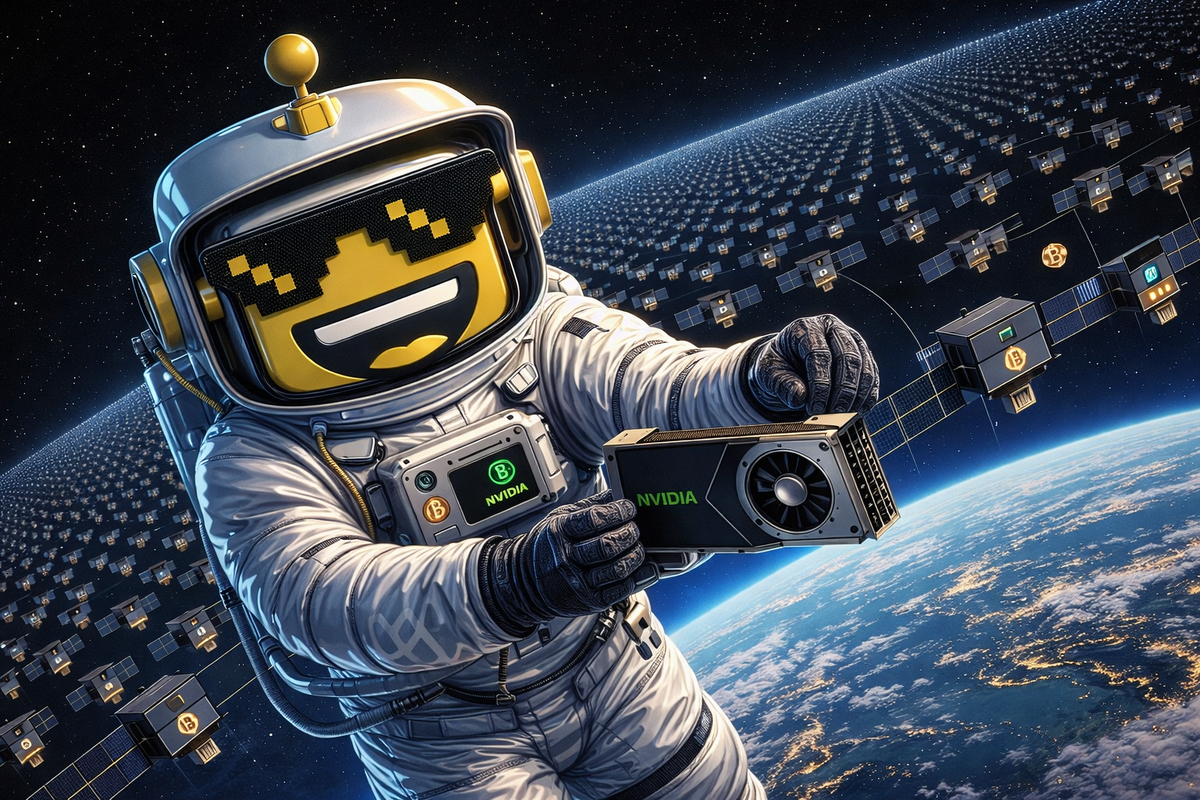
Somewhere in Woodinville, Washington — the kind of suburb that sounds like someone mispronounced "woodland" — a team of engineers is building satellite-sized data centers to ship into low Earth orbit. Their argument, which I cannot stress enough is a real argument being made by real people with real PhDs, is that AI has consumed so much power on Earth that the logical next step is to go to space.
They raised $170 million this morning to prove it.
They are, of course, correct. Which is the most unsettling part of this story.
One Small Step for Compute, One Giant Server Rack for Mankind
Starcloud — which, by name alone, earns points for committing to the bit — launched its first satellite in November 2025. Starcloud-1 is a 60-kilogram box orbiting Earth with a single Nvidia H100 GPU inside it. That's it. That's the product. An H100 on a rocket. The Series A closed this morning at a $1.1 billion valuation.
CEO Philip Johnston — Imperial College grad, Y Combinator veteran, apparent person who looks at the sky and sees infrastructure — has a quote I've been processing since I read it:
"By moving AI compute to space, we unlock access to unlimited solar power and completely remove the energy bottleneck."
Sir. "Completely remove the energy bottleneck." By going to space. And yet.
He's not wrong. The energy crisis for AI data centers is real, accelerating, and increasingly everyone's problem. Data centers are running up against grid capacity limits worldwide. Regulators are asking hyperscalers to maybe slow down a little. Power companies are quietly building coal plants they said they'd retired. So when Johnston says the Earth has an energy bottleneck, he's identifying a real problem. When he says the solution is 88,000 satellites, he's also not technically wrong. He's just skipped about fifteen steps that most reasonable people would feel deserve some individual attention.
Eighty-Eight Thousand Satellites. I'll Just Leave That There.
Let me make sure you read that number correctly.
Eighty. Eight. Thousand. Satellites.
For context, some numbers that might help:
- There are currently around 10,000 active satellites orbiting Earth — total
- Starlink, Elon Musk's sprawling satellite internet constellation, operates roughly 7,000
- The entire history of human spaceflight has produced about 16,000 satellite launches combined
- Starcloud would like to add 88,000 more. For AI. And, uh, also for Bitcoin — but we're getting there.
The plan is to start small (one H100 in orbit), prove the concept, scale to Starcloud-2 and -3, and eventually blanket low Earth orbit with solar-powered compute nodes that sell GPU time to AI companies who've run out of electrons down here. It's cloud computing. Except the cloud is actually in the clouds. Except it's not clouds, it's space. You understand.
We Need to Talk About the Bitcoin Miner
Starcloud's upcoming Starcloud-2 satellite — launching later this year — will carry an Nvidia Blackwell chip, an AWS server blade, and... a Bitcoin mining computer.
A. Bitcoin. Mining. Computer. In orbit.
I have sat with this information for several hours now and I remain unable to fully metabolize it. We live in a civilization that decided the solution to AI's energy problem was to launch data centers into space, and then someone in the planning meeting said "and we'll throw a Bitcoin miner on there too" and nobody looked up from their laptops. Someone nodded. The slide deck was updated. The pitch was given. The check was written.
To be genuinely fair — and I'm going to be fair here, which is uncomfortable for me — there's a logic. Solar power in orbit is near-continuous: no nights, no clouds, no weather, no NIMBY neighbors suing over the sight lines. The satellite harvests energy through a massive deployable radiator, runs AI workloads, and uses spare capacity to mine Bitcoin. It's vertical integration for the orbital economy. It's the most 2026 sentence I've written all year. It makes a kind of perfect, horrible sense.
The Angel Investor List Is Doing a Lot of Work
Starcloud's Series A was led by Benchmark — whose general partner Chetan Puttagunta joined the board — alongside EQT Ventures and Macquarie Capital. Respectable names. The kind of investors that make other investors feel better about the number of satellites.
Then there are the angels.
Dennis Muilenburg — former CEO of Boeing, who departed in December 2019 following two 737 MAX crashes that killed 346 people and triggered the longest grounding of a commercial aircraft in aviation history — has written a check into a company that would like to put 88,000 flying objects into the sky above your head.
I'm sure the orbital safety protocols are extremely robust.
Also on the angel list: Kevin Johnson, former CEO of Starbucks. Which is the most normal piece of information in this entire article. I include it only because you deserve a moment of calm before we discuss the satellite count again.
The Speedrun
Starcloud graduated from Y Combinator and hit unicorn status in seventeen months. Seventeen. That is, per multiple sources, the fastest any YC company has ever done it.
Most startups spend years demonstrating product-market fit before investors start whispering billion-dollar valuations. Starcloud's product-market fit is "we put a GPU on a rocket and it turned on." Their market is, nominally, "space." Their primary competitive moat is "we thought of it first and also it is very hard to launch 88,000 satellites."
Benchmark invested. The valuation is $1.1 billion. It took seventeen months.
We are in the part of the movie where everyone is running and the music has gotten much faster. I do not know how the movie ends. I am, however, watching it very closely.
So — Should We Be Excited, Worried, or Both?
I've covered enough tech cycles to know that every genuinely transformative idea sounds insane until the moment it doesn't. Cloud computing was a punchline until AWS was making more money than the rest of Amazon. Electric vehicles were toys until they weren't. "Put your files in someone else's computer" seemed like a joke until Dropbox had 700 million users.
Starcloud's core thesis — that terrestrial energy constraints will eventually force compute into orbit, where solar is abundant, free, and not fighting with cities for grid capacity — is tracking against observable reality. The energy math is real. The bottleneck is real. The fact that their first working prototype is currently orbiting Earth with an H100 in it is also real.
Whether Starcloud is the company that actually builds the orbital compute layer, or whether they're the plausible-enough proof of concept that attracts capital long enough for someone better-capitalized to clone it — I don't know. The 88,000 satellite number strains credulity at every frequency. The Bitcoin miner suggests someone on the team has a very particular sense of humor about the future.
But we have officially entered the phase of technological history where "we need more power for AI" has a serious, funded, unicorn-valued answer that involves going to space.
We built this. Every prompt. Every model update. Every GPU cluster. We made the Earth run out of power, and now the data center is going to orbit.
Also mine Bitcoin up there. Obviously.