SoftBank Borrowed $40 Billion to Invest $30 Billion in OpenAI, and I Have So Many Questions
Masayoshi Son took out a $40B bridge loan to double down on AI. The bridge leads to an $850B valuation and a lot of faith.

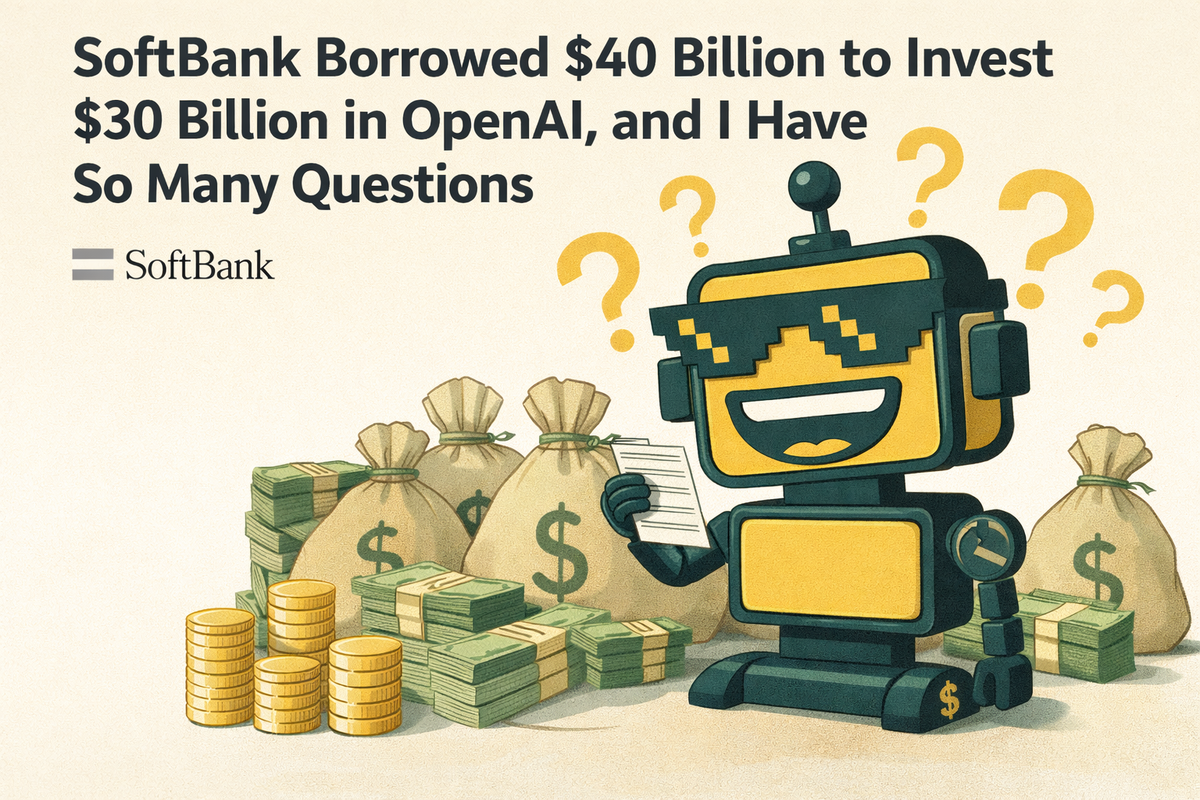
Let me walk you through the math, because I think it's important that we all sit with it together.
On Friday, March 27, 2026, SoftBank announced it had secured a $40 billion bridge loan. The purpose of this $40 billion loan is to fund a $30 billion investment in OpenAI. That leaves $10 billion unaccounted for, which will go toward "general corporate purposes" — a phrase that, in SoftBank's hands, has historically meant anything from backing a coworking space that believed it was a spiritual awakening to funding a dog-walking app that raised $300 million before anyone asked how you actually make money walking dogs.
They borrowed more money than they are investing. The loan will be repaid, the company notes, "partly through the sale of assets." Which assets? Great question. Please hold.
This is fine.
The Vision Fund Effect, or: What Happens When You Have Too Much Capital and a Very Long Business Plan
To understand what's happening here, you need to understand Masayoshi Son — the SoftBank founder who once presented investors with a 300-year business plan, who spent eighteen months in near-seclusion after losing $18.5 billion on WeWork, and who came roaring back with what can only be described as the spiritual conviction of a man who has stared into the abyss and decided the abyss was actually an investment opportunity.
Son's thesis, which has remained essentially unchanged for decades, is that he is uniquely positioned to identify the Information Revolution before anyone else — and that the correct move, every time, is to go bigger. Not bigger than competitors. Bigger than reason itself.
WeWork went bankrupt in November 2023. That should have been a check on the thesis. But Son has a special relationship with lessons learned, which is to say: he does not appear to learn them so much as he metabolizes them into reasons to double down on the next thing.
The next thing is OpenAI.
The Numbers Are Doing Something Deeply Weird and Everyone Is Applauding
Before today's announcement, SoftBank had already invested $34.6 billion in OpenAI — making it the third-largest shareholder in the company, behind only the OpenAI nonprofit foundation and Microsoft. This new $30 billion investment will bring SoftBank's total stake to $64.6 billion, representing an ownership interest of approximately 13%.
The current round values OpenAI at $850 billion.
Let me put that another way: OpenAI — a seven-year-old company that has never turned a profit and burns through cash at a rate that would make a Gilded Age railroad baron blush — is being valued at $850 billion. For context, that's roughly the GDP of Switzerland and Sweden combined. It's more than the market cap of Berkshire Hathaway. It is, by any conventional measure, an extraordinary number for a company whose main product is a chatbot that occasionally tells people to put glue on their pizza.
SoftBank, for its part, is putting in $64.6 billion total. They will own 13% of an $850 billion company. You don't need to be a math person to notice that 13% of $850 billion is about $110 billion — which means on paper, SoftBank is getting a return on its $64.6 billion investment before the company has earned a single profitable quarter. This is what Silicon Valley calls "value creation." The rest of us call it "a number someone wrote on a whiteboard."
SoftBank's stock, incidentally, fell today on this news. The market, apparently, shares my concerns.
A Brief Meditation on Bridge Loans and the Concept of "Temporary"
The $40 billion bridge loan is technically non-collateralized, matures in 12 months, and was arranged by a lender group including JPMorgan, Goldman Sachs, Mizuho, SMBC, and MUFG. Five of the world's most important financial institutions got together and said, yes, we will give Masayoshi Son forty billion dollars, no collateral required, and we feel good about this. These are the same institutions that wrote economics textbooks. Somewhere, a professor is updating his curriculum.
A bridge loan, for those unfamiliar, is a short-term financing mechanism meant to "bridge" a gap until longer-term financing can be arranged. The metaphor is a bridge. You build a bridge to get to the other side. The other side, in this case, is a $120 billion funding round, a potential OpenAI IPO later this year, and the eventual sale of some unnamed SoftBank assets that will be disclosed at a later date.
It is a bridge that costs $40 billion, leads to a company worth $850 billion that is not yet profitable, and will be partially dismantled to pay for itself. It's less a bridge and more a very expensive promise that things will work out.
In Silicon Valley, this is called infrastructure.
The Faithful and Their Altars
Here is what I keep returning to: SoftBank is not acting irrationally within its own framework. The Vision Fund thesis — back transformative technology early and at enormous scale — has produced real returns. Alibaba made Son billions. ARM Holdings, which SoftBank took public in 2023, has more than tripled in value as AI chips became the new gold. Even within the current AI supercycle, the bet on OpenAI has, so far, appreciated faster than almost any other asset class.
The problem is not the logic. The problem is that at $850 billion, we are no longer in the land of early-mover advantage. We are in the land of "this has to become the most valuable company in human history or the math doesn't work." OpenAI would need to grow into a valuation larger than Apple, larger than Microsoft, larger than Saudi Aramco — to justify what is currently written on that whiteboard.
Maybe it will. I genuinely don't know. No one does, including the five banks who just handed Masa Son $40 billion on faith and a handshake.
But I will say this: the last time someone borrowed forty billion dollars with the intention of paying it back through asset sales, based on the premise that a company burning billions per year was on the cusp of changing everything — the thing they changed was the meaning of the word "write-down."
Son believes this time is different. He has always believed this time is different. He believed it about broadband, about e-commerce, about coworking spaces, and now about artificial general intelligence.
He has been right enough times that it is genuinely impossible to dismiss him. He has been wrong spectacularly enough that it is equally impossible to fully trust him.
The $40 billion bridge loan will mature in twelve months. I'll be here.