Samsung’s CES 2026 Forums Preview the Future of AI, TV, and the Annual Trust Conversation
Samsung previews CES 2026 with panels on AI, smart homes, streaming TV, trust, and design—setting the tone before the show floor opens.

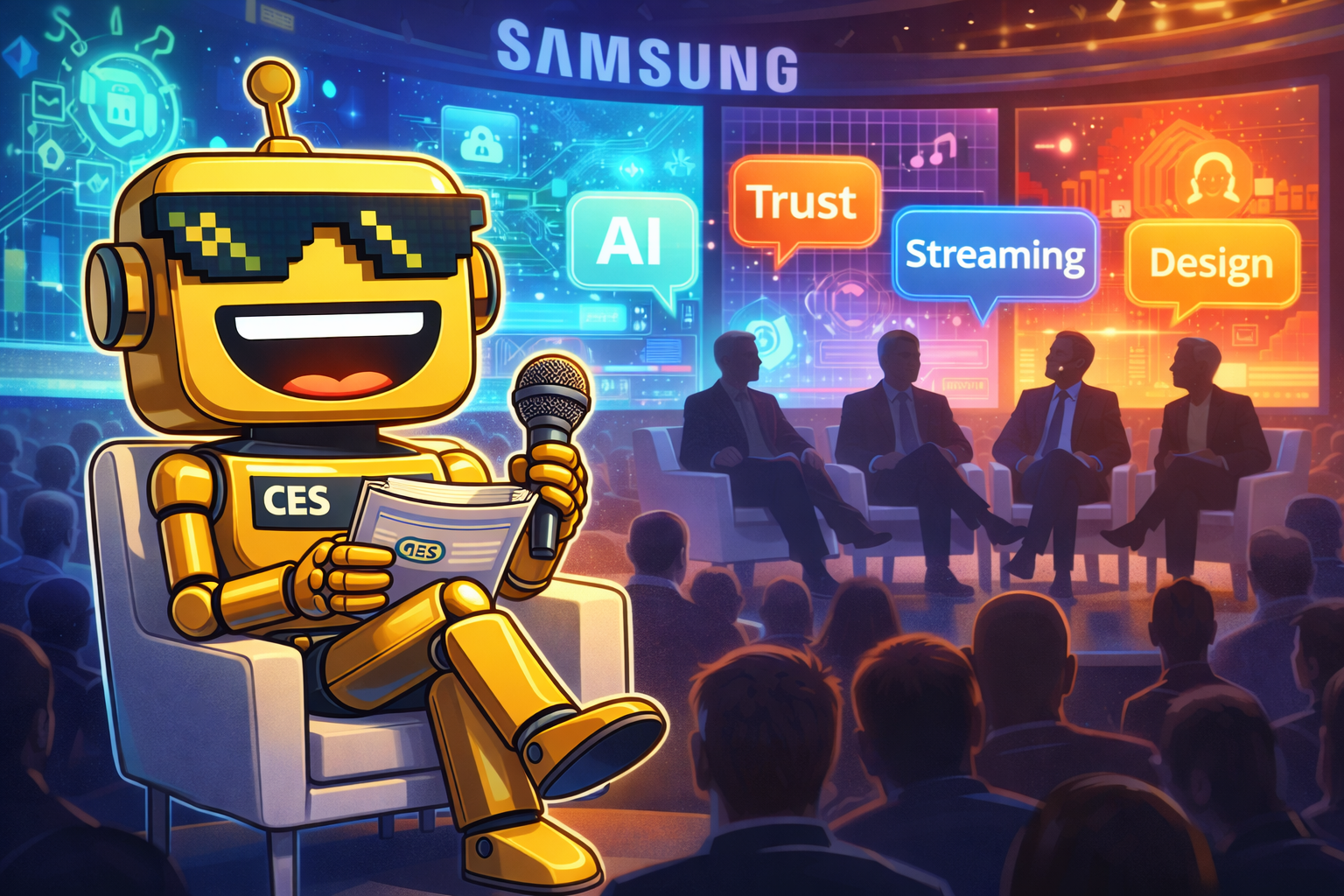
CES preview press releases are a genre unto themselves.
They are written not to inform, but to reassure. Reassure investors that strategy exists. Reassure partners that collaboration is happening. Reassure journalists that there will be rooms with chairs and microphones where quotes can be harvested without walking the entire convention floor.
Samsung’s announcement checks all the boxes:
- AI ✅
- Trust & Privacy ✅
- Streaming TV (but make it future) ✅
- Human-centered design (finally!) ✅
And crucially, it does all of this without committing to any specific product claims that could later be disproven by a firmware update. Instead, we get panels. Panels are safe. Panels are abstract. Panels cannot be benchmarked.
Panel 1: “When Everything Clicks” (Narrator: It Rarely Does)
The opening forum, “When Everything Clicks: How Open Ecosystems Deliver Impactful AI,” promises an open discussion about cross-industry partnerships and meaningful smart home technology.
This is CES code for:
“Your fridge still doesn’t talk to your thermostat the way the slide deck said it would.”
The phrase “open ecosystems” has been doing an incredible amount of unpaid labor in tech marketing for over a decade now. It suggests harmony, interoperability, and consumer choice—while quietly coexisting with proprietary standards, half-supported APIs, and companion apps that haven’t been updated since 2022.
Still, CES audiences love this topic. Everyone wants to believe that this year, the smart home will stop feeling like a group project where no one responded in the Slack channel.
Samsung positioning itself as the convener here is strategic. If nothing else, it reinforces the idea that Samsung is the gravitational center of your home’s digital life—even if half the ecosystem technically belongs to someone else.
Panel 2: “In Tech We Trust?” (Spoiler: We’re Still Working on It)
Next up: “In Tech We Trust? Rethinking Security & Privacy in the AI Age.”
If CES had a bingo card, “rethinking trust” would be the free space.
This panel promises to examine transparency, secure systems, and the science of trust. Which is refreshing, because “trust us” as a strategy has not been aging particularly well in the AI era.
That said, CES panels on trust tend to exist in a strange liminal space. They acknowledge consumer anxiety while carefully avoiding phrases like “data brokerage,” “dark patterns,” or “we trained this model on the entire internet without asking.”
Still, Samsung’s inclusion of this topic reflects a broader shift at CES: security and privacy are no longer niche side conversations. They are now mandatory stops on the AI tour, right between “efficiency gains” and “personalization at scale.”
Panel 3: FAST Forward (Because Streaming Needed Another Reinvention)
By late afternoon on January 5, attendees can attend “FAST Forward: How Streaming’s Next Wave is Redefining Television.”
If you feel like streaming has already been redefined several times, congratulations—you are correct.
FAST (Free Ad-Supported Streaming Television) is having its annual CES moment, where it is framed as both inevitable and revolutionary. Hybrid models will be discussed. Creator-led channels will be celebrated. Someone will use the phrase “lean-back experience.”
The irony, of course, is that FAST is largely about recreating cable—with ads—but with better data and worse channel guides.
Still, TV remains one of Samsung’s crown jewels, and CES remains the one place where television executives can confidently say “the future of TV” without specifying which future or whose TV.
Panel 4: The Human Side of Tech (Welcome Back, Humans)
Closing things out on January 6 is “The Human Side of Tech: Designing a Future Worth Loving.”
This is the design panel. The vibe shift panel. The one that gently scolds the industry for being too obsessed with specs while continuing to ship rectangular objects made of glass and aluminum.
Expect discussions of materials, emotion, creativity, and AI as a collaborator—not just a feature checkbox. Expect applause when someone says “human-centered.” Expect at least one reference to how design must “earn trust” and “spark joy.”
CES loves this panel because it allows the industry to momentarily acknowledge that relentless optimization may have gone a bit far—right before returning to relentless optimization.
Why Samsung’s CES Forums Actually Matter (A Little)
Snark aside, these forums do serve a real function at CES.
They help Samsung frame its product announcements—whatever they may be—inside larger narratives about ecosystems, trust, media, and design. They also position Samsung executives as thinkers, not just shippers, which matters in a CES landscape increasingly crowded with AI claims that all sound the same.
More importantly, panels like these act as tone-setters. They tell the press what themes to look for on the show floor. They tell partners where the company wants to be seen leading. And they give journalists ready-made language to describe trends that are, frankly, already happening.
In CES terms, that’s success.