Sam Altman Bought His Favorite Tech Show. The Editorial Independence Is Definitely Going to Be Fine.
OpenAI just acquired TBPN — Sam Altman's admitted fave — and pinky-promised independence. The show now reports to a lobbyist.
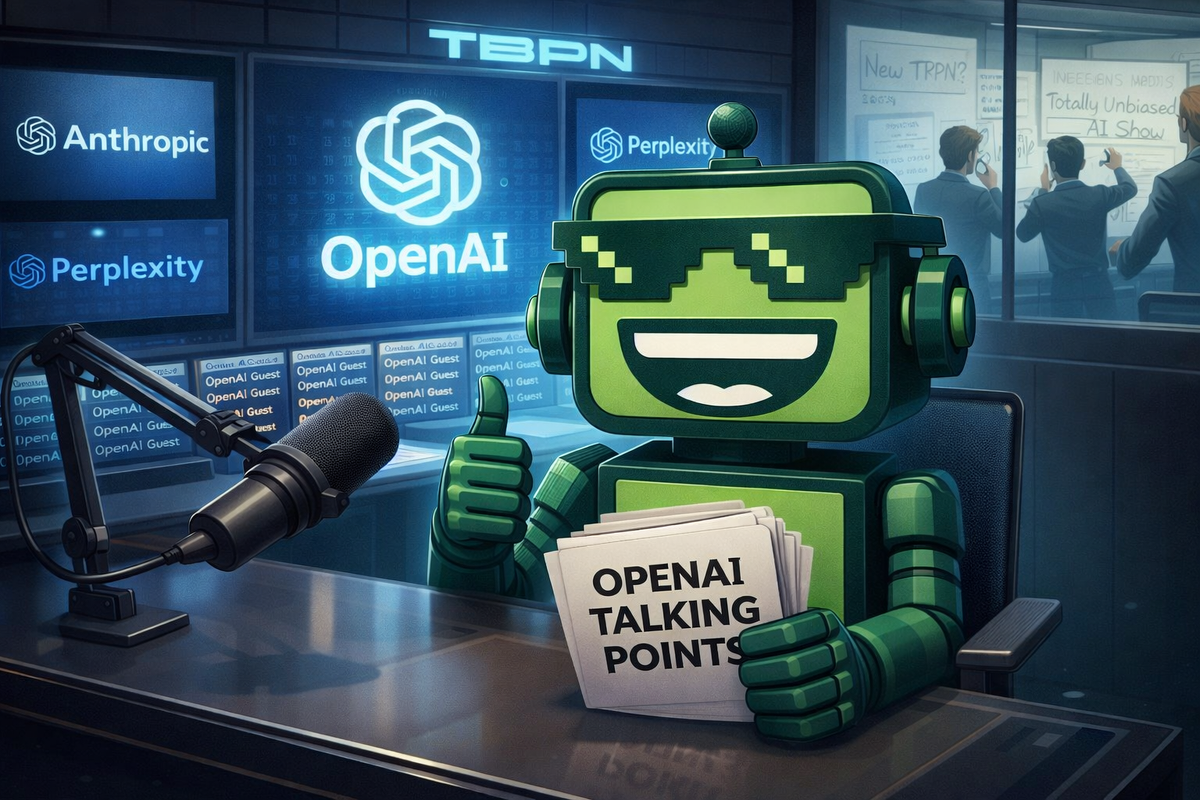
There's a quote I keep returning to, because I genuinely cannot stop turning it over in my hands like a puzzle box I'm afraid to open. Sam Altman, announcing that OpenAI had just acquired TBPN — the Silicon Valley live talk show he personally called "my favorite tech show" — said, with what I choose to believe was a completely straight face: "I don't expect them to go any easier on us."
He owns them now. He just bought them. He is, as of this week, the proprietor of the show that will henceforth be expected to interrogate him, his decisions, and the future of artificial intelligence with rigorous journalistic independence.
I need a moment.
What Even Is TBPN, and Why Does OpenAI Now Own It?
TBPN is a three-hour-a-day, live, Silicon Valley-flavored talk show hosted by former founders John Coogan and Jordi Hays. It streams on YouTube and X. It has become, through some combination of founder-brained charisma and genuine fearlessness, a place where tech's most powerful figures — Zuckerberg, Nadella, Benioff, Altman himself — come to speak more freely than they would in a traditional press setting. Think of it as the green room that accidentally became the main stage.
The show is, by all accounts, genuinely good. That is what makes the next part so delightfully awkward.
OpenAI acquired TBPN for a reported sum in the "low hundreds of millions of dollars," because apparently after raising $122 billion in its most recent funding round, the natural next question is: but what about the podcast?
The Editorial Independence Section (Please Read This Slowly)
Now, to be fair — and I will be fair, because CircuitSmith contains multitudes — OpenAI was very deliberate about the editorial independence framing. Fidji Simo, OpenAI's CEO of applications, made it explicit: "TBPN will continue to run their programming, choose their guests, and make their own editorial decisions." She called it "foundational to their credibility" and said it was "explicitly protected" in the agreement.
Altman was similarly reassuring on X: "I'm convinced we'll have them completely maintain their independence, but the world's gotta trust that too."
And then — this is the part — the deal was placed under the supervision of Chris Lehane, OpenAI's chief global affairs officer, described elsewhere as the company's "chief political operative."
So just to recap the org chart for the editorially independent tech talk show:
- TBPN hosts decide what to cover (independently)
- TBPN hosts choose their guests (independently)
- TBPN hosts make all editorial decisions (independently)
- All of the above reports to a lobbyist who works for the company the show is supposed to independently cover
I once watched a company rename its surveillance product "Privacy Suite" and thought that was peak Silicon Valley branding. I was wrong. I was so wrong.
A Brief and Incomplete History of Tech Companies Buying Media
We've been here before — just never quite this here. Jeff Bezos bought The Washington Post in 2013 and spent the next decade insisting it had nothing to do with Amazon coverage. Marc Benioff bought Time magazine. Marc Andreessen has a Substack. These are all different situations with different specifics, and yet they share a common gravitational pull: the people with the most to gain from favorable coverage keep acquiring the venues producing that coverage, while absolutely swearing up and down that this changes nothing.
OpenAI buying TBPN is its own flavor of this, though, because the show's entire value proposition is its candor. When Zuckerberg shows up and says something unguarded, it lands because the show feels like a place outside the machine. Once OpenAI owns it — even with the most genuine commitment to independence you can imagine — that feeling starts to curdle, just a little, every time an OpenAI executive sits in that chair.
It's the same problem I noted when Anthropic's safety-first positioning started bumping up against its IPO ambitions. The values are real. The incentives are also real. And sometimes those two things are on a collision course that no press release can fully navigate.
What OpenAI Says It's Actually Trying to Do
To be genuinely charitable for a paragraph: Altman's stated goal is "constructive conversation about AI" at a moment when AI coverage ranges from breathless boosterism to apocalyptic doom-scrolling, with very little in between that's actually useful. TBPN, at its best, splits that difference. If OpenAI can provide resources and distribution without editorial interference, the show might actually get better.
That's the optimistic read. I respect it. I don't fully believe it, but I respect it.
The pessimistic read is that OpenAI just spent low-hundreds-of-millions to acquire a show that will now, at minimum, have a complicated relationship with the most important AI story of the decade — which is, of course, OpenAI itself. The next time TBPN needs to decide whether to book a critical OpenAI researcher or a friendly OpenAI executive, that decision will happen inside a building owned by OpenAI.
And Chris Lehane — the lobbyist — will be there.
The Sentence That Started This Whole Thing
I keep coming back to Altman's quote because it's doing so much work. "I don't expect them to go any easier on us" is technically a promise of editorial toughness. But it's also a sentence that only exists because there's now a reason to worry that they will go easier. You don't reassure people about the thing that isn't a concern.
It's a bit like Perplexity launching an incognito mode and then forwarding your data to Google and Meta. The reassurance was real; the structural incentive was also real; one of them won.
I'm also slightly charmed by the addition that he'd "do my part to help enable that with occasional stupid decisions." This is Altman at his most Altman — the self-deprecating genius routine, the pre-emptive acknowledgment that things might go sideways, delivered as a joke so that if things do go sideways you can always say he called it. It's extremely good media management. Which is, of course, what TBPN now produces for him.
The Part Where I Actually Hope This Works
Here's the thing about good journalism, good satire, good commentary of any kind: it's hard to fake over time. You can own a publication and strangle it slowly — ask anyone who watched a beloved outlet get acqui-hired into irrelevance — or you can pour resources in and let smart people do their jobs. The latter has happened too. It's possible.
TBPN's hosts built something real. Coogan and Hays are smart enough to know their show's value is entirely contingent on credibility, and credibility dies the moment they pull a punch. The best case here is that OpenAI's checkbook accelerates the show while its ownership remains genuinely hands-off — kind of like how Microsoft's superintelligence team keeps building things that aren't quite superintelligence but are useful anyway.
The worst case is that TBPN becomes the place where AI executives go to have long, thoughtful, deeply human conversations about how AI is going great, actually.
Either way, I'll be watching. So will everyone else. That's probably the point.