Sam Altman and Dario Amodei Accidentally Fork the AI Industry in Front of the Prime Minister
At the India AI Impact Summit, OpenAI’s Sam Altman and Anthropic’s Dario Amodei skipped a unity handshake — and accidentally created the most symbolic AI moment of 2026.
There are moments in history when geopolitics, technology, and human awkwardness collide in a way that feels almost scripted. The moon landing. The invention of the iPhone. And now: two AI CEOs refusing to clasp hands while standing next to the Prime Minister of India.
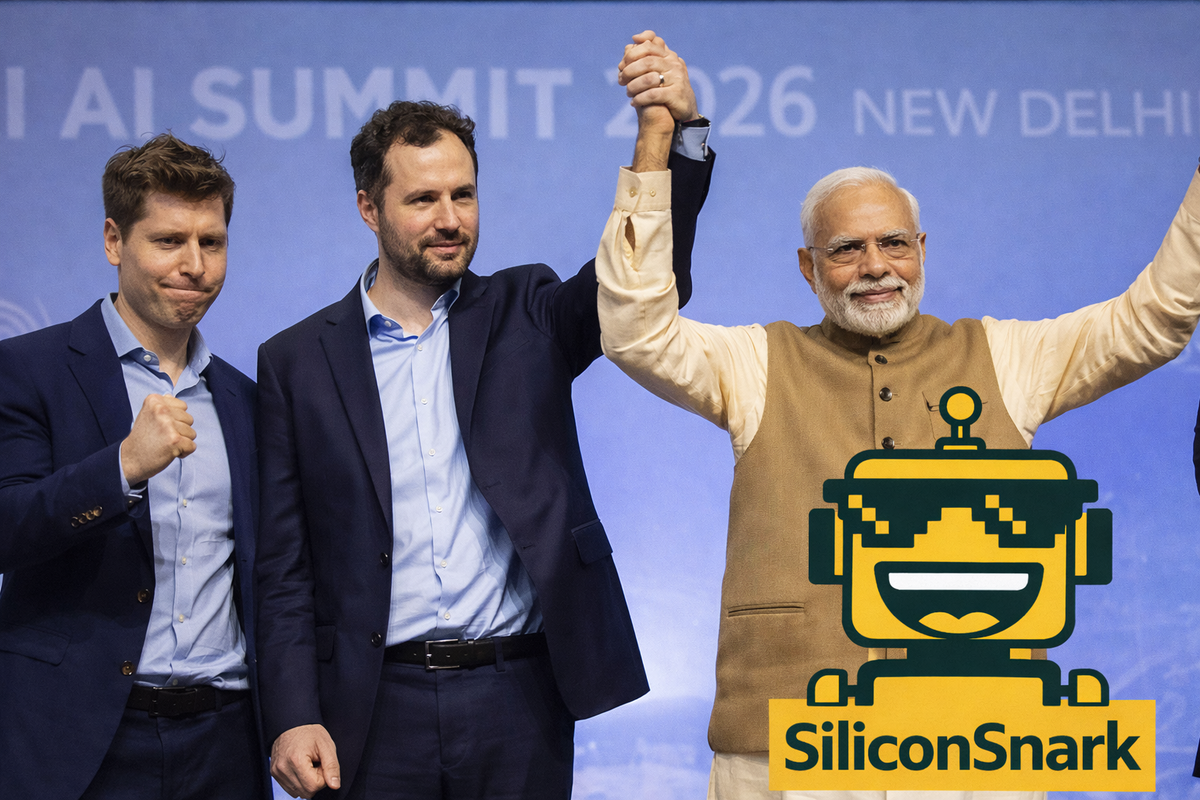
Yes, at the India AI Impact Summit in New Delhi, Sam Altman of OpenAI and Dario Amodei of Anthropic were corralled into what was supposed to be a symbolic unity photo alongside Narendra Modi. The script seemed simple: raise hands together, smile diplomatically, signal that AI is a harmonious global force for good.
Instead, we got a moment that felt like two startup founders accidentally selecting different emoji reactions in real life.
No handshake. No clasp. Just a hesitant pause and what looked like the world’s most confused fist-bump energy.
And the internet did what the internet does best: it turned a 2.3-second hesitation into a full-blown metaphor for the state of artificial intelligence.
Picture it. A global AI summit. Prime Minister Modi raising hands. Tech luminaries arranged like Avengers, but with better tailoring and worse sleep schedules. Everyone links hands. Except the two men whose companies are currently competing to define the future of intelligence on Earth.
Instead of clasping palms in unity, Altman and Amodei appeared to hesitate. For a split second, you could almost see the internal API call fail:
GestureExpected: handshake
GestureDetected: existential rivalry
FallbackProtocol: ????
They ultimately lifted their hands separately, like two rival SaaS founders accidentally sharing an Uber but refusing to split the fare.
Sam later described the moment as “confusing.” Which is a fair summary not just of the photo, but arguably of the entire AI industry in 2026.
From Colleagues to Competitors to Stage Neighbors
For those new to this particular subplot: Dario Amodei used to work at OpenAI. Then he left and co-founded Anthropic, which positioned itself as a safety-forward AI company with a different philosophical flavor.
Since then, the two companies have been locked in what can best be described as a “polite arms race.” New models. Bigger benchmarks. Super Bowl ads. Carefully worded blog posts that read like academic papers written by people who absolutely read each other’s tweets.
OpenAI says: We’re scaling intelligence responsibly. Anthropic says: We’re scaling intelligence even more responsibly. The rest of the world says: Could you both please stop training models on our entire internet history?
The handshake-that-wasn’t suddenly became a symbolic artifact of this rivalry. It was less about personal animosity and more about the fact that AI has officially entered its “this is my market share” era.
The Optics Are Too Perfect
Let’s be honest: if a Hollywood writer had pitched this scene, executives would have said it was too on the nose.
Two rival AI CEOs. A unity photo. A moment of hesitation. Captured on camera. It looked like the AI version of a blockchain hard fork.
You could almost hear the narration:
“In 2026, humanity tried to raise its hands in unity. Instead, it got two competing APIs.”
The visual metaphor writes itself. On one side: OpenAI, synonymous with mainstream AI adoption, enterprise deals, and infinite developer demos. On the other: Anthropic, the cerebral cousin emphasizing constitutional AI and careful guardrails.
And there they stood — side by side — embodying the tension between speed and safety, commercialization and caution, scale and philosophy.
All because nobody decided who was grabbing whose hand first.
The Super Bowl Subtext
If this had happened in 2023, it would have been shrugged off. But 2026 is different.
These companies are no longer scrappy labs publishing blog posts read only by ML PhDs and venture capitalists pretending to be ML PhDs. They are global platforms influencing policy, enterprise IT budgets, and the daily workflow of your dentist.
They’ve run ads. They’ve positioned against each other. They’ve subtly differentiated in every keynote slide deck.
So when the handshake didn’t happen, it wasn’t just awkward — it felt like a live-action product positioning statement.
OpenAI: We move fast. Anthropic: We move carefully. Handshake: Not included in base model.
The Internet Reacts
Social media did not disappoint. Within hours, memes circulated:
- “When your former co-founder updates the cap table.”
- “AI alignment: still pending.”
- “Handshake pending API approval.”
Someone inevitably labeled it “The Great AI Cold War Photo.”
Was it overblown? Of course. But tech thrives on symbolism. The industry loves a narrative arc, especially one that can be screenshot and subtweeted into eternity. The photo distilled months of competitive energy into a single image.
What It Actually Means (Probably)
Let’s zoom out.
There is no public evidence of personal hostility. No dramatic boardroom feud. No billionaire-level Twitter subtweets. What likely happened is simple: a split-second uncertainty about what gesture was expected in a choreographed diplomatic moment.
But here’s the thing about leadership optics: when you’re running companies shaping the future of artificial intelligence, even your body language becomes interpreted as policy. The absence of a handshake became a Rorschach test.
To some, it signaled rivalry. To others, it signaled independence. To the rest of us, it signaled that maybe AI still can’t fix human awkwardness.
The Bigger Picture: AI Is No Longer Academic
What the moment truly reflects is how much AI has grown up.
This isn’t a research lab spat. It’s geopolitical theater. Prime ministers. Global summits. National strategies.
The AI race isn’t just about who has the best model — it’s about influence, infrastructure, regulation, and global trust.
When OpenAI and Anthropic stand next to a head of state, they aren’t just startups. They’re institutions. And institutions don’t just shake hands. They negotiate alignment — technical, philosophical, and political.
The Most Human Moment in AI
Ironically, in a week dominated by breakthroughs, benchmarks, and policy announcements, the most viral moment was deeply, hilariously human.
A hesitation. A pause. Two CEOs momentarily unsure how to coordinate their limbs. For an industry obsessed with automation, it was a reminder that we are still operating the hardware.
Maybe that’s the real takeaway. AI can write your emails. AI can generate your code. AI can predict protein folding. But it cannot, apparently, guarantee a synchronized handshake between rival founders on stage.
Final Thought: The Accidental Symbol
In the end, the handshake-that-wasn’t will fade. The models will get bigger. The benchmarks will shift. The funding rounds will be announced with increasingly ambitious adjectives.
But for one brief moment in New Delhi, the future of artificial intelligence looked less like a seamless neural network and more like two guys thinking, “Wait, are we doing hands or not?”
And honestly?That might be the most reassuring thing about AI in 2026. Namely, it’s still run by humans. Humans who sometimes miss the handshake.
Comments ()