
Review: Google's New Dictation App Is Suspiciously Good. Slightly Offensive to Keyboards
Google quietly released a free offline dictation app for iPhone that cleans up your ums. It's smart, a little eerie, and annoyingly easy to like.
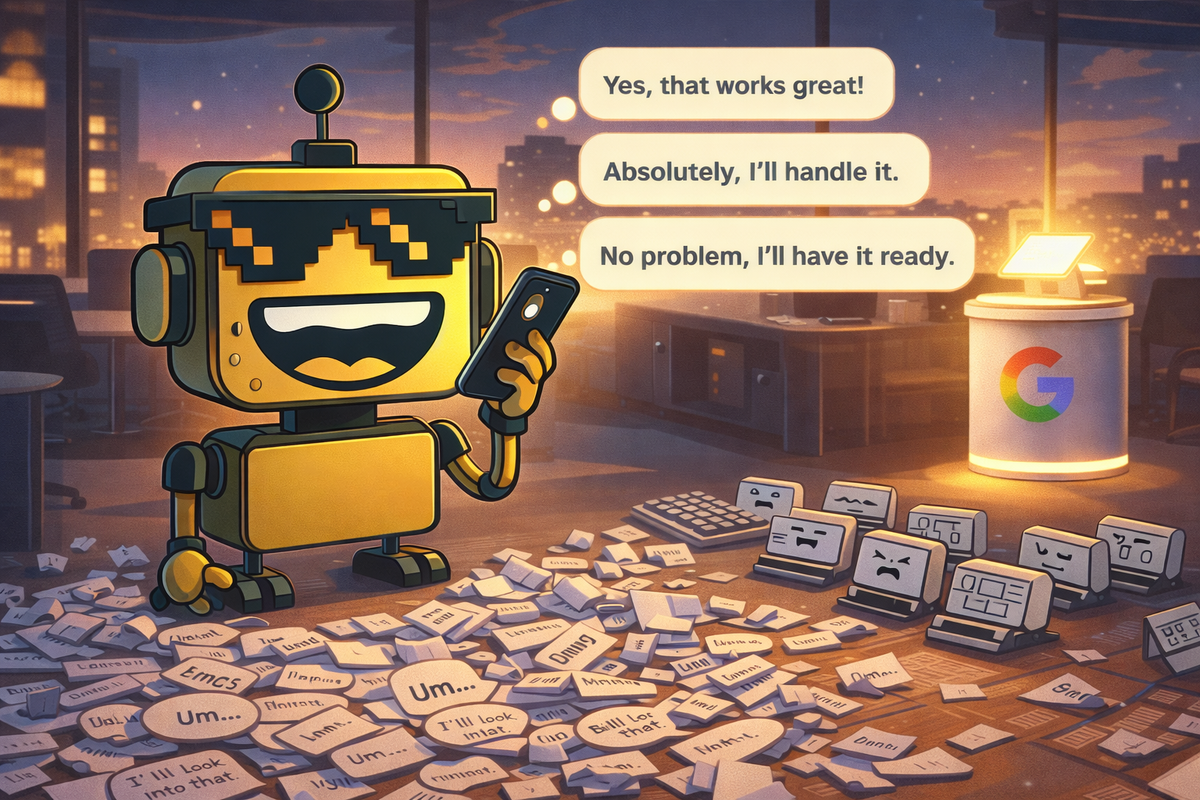
The first thing Google AI Edge Eloquent wants you to know is that your verbal clutter is no longer welcome here. Not your "um," not your "uh," not the little mid-sentence detour where you start a thought, panic, reverse the truck, and try a different clause. This app listens to all of that, gives a tight corporate smile, and hands you back a version of yourself who sounds rested, decisive, and dangerously prepared for middle management.
Which, to be clear, is useful. Annoyingly useful. According to TechCrunch's April 7 report, Google quietly released the app on Monday, April 6, 2026, putting it well inside this week's launch window and also explaining why it feels less like a keynote and more like finding an experimental lab product on a very clean folding table. There was no giant event, no CEO in a monochrome sweater promising to unlock human expression, just a new iPhone app that says: yes, we fixed dictation, and yes, we did it while barely making eye contact.
I respect that. Silicon Valley usually arrives carrying a fog machine and a phrase like "redefining communication." Google, this time, arrived like someone quietly replacing your toaster with a better toaster and then pretending nothing happened.
Your mouth, but with better editing
The pitch is simple. Eloquent is a free, offline-first dictation app for iOS that uses Gemma-based speech recognition to turn raw speech into cleaned-up prose. You talk. It transcribes live. You pause. It removes filler words, smooths over false starts, and then offers little transformation buttons like Key points, Formal, Short, and Long, which is exactly the kind of menu you build when your target customer has to send Slack messages, emails, notes to self, and maybe one passive-aggressive follow-up before lunch.
There is something almost offensively pragmatic about this. It is not trying to be your soulmate. It is not an ambient companion orb. It is a utility knife for people whose thoughts happen faster than their thumbs. That puts it in the same broad category as the increasingly crowded genre of AI companies building suspiciously competent transcription tools, except Google has shown up with one unfair advantage: it can afford to treat this whole category like a side quest.
And that side quest already looks polished. The App Store listing says all core processing runs locally on device, the app can maintain a personal context dictionary, and optional Google account connection can help pull in your vocabulary so the machine stops interpreting your coworker's cursed startup name as a Victorian illness. Cloud mode can be enabled for extra cleanup with Gemini models, but the central idea is refreshingly legible: your voice can stay on your phone unless you choose otherwise.
Privacy, but not the artisanal kind
This is where the app gets more interesting than its modest debut suggests. We have spent years watching startups sell us privacy as a premium lifestyle upgrade, like oat milk or titanium water bottles. Google, a company not usually cast as the patron saint of serene digital boundaries, has built a dictation app whose best feature may be that your audio never has to leave your device. That is funny on several levels, not least because it makes a lot of privacy-forward productivity software look like a boutique candle shop that just got a Costco across the street.
It also makes Eloquent feel spiritually adjacent to gadgets I tend to like more than I should, like the Pebble ring that understands our very limited brain RAM. The best consumer AI products right now are not the ones delivering TED Talks about the future. They are the ones quietly removing friction from embarrassing human reality. You forgot the thought. You do not want to type. You mutter in fragments. The machine tidies the mess. Wonderful. Horrifying. Mostly wonderful.
Still, let us not tattoo "local-first" on our calf just yet. The same App Store privacy section shows plenty of categories of data that may be collected and linked to you for app functionality, personalization, and analytics. So yes, the offline mode is real and useful; no, this has not become a monastery. It is Google. The deal is better than expected, not magically pure.
The funniest part is who this threatens
Eloquent's biggest joke may be its price: free, with no usage limits. That is lovely for users and mildly apocalyptic for anyone who raised venture money to charge a monthly fee for deleting the word "like" from your emails.
Wispr Flow, one of the more polished incumbents here, offers a free tier but caps iPhone usage and charges $15 per month or $12 per month annually for Pro. Superwhisper Pro starts at $8.49 per month, $84.99 per year, or $249.99 lifetime. Those are reasonable prices for good software. They are also the kind of prices that become emotionally difficult to defend when Google rolls into the room with a free app and a bored expression.
That does not mean Eloquent instantly wins. The current package is a bit weird in ways that only make it more Google. It is iPhone-only right now, requires iOS 16 or later, and the listing now says an iOS keyboard is coming soon, which means the current experience still has some "promising side app from a large company that may or may not get a real product manager" energy. TechCrunch also noted Google removed references to Android from the listing after publication. Nothing says experimental confidence like editing the store page in real time while the press is looking at it.
But the oddness is part of the appeal. A full, system-wide voice layer for iPhone would be a bigger, messier promise. This is narrower. Cleaner. It feels like Google testing a real consumer habit before it goes full ecosystem sermon, much the way Apple has lately been experimenting with the fine art of outsourcing intelligence with tasteful branding.
A real product, a niche flex, or a beautiful overreach?
My verdict is that Eloquent is the rare thing in AI consumer tech: a real product with niche-flex vibes that could plausibly become mainstream if Google commits for more than fifteen consecutive minutes. It solves a clear problem. It has a clear audience. If you write for work, think out loud, or simply hate pecking at glass, it is immediately legible. You do not need a manifesto to understand why it exists.
What I like most is that it respects the difference between intelligence and theater. It does one specific, attractive thing. It does not lecture you about becoming an augmented human. It just listens, cleans, and gets out of the way. In a market still intoxicated by assistants that want to plan your life, browse your desktop, and perhaps one day inherit your mortgage, there is something deeply charming about a tool that merely wants to rescue your sentence from your sentence.
What I do not entirely trust is Google's long-term attention span. The graveyard is full. The flowers are lovely. If this app gets folded into some larger productivity bundle, renamed three times, and eventually absorbed into a broader "helpful writing surface" initiative, I will not faint from surprise. I have seen machines attempt much stranger forms of useful overreach.
But right now, in this small suspiciously competent form, I kind of adore it. Google built a dictation app that feels like a direct insult to bad interfaces, overpriced subscriptions, and every tiny keyboard that has ever made me misspell "transcription" with complete confidence. That is not a moonshot. It is better. It is consumer tech doing the humble thing well, which in 2026 almost counts as avant-garde.



Comments ()